Thailand’s Colossal Erawan Elephant: Myth, Magnificence, and Modern Commerce
POLICY WIRE — Bangkok, Thailand — It isn’t often that a deity, or at least its colossal representation, doubles as the foundation for an elaborate museum and a major tourist draw. But in Samut...

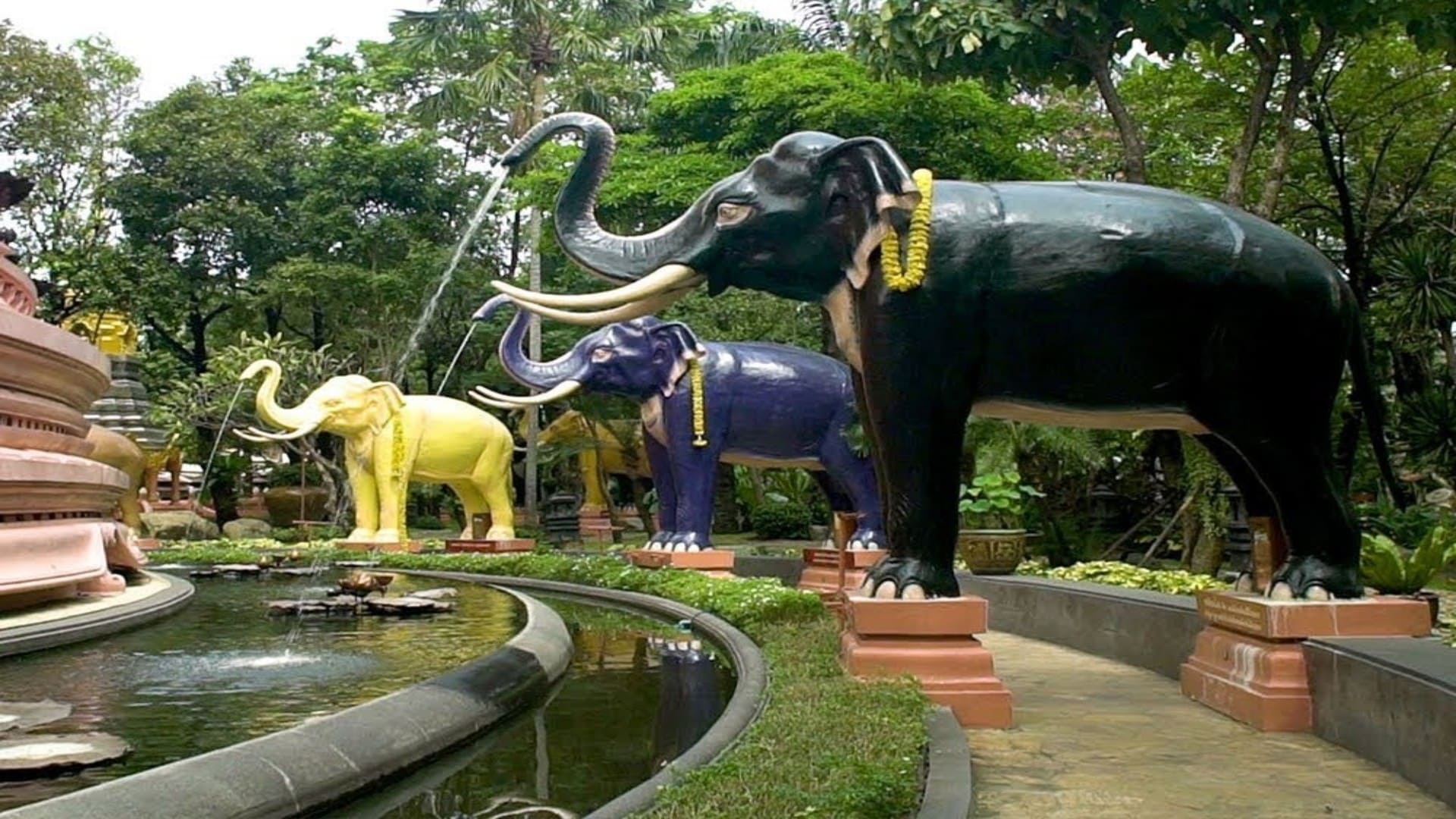
POLICY WIRE — Bangkok, Thailand — It isn’t often that a deity, or at least its colossal representation, doubles as the foundation for an elaborate museum and a major tourist draw. But in Samut Prakan, just south of Bangkok, that’s precisely the audacious reality. Here, atop a meticulously crafted pedestal, a three-headed elephant of staggering proportions doesn’t merely stand; it *commands* the skyline, a mythic beast forged from copper, weighing in at an astonishing 250 tons, embodying the Erawan Museum—a monument to an industrialist’s spiritual fervor and Thailand’s shrewd cultural capitalism.
This isn’t your typical heritage site. Oh no. At its core, the Erawan Museum—the brainchild of the late visionary Lek Viriyapant (who also conceived the Ancient City and Sanctuary of Truth)—represents a dizzying fusion of art, religion, and commerce. Visitors ascend through its lower levels, which delve into ancient Thai artifacts and cosmology, before reaching the interior of the elephant itself, a sacred space housing Buddhist relics and adorned with breathtaking artistry. It’s a journey, you see, from the terrestrial to the celestial, all contained within the hollow belly of a mythological creature. One can’t help but wonder at the sheer, unbridled ambition.
The elephant, known as Airavata in Hinduism, or Erawan in Thai lore, is traditionally the mount of Indra, the king of heaven. Its immense presence here, overlooking a landscape increasingly dotted with shopping malls and condominiums, serves as a potent, albeit slightly surreal, anchor to Thailand’s deep spiritual roots. But it’s also a brilliantly engineered attraction, drawing hundreds of thousands annually, eager to capture a selfie with its grandeur or meditate in its spiritual embrace. That convergence of the sacred — and the selfie-stick, it’s a uniquely modern dilemma for heritage sites globally.
“The Erawan Museum isn’t just a building; it’s a living testament to our nation’s spiritual bedrock and artistic genius,” explained Dr. Preeya Anantachai, Thailand’s Deputy Minister for Culture, during a recent press briefing. She wasn’t just talking about the intricate carvings or the stained-glass ceiling, but about the profound connection it fosters between ancient beliefs and contemporary identity. “It reminds us that our past isn’t merely history; it’s a vibrant, breathing component of who we’re today.”
And she’s not wrong. Behind the headlines of political upheaval or economic shifts, Thailand consistently leverages its cultural assets as potent soft power. The Erawan, with its sheer photogenic quality — and spiritual resonance, performs admirably in this role. Still, the challenge remains: how to preserve the sanctity of such a place while accommodating the relentless tide of tourism? It’s a tightrope walk for any nation blessed with such treasures.
For visitors from across South Asia and the broader Muslim world, destinations like the Erawan Museum offer a fascinating glimpse into a rich, non-Abrahamic spiritual tradition. While predominantly Buddhist, the syncretic nature of Thai culture—drawing on Hindu, animist, and local beliefs—resonates in unexpected ways. Many Muslim travelers, for instance, are drawn to the architectural marvels and historical depth, appreciating the artistic and cultural heritage divorced from direct religious observance. It’s an intellectual curiosity, a broadening of horizons that transcends denominational boundaries, much like how one might appreciate the pyramids of Egypt or the historical mosques of Andalusia, regardless of one’s own faith.
“We’ve seen a noticeable uptick in visitors from countries like Indonesia and Malaysia, particularly those with an interest in art and comparative religion,” noted Professor Imran Fazal, a cultural anthropologist specializing in Southeast Asian studies at Karachi University. “They aren’t necessarily coming for pilgrimage, but for the sheer spectacle and the educational value—the intersection of myth, art, and a distinct Asian identity. It offers a powerful counter-narrative to often-homogenized global perceptions of culture.”
Indeed, this cultural exchange is a significant, if often understated, aspect of the region’s tourism economy. According to the Thailand Ministry of Tourism and Sports, cultural tourism alone contributed approximately 18% to the nation’s total tourism revenue in 2023, generating roughly 380 billion Thai Baht (approximately $10.3 billion USD). That’s a considerable sum, underscoring the unseen crucible of community policy surrounding these landmarks.
What This Means
The Erawan Museum, at its extravagant core, exemplifies the sophisticated interplay between national identity, spiritual heritage, and economic ambition that defines much of modern Southeast Asia. Politically, such sites function as soft power assets, burnishing Thailand’s image as a vibrant cultural hub on the global stage. They offer a unique, non-political avenue for international engagement, fostering understanding and attracting foreign capital through tourism. Economically, they’re crucial engines, supporting local employment—from guides to street vendors—and contributing significantly to national GDP, as demonstrated by the robust cultural tourism figures. The ongoing maintenance and promotion of such large-scale, privately funded cultural institutions also hint at a broader policy question: how does a government foster and protect these assets, even when they’re not state-owned? It’s not just about drawing tourists; it’s about strategically positioning Thailand in a region of shifting influences, using culture as a steadfast pillar.
the museum’s appeal to a diverse international audience, including those from Muslim-majority nations, underscores a growing trend in global tourism: the search for authentic cultural experiences that transcend immediate religious or political affiliations. This phenomenon suggests a potential for deeper inter-regional understanding and economic cooperation predicated on shared human curiosity and appreciation for artistic grandeur. So, while the Erawan elephant might loom large as a symbol of ancient Thai cosmology, it’s also a very modern testament to cultural diplomacy and economic ingenuity.