

Beyond Gravity: Beijing’s New Crew Stakes Claim in Celestial Chessboard
POLICY WIRE — BEIJING, CHINA — Down here on terra firma, amidst the perennial squabbles over trade, tech supremacy, and a general air of geopolitical unease, Beijing is—once again—quietly getting...

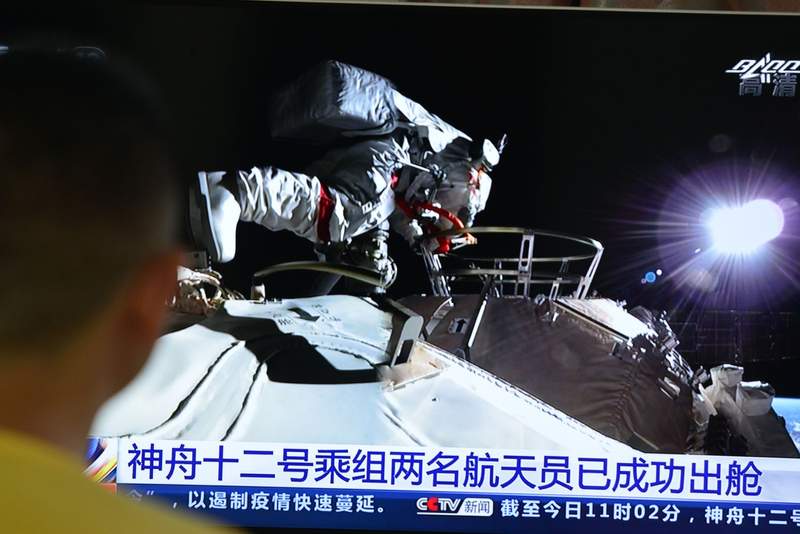
POLICY WIRE — BEIJING, CHINA — Down here on terra firma, amidst the perennial squabbles over trade, tech supremacy, and a general air of geopolitical unease, Beijing is—once again—quietly getting things done. While much of the world was consumed by, well, just about anything else, a new batch of China’s finest, its latest crew, effectively checked into their celestial apartment. Three astronauts, no fuss, no Western fanfare. Just another rotation on the Tiangong space station.
It’s an almost mundane event now, this continuous orbital presence. Yet, don’t let the procedural nature fool you. Every liftoff, every crew change, every successful docking is a calculated step in a much larger, Earth-bound power game. China isn’t just sending people to orbit; it’s sending a message. A very clear one, I’d say.
The space race, or what some might call the ‘space assertion’ for Beijing, isn’t really a race against anyone particular anymore. It’s an affirmation of capability. And, yes, of self-reliance. While others have either aged out of the manned space game (looking at you, Russia) or struggle with budgetary black holes (cue NASA’s persistent drama), China’s going full steam ahead. They’ve built their own orbiting laboratory, they’re launching their own crews, and they’re doing it with a systematic resolve that could make a Swiss clockmaker blush.
“Our space program isn’t just about exploration; it’s a profound statement of self-reliance and progress for our nation. The Tiangong station serves as a laboratory for all humanity, offering insights that benefit us all,” remarked General Li Wei, a spokesperson for the China Manned Space Agency, his words broadcast with familiar gravitas across state media. You can almost hear the unstated subtext: we don’t need anyone else’s ride to space anymore.
Because that’s the underlying reality. Years ago, China watched, then learned. Now, it leads in some key areas, quietly, confidently. Their official space budget for 2022, for instance, stood at approximately $12 billion, positioning it firmly as the second-largest globally, behind only the United States. That’s a significant investment, signaling a long-term play, not just a fleeting aspiration. But the true figure, analysts often muse, might be significantly higher given the opaque nature of military-civilian fusion programs.
This relentless march into orbit certainly doesn’t go unnoticed in places like South Asia, where regional power dynamics are already a delicate dance. Pakistan, for example, a long-time partner and recipient of Chinese technological cooperation, observes Beijing’s space successes with a blend of awe and strategic consideration. It’s a relationship of growing importance, influencing everything from infrastructure to military-tech transfers. What happens in Chinese orbit has an undeniable ripple effect down into countries like Pakistan, feeding into aspirations for indigenous capabilities and strategic partnerships.
📄 POLICY WIRE WHITEPAPER PUBLISHED: PAKISTAN'S NATIONAL SECURITY POLICY PRIORITIES
👉 READ BY CLICKING HERE“China’s rapid ascent in space capability—it’s undeniable, isn’t it? For countries like Pakistan, we watch not just with interest, but with an eye toward collaboration, learning, and what this expansion means for regional security paradigms,” stated Dr. Ayesha Siddiqa, a noted South Asian strategic analyst, capturing the mixed sentiments of ambition — and apprehension. It’s about access, yes. And it’s also about prestige.
And so, while three individuals settle into their new jobs far above, patching wires, monitoring experiments, and looking out at the Big Black, the quiet machinery of geopolitics continues its grind. Earth might look small from up there, but the ambitions certainly aren’t.
What This Means
The arrival of a new crew isn’t just a mission update; it’s another bold brushstroke on China’s canvas of global leadership. This consistent, self-sufficient operation of its own space station reinforces Beijing’s image as a technological powerhouse. It signals a sustained investment in high-tech research, which invariably spills over into defense, artificial intelligence, and manufacturing—areas where global competition is already fierce. Economically, this creates new industries, spurs innovation, and builds domestic expertise, making China less reliant on Western technology. But it’s not just about what they can do; it’s about what they might share.
Politically, the Tiangong station offers China a unique diplomatic tool. They’ve already invited international scientific collaborations, opening a pathway for cooperation that sidesteps Western-dominated institutions like the ISS (which, excluded China). For countries in the Muslim world or South Asia, this represents an alternative—a chance to participate in cutting-edge space research without aligning solely with traditional Western partners. This orbital diplomacy helps solidify existing alliances and could cultivate new ones, bolstering China’s soft power and strategic reach. It also implies a certain self-assuredness that speaks volumes—Beijing isn’t waiting for an invitation to the cosmos; it’s building its own lodge.