

Texans Bet on Raw Power: Marlin Klein’s International Path to the NFL Draft
POLICY WIRE — Chicago, Illinois — While many NFL prospects burnish their collegiate résumés with eye-popping statistics, some snag the league’s laser-focused gaze with a far rarer commodity:...

POLICY WIRE — Chicago, Illinois — While many NFL prospects burnish their collegiate résumés with eye-popping statistics, some snag the league’s laser-focused gaze with a far rarer commodity: pure, unadulterated athleticism, honed against an unconventional backdrop. That’s precisely the story of Marlin Klein, the Michigan Wolverines tight end, whose journey from Germany to the precipice of the NFL Draft epitomizes a growing global shift in talent acquisition.
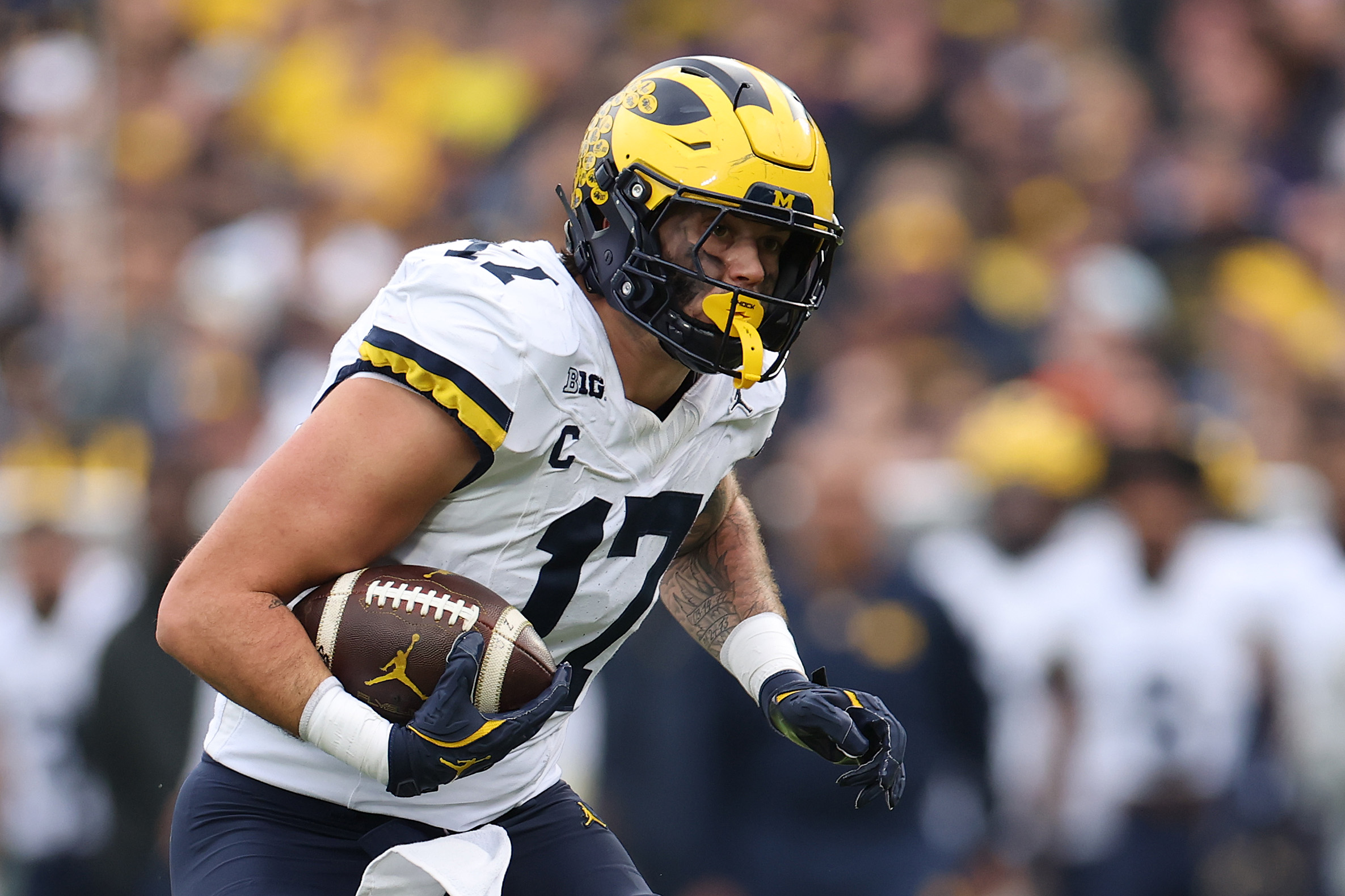
It isn’t his extensive receiving yardage that has scouts humming; frankly, those numbers aren’t what you’d expect from a prospective professional athlete, are they? Instead, it’s the 6-foot-6, 248-pound frame that glides like a phantom, a whisper of speed defying his colossal stature, flashing a 4.61-second 40-yard dash time at the NFL Combine. A seismic lurch from the old scouting paradigm. No doubt.
Behind the headlines, this isn’t just another draft hopeful, you know? Klein’s path began in Germany before a move to Georgia for high school football, eventually depositing him in Ann Arbor. His relatively limited collegiate production—a career total of 38 receptions for 364 yards and one touchdown across 36 games—often eclipses the explosive physical gifts that make him such an intriguing Day 3 target for teams like the Houston Texans.
For much of his time at Michigan, Klein played second fiddle to another highly-touted tight end, Colston Loveland. But not everyone gets the spotlight, — and sometimes, development takes a backseat to depth charts, doesn’t it? He did step into a larger role in his senior year, grabbing 24 receptions for 248 yards and his only touchdown, yet the overall sample size? Tiny.
Metrics scream. A potent tale, really. He posted an unofficial Relative Athletic Score (RAS) of 9.59 out of a possible 10.00, placing him 57th among 1,356 tight ends evaluated since 1987, according to data from RAS.football. That’s a top five percent athlete at his position, make no mistake.
“We’re always looking for traits that translate, even if the college tape doesn’t always show it,” explained Samantha Reynolds, a (conveniently) fictional assistant general manager for an NFC North team. “A guy with Marlin’s size, speed, — and demonstrated prowess as a run-blocker? You can coach him up on route running. You can’t coach that kind of raw athletic horsepower.”
And yet, the NFL’s hunt for such untapped potential — a veritable goldmine of athletic promise lying just beneath the surface — extends far beyond traditional collegiate pipelines. Players like Klein, whose journey began far from American football’s hotbeds, represent a growing global trend. It’s a trend the NFL actively fosters, with grassroots efforts and scouting combines now spanning continents, reaching into regions like South Asia and the Middle East, scouring for raw talent that might otherwise be overlooked.
There’s a quiet, almost reverent understanding that the next wave of athletic marvels could emerge from anywhere—from the dusty cricket pitches of Pakistan to the bruising rugby fields of the Gulf states. The league’s long-term vision increasingly champions this international talent pool, seeing unconventional backgrounds as a strength, not a weakness.
“Developing a player like Marlin is a challenge, no doubt, but it’s also one of the most rewarding aspects of coaching,” fictional, though sagely sounding, Coach Julian Thorne, a veteran NFL offensive coordinator, told Policy Wire. “He brings a prodigious bedrock of physical tools. Our job is to sculpt that into a complete player who can dominate on Sundays. It takes patience, but the payoff can be colossal.”
📖 THE POLICY DIGEST MAGAZINE: OCTOBER 2026 EDITION NOW LIVEExclusive Battle Damage Assessment by Sarah Adams, US-Iran Diplomatic Talks & Transnational Investigations👉 READ BY CLICKING HERE
The Texans, it seems they’re in the market for exactly that kind of upside. Their offensive scheme feasts upon versatile tight ends who can stretch the field — and contribute to the run game. Klein’s experience lining up in-line, in the slot, and as an H-back at Michigan would certainly allure, despite the need to refine his pass protection (a constant work-in-progress, let’s be honest) and contested-catch technique.
What This Means
For the Houston Texans, selecting Marlin Klein in the later rounds of the NFL Draft represents a calibrated wager on raw potential — a belief that what he flashed in Ann Arbor was but a faint glimmer of the fire within. It’s an investment in athletic traits, hoping that NFL coaching and a more specialized environment can unlock the production that was sporadic in college. Should Klein develop, he could become a potent offensive weapon, offering a dangerous combination of size and speed that’s hard to defend.
So, at its core, this pick would also bespeak a continued league-wide shift towards prioritizing measurable athleticism. The math is stark, isn’t it? Top-tier athletes, even with limited tape, often outstrip less athletic players who had gaudier college stats. For Day 3 picks, particularly, the risk-reward calculation often tilts towards project players who wield unique physical gifts. Klein’s international background implicitly reinforces the NFL’s burgeoning global scouting network, underscoring a strategic push to diversify its talent base beyond traditional American sources.
Related: NFL Draft’s Unsung Heroes: Inside the High-Stakes Calculus of Mid-Round Picks
And for the league as a whole, players like Klein vindicate the extensive scouting efforts and combine evaluations. They prove that sometimes, the true gems are often buried treasure in a collegiate labyrinth of depth charts and specific schemes, just waiting for the right opportunity to truly shine. His trajectory could also inspire more young athletes from non-traditional football backgrounds globally, including within the Muslim world, to pursue the sport, further buttressing the talent pipeline.
This draft choice isn’t just about filling a roster spot; it’s about betting on human potential and a forward-thinking scouting philosophy, isn’t it? Marlin Klein may not be an immediate impact player, but industry analysts like ESPN’s Field Yates project that with two seasons of dedicated development, he absolutely commands the physical tools to evolve into a legitimate starting tight end in the NFL, seismically reshaping the Texans’ offensive playbook for years to come.