

Gridiron’s Great Stasis: Why the Jaguars are Sticking to Their Own Playbook on Anton Harrison
POLICY WIRE — Jacksonville, Florida — The sporting world, like global geopolitics, loves a good drama, an unexpected pivot, the bold declaration of change. But sometimes, the most telling narratives...

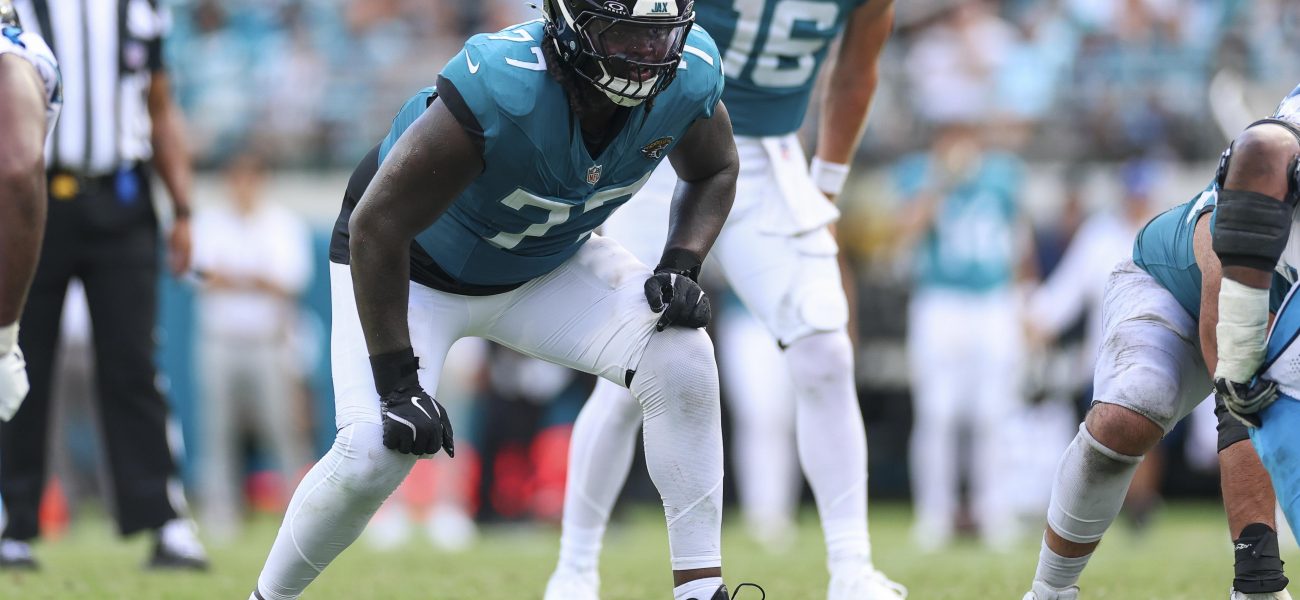
POLICY WIRE — Jacksonville, Florida — The sporting world, like global geopolitics, loves a good drama, an unexpected pivot, the bold declaration of change. But sometimes, the most telling narratives unfold not in a dramatic re-alignment, but in the stubborn refusal to budge. That’s the quiet tale emanating from the Miller Electric Center, where the Jacksonville Jaguars appear to be content keeping Anton Harrison, their former first-round pick, cemented firmly at right tackle.
And boy, it’s a posture that speaks volumes about organizational conservatism, or perhaps, a certain strategic comfort with the known rather than the potentially great. All the buzz last year, you remember, was about moving the young brute to left tackle, the position everyone seems to crave. Harrison, coming out of Oklahoma, had mostly guarded the quarterback’s blind side – a hero’s journey, really. But the Jaguars had other ideas, parking him on the right for his first two seasons. He’s done pretty darn good there, it seems. So good, in fact, that Houston Texans defensive end Will Anderson Jr.—who, incidentally, commands an eye-watering salary north of $30 million annually, according to Spotrac data, making him the highest-paid non-quarterback in the league—recently gave the big man a shout-out on Randy Moss’ fishing podcast. Anderson said Harrison’s the first name that pops into his head when he considers players who just make his life difficult on the field.
“We’re in the same class. And of course, we play each other more than any other tackle I go against,” Anderson quipped, then dropping a pearl, “but he kind of reminds me of LT [Laremy Tunsil] a little bit. Like they’re kind of the same size, athletic build.” High praise from a guy whose job is to systematically dismantle offensive lines.
For a fleeting moment, a few months back, there were whispers. Because Walker Little’s eight-game try-out at left tackle, after the Cam Robinson trade in October 2024, didn’t exactly set anyone’s hair on fire. It was about as inspiring as watching paint dry, by most accounts. That brief window felt like the opening for Harrison to return to his collegiate roots, to reclaim the ‘premier’ tackle spot. The internal desire was there, some folks insisted; the Jaguars’ brass, it was widely believed, yearned to make Harrison their long-term left tackle. But then, as fate would have it, an ankle sprain in training camp effectively shut down any serious talk. The opportunity deflated quicker than a faulty football.
What now, though? Head coach Liam Coen, asked recently about any cross-training plans for Harrison this offseason, seemed to gently shut the door on dramatic shifts. His voice carried a measured cadence, a sort of weary wisdom of not disturbing a working system. “We actually did talk about it a little bit last week,” Coen admitted, “It’s something that you don’t want to mess with too much unless you’re going to make a change. I mean, look at what Detroit’s doing with Penei Sewell; that’s going to be a long-term change they’re making.” It’s about committing, you see, not dabbling.
“We will do that again, at some point,” Coen continued, referencing the minimal cross-training they did in mock games, mostly to gauge reactions. But, he stressed, it’s early in the Organized Team Activities, — and continuity rules the day. He also alluded to the player’s own preferences. “If that was something he was super into, like, ‘Man, I want to go play left, this is where I see myself as a player,’ that would probably push us more in that direction.” Then came the kicker: “But we’ve had conversations about it. He’s very comfortable on the right side. So, I would imagine we would do it again at some point.” Comfortable. The word hangs in the air, a weighty affirmation of the status quo.
📄 POLICY WIRE WHITEPAPER PUBLISHED: PAKISTAN'S NATIONAL SECURITY POLICY PRIORITIES
👉 READ BY CLICKING HEREAnton Harrison himself, in a brief huddle with local beat reporters last month, seemed to confirm the general sentiment without causing a fuss. “My job is to protect the quarterback — and create lanes for our runners,” he said, shrugging slightly. “Doesn’t matter which side that’s. I’m good with where I am — and what the coaches need me to do for the team to win. It’s not about me, it’s about the mission.” Classic, textbook team-player talk, designed to deflect, perhaps to genuinely reflect. It doesn’t scream ‘personal ambition being stifled,’ but it doesn’t shout ‘unwavering contentment’ either.
And this isn’t just about an individual athlete or a single team. This is how organizational thought often works, even across oceans. Think of the intricate, often frustrating, geopolitical dance in South Asia, where established regional powers sometimes resist calls for structural reforms or bold new alignments, opting instead for a known, albeit imperfect, stability. The internal comfort with the existing ‘post’—even if another ‘side’ promises greater strategic prestige—often wins out against the inherent risk of a new deployment. It’s less about a lack of potential, more about the perceived costs of disruption. Like a nation carefully weighing its alliances; why upset a known quantity for a perceived, uncertain upgrade? In a world of chaos, sometimes sticking to your own well-trodden ground is the only smart play.
What This Means
This isn’t just a coach playing it safe with his young talent; it’s a window into the deep-seated pragmatism that often dictates strategy in high-stakes environments, be it football or foreign policy. On one hand, the Jaguars are effectively prioritizing cohesion — and the known success of Harrison at right tackle. It minimizes risk, maximizes consistency—important qualities when a new coaching staff is trying to build a foundation. But, it might also betray a subtle lack of aggressive, transformative vision. By not pushing Harrison to the more prestigious and often higher-compensated left tackle spot, the team could be leaving talent on the table, limiting his ceiling and potentially, his long-term market value down the line. It’s a calculation that might save a headache now but could cost them a strategic advantage later.
Economically, it stabilizes the value chain of their offensive line. Harrison performing well at right tackle means one less ‘problem area’ to address, theoretically freeing up resources (draft picks, salary cap) to focus on other positions. But it also reinforces the idea that even in professions demanding peak physical performance and ambition, ‘comfort’—for both player and management—can become a surprisingly influential factor in decision-making. Are they prioritizing player well-being and established dynamics, or are they subtly admitting the difficulty, or even the fear, of enacting significant change once a pattern has been set? It’s a fine line between judicious management and a lack of imaginative flexibility, a line many institutions walk every day. And, perhaps, a timely reminder of the unseen costs of glory, even when simply maintaining the status quo.