


Tennessee’s ‘Order’ Call: Democracy’s Quiet Erosion in Plain Sight
POLICY WIRE — Nashville, United States — It’s an old dance, this legislative power play, but in Tennessee, the music’s taken an ominous turn. They’re not just arguing across the aisle anymore;...

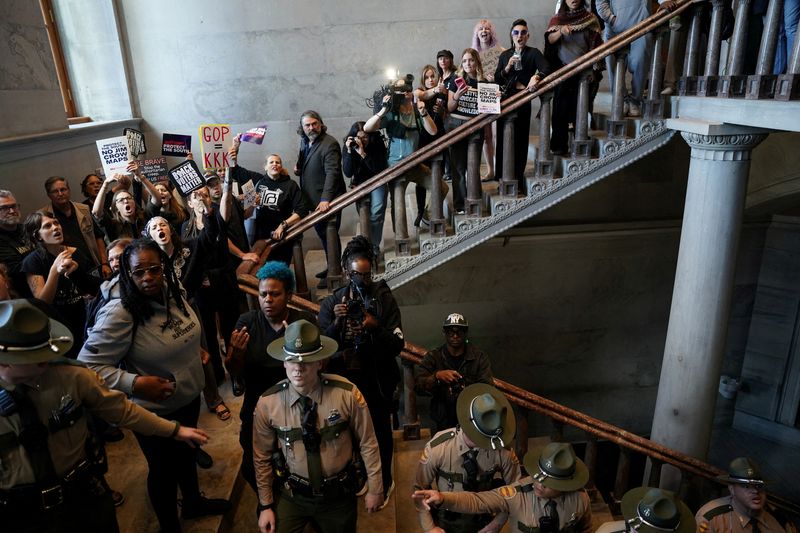
POLICY WIRE — Nashville, United States — It’s an old dance, this legislative power play, but in Tennessee, the music’s taken an ominous turn. They’re not just arguing across the aisle anymore; they’re using the rulebook as a cudgel, shattering long-held norms in the state House. The formal rationale, you see, was maintaining ‘decorum.’ But watch closely, and you’ll detect a colder, more calculated motive beneath the official pronouncements: a swift, brutal lesson delivered to the minority party, leaving its committee seats bare and the state’s democratic machinery a bit more frayed.
It began with protests against the controversial redistricting maps. A minority, feeling unheard, pushed back—maybe too hard for some, maybe not hard enough for others. But what came next wasn’t a rebuke, a formal reprimand, or even a debate. No. It was an amputation. House Republicans, commanding an iron-fisted supermajority, voted to strip key Democratic representatives of their committee assignments. It wasn’t just a political defeat; it was a legislative neutering, a move designed to mute dissenting voices where much of the real work, and real influence, actually happens.
And let’s be clear, this isn’t just local gossip. This sort of parliamentary maneuver, weaponizing procedural rules to silence the opposition, it’s often associated with legislative bodies in nations still finding their footing with democratic institutions. Think less, ‘Westminster debate,’ and more, ‘unsettled nascent democracy.’ It raises eyebrows globally—particularly when it unfolds in a country that frequently touts itself as the gold standard of democratic governance.
State House Speaker Cameron Sexton (R), ever the picture of procedural righteousness, framed the actions as unavoidable. “Order isn’t optional here,” Sexton stated with an almost palpable sigh, presumably for the cameras. “When members repeatedly flout procedure — and disrupt the people’s business, there’s a cost. This isn’t about politics; it’s about parliamentary integrity. We didn’t want to do it, but they left us no choice.” One might detect a subtle irony in his phrasing; choice, it appears, was very much an option, one decidedly exercised with heavy-handed efficiency.
But the Democrats weren’t buying the ‘unavoidable’ narrative. State House Minority Leader Karen Camper (D) didn’t mince words. “They call it order, we call it tyranny,” Camper retorted, visibly frustrated. “What you saw wasn’t governing; it was a punitive assault on dissent. When the majority weaponizes the rules to silence opposing voices, it’s not just a committee reshuffle—it’s an attack on democracy itself.” Strong words. And hard to argue against their core message when you consider the functional reality of legislative work happens behind those committee doors. To be barred from them is to be effectively locked out of policy-making itself. You’re left yelling into the wind.
This episode, chillingly efficient in its execution, spotlights a worrying trend: the relentless shrinking of the political center and the corresponding surge in bare-knuckle tactics. When a supermajority decides that basic dissent—even passionate, perhaps disruptive dissent—is grounds for stripping power, it sends a powerful message to everyone in the legislature: fall in line, or be erased. It’s an escalating brinkmanship that, once crossed, is incredibly hard to reverse. Political precedent, once established, has a nasty habit of metastasizing.
Think about regions like South Asia. In places like Pakistan, the ebb and flow of parliamentary power often resembles a zero-sum game, where procedural squabbles frequently escalate into wholesale political crises. While the US isn’t sending tanks to state capitols (yet), the intent to disenfranchise, to remove agency from legitimate opposition, shares a disturbing lineage. The U.S. ranked 26th globally in the Economist Intelligence Unit’s 2023 Democracy Index, categorized as a ‘flawed democracy.’ Actions like these do little to improve that standing. And honestly, they’ve only exacerbated partisan resentment, probably guaranteeing even more legislative obstruction down the line. It’s an arms race with gavels.
What This Means
This wasn’t a nuanced debate about policy; it was a raw display of brute legislative force, a punitive exhibition designed to ensure future compliance through fear, plain and simple. The political implications are immediate — and stark. First, it further ossifies the already hardened partisan lines in Tennessee. Why compromise when the majority can simply steamroll? Second, it sets a troubling precedent for other states where supermajorities are tempted to employ similar tactics, accelerating the erosion of bipartisan cooperation and mutual respect. Economically, while a state-level political squabble might seem remote from the average wallet, stable and predictable governance is a cornerstone of economic confidence. When the rules of engagement are perceived as arbitrary or weaponized, it breeds uncertainty—certainly not good for attracting investment or fostering long-term stability. The state’s political brand—that crucial, if intangible, aspect of its public persona—takes a hit, projecting an image of partisan infighting rather than collaborative problem-solving. This isn’t just Tennessee’s problem; it’s a snapshot of a widening chasm in democratic functionality across various strata of governance, domestic and international. The foundations are shifting, folks. Better hold on tight.