


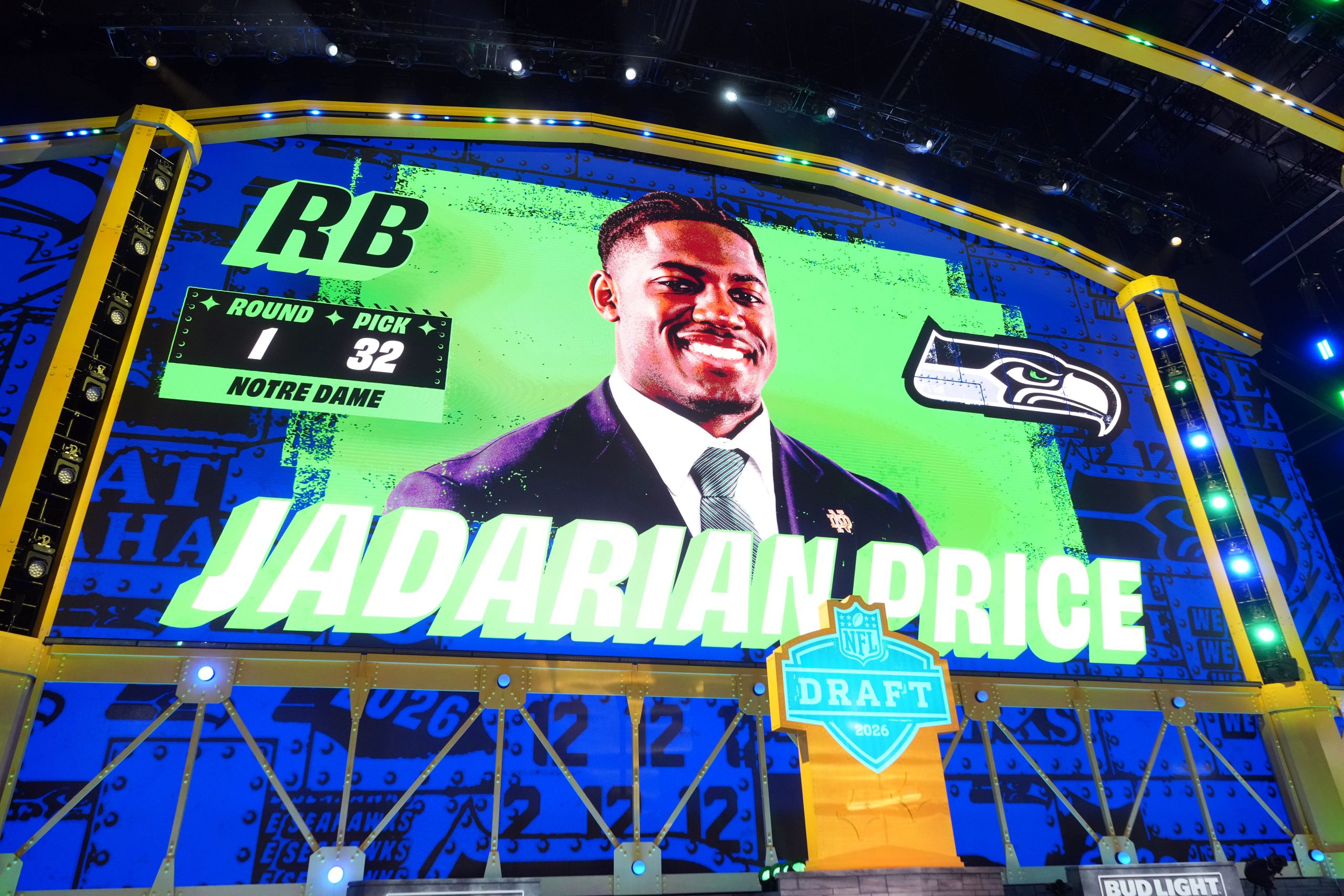
Seahawks Make Unprecedented Draft Gamble on Notre Dame RB Jadarian Price
POLICY WIRE — Pittsburgh, USA — Few teams in professional sports manage to cobble together a dynasty while consistently upending conventional wisdom. Seattle’s Super Bowl Champion Seahawks, however,...

POLICY WIRE — Pittsburgh, USA — Few teams in professional sports manage to cobble together a dynasty while consistently upending conventional wisdom. Seattle’s Super Bowl Champion Seahawks, however, just did it again, pulling a bold, head-scratching move in the recent 2026 NFL Draft that’s got analysts gabbing and traditionalists utterly stumped.
Forget predictable choices. The Seahawks, picking 32nd, snagged Notre Dame running back Jadarian Price. Not just another running back, mind you, taken in the first round — a position increasingly devalued in modern NFL strategy.
At its core, Seattle’s decision represents a seismic gamble on raw potential over collegiate production, a philosophy that frankly feels more at home in a startup incubator than a storied NFL franchise (and frankly, who’s surprised by that anymore?). Don’t misunderstand, Price is gifted. But his college résumé? It’s scandalously sparse for a first-round selection.
For context, Price never once held the starting job for the Fighting Irish. He never even eclipsed 15 carries in a single game. And that matters. Especially when you’re talking about a premium draft pick.
The math’s stark. Analyst Scott Barrett dropped a statistic that, frankly, rocked the entire scouting community: “Jadarian Price is the first RB in NFL Draft history to be drafted in Round 1 or Round 2 and never reach 125 touches in a single CFB season.” That’s a watershed moment for what teams typically hunt.
Back in his freshman year, Price suffered a torn Achilles, effectively redshirting. He then logged just 52 touches the following season. While he ramped up to 120 carries and 4 receptions in 2024, and 113 carries with 6 receptions last season, his total offensive touches over three healthy seasons barely crack 295 (a number that’d make most draft pundits blanch). This came even as Notre Dame made a run to the national title game in 2024, playing 16 games. And yeah, he had 22 kick returns — and three touchdowns, but c’mon, that ain’t a hefty workload.
“We trust our process, we trust our scouts, and we trust what we saw on film,” Seahawks General Manager John Schneider told reporters following the pick. “Sometimes, the numbers don’t tell the whole story. Jadarian has speed, vision, — and an explosive burst that’s rare. We believe he’s got very little tread off the tires, — and we’re excited about what he can become in our system.”
Many a scout, however, grumbled about the sheer risk. After all, the Seahawks just let their Super Bowl MVP running back walk in free agency. Replacing him with a player who’s essentially an unknown quantity at the pro level, statistically speaking, feels like a high-stakes poker game — a gambit that could either pay off handsomely or crater faster than a lead balloon.
But yet, this isn’t entirely uncharted territory. The NFL, a multi-billion dollar juggernaut, often looks to broaden its talent pools and scouting methodologies, much like a global investment firm seeking out undervalued assets in emerging markets. Consider how scouting’s expanded globally, with teams now scrutinizing athletes from diverse backgrounds, sometimes with unconventional training paths. Even in regions like South Asia, where cricket dominates, there’s a growing savor for the analytical depth and strategic gambles inherent in American football, drawing parallels to how businesses wrestle with complex, often unpredictable, environments.
This pick, then, isn’t merely about football; it’s a pronouncement about modern talent evaluation. It asks whether traditional metrics still carry the same sway in an era of advanced analytics — and bespoke training. The Seahawks, under Schneider, don’t shy away from zagging when others zig.
Still, the question remains: was this an act of audacious genius or a bridge too far?
What This Means
Seattle’s gamble on Jadarian Price sends a resounding clarion call throughout the league. For one, it reinforces the running back position’s ebbing market luster, suggesting teams might be willing to take huge risks on raw talent later in the draft rather than plowing resources into established college producers. This could reset expectations for future draft classes.
it underscores the increasing conviction teams place in their own coaching — and development staffs. By picking a player with limited experience, the Seahawks are essentially saying, “We can teach him to be an NFL starter.” That’s a heavy burden. Not just on Price. But on the coaching staff. If it works, Seattle sets a new benchmark for unearthing and nurturing talent — a true testament to their long-term vision, the patient building of a culture, and the meticulous identification of unique skill sets that defy traditional measurements. If it doesn’t, well, that’s a first-round pick they won’t get back.
This particular draft pick by the Seahawks will be watched with keen interest, perhaps even more than some of the top-10 selections. It’s a bellwether of the larger, tempestuous discourse raging in football: how does one quantify potential versus proven performance? The Colts’ 2026 draft gambit, for instance, also showcased a departure from conventional wisdom, but perhaps not with such a stark outlier.
“Price has the athletic gifts to be special, no doubt,” observed one veteran NFL scout, speaking off the record. “But building an NFL back from such a small sample size? That’s like buying a high-tech firm in a developing nation with amazing blueprints but no working prototype yet. The upside is astronomical, but so is the failure rate. It’s a genuine roll of the dice.”
Ultimately, this isn’t just about a single player or a single team. It’s a litmus test for how far the NFL’s increasingly sophisticated scouting departments are willing to push the boundaries of what constitutes a ‘safe’ investment. If Jadarian Price becomes a star, it won’t just vindicate the Seahawks’ belief; it’ll reimagine how teams approach the running back position in drafts for years to come. If he doesn’t, well, we’ll see a swift return to more conventional wisdom.
Related: NFL Draft 2026: Rams Gamble on Simpson, Giants Build Foundation Amid Risky First Round