


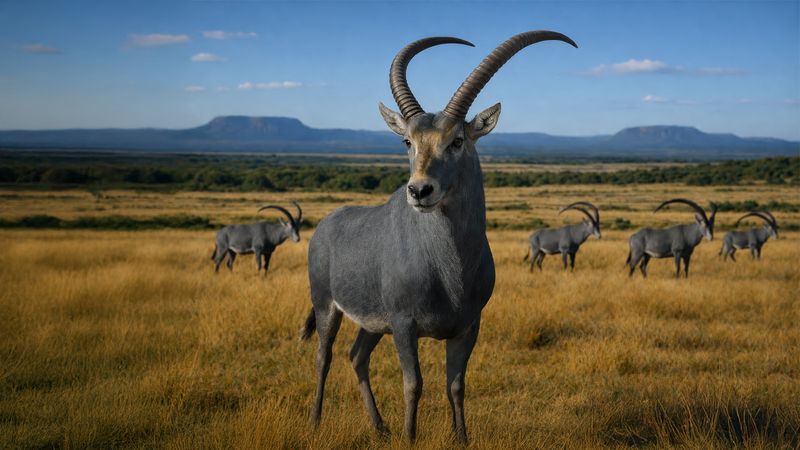
Rewriting Extinction: US Biotech Eyes a Bluebuck Revival, Stirring Ethical Tempest
POLICY WIRE — Washington D.C., USA — The ghosts of species past, often confined to dusty museum exhibits or tragic footnotes in natural history, might just be getting a second act. Not through some...

POLICY WIRE — Washington D.C., USA — The ghosts of species past, often confined to dusty museum exhibits or tragic footnotes in natural history, might just be getting a second act. Not through some mystical intervention, but via a highly capitalized, profoundly ambitious American biotech firm. They’ve set their sights on the bluebuck antelope – a creature hunted to oblivion over two centuries ago – as their inaugural project in a quixotic quest to rewind extinction’s clock.
It’s not just an exercise in scientific hubris; it’s a direct challenge to the very finality of death, at least for some creatures. The San Francisco-based enterprise, known as ‘BioGenesis Futures,’ believes advancements in genetic sequencing and cloning technology have now matured sufficiently to tackle what was once pure science fiction. Their ultimate goal? To reintroduce these venerable creatures to their native South African plains, provided, of course, that viable habitat still exists for an animal no human has seen alive since roughly 1800.
Behind the headlines, this isn’t simply about a single antelope; it’s a profound inflection point. It asks whether humanity, having mastered the art of destruction, can truly perfect the science of redemption. Dr. Aris Thorne, BioGenesis Futures’ indefatigable CEO, isn’t shy about the stakes. “We’re not just bringing back an animal; we’re reclaiming a piece of Earth’s lost heritage, righting a historical wrong through unparalleled scientific endeavor,” Thorne shot back during a recent virtual press briefing, his conviction palpable. “It’s our moral imperative, frankly, to explore these frontiers. We’ve got the tools; it’s time to use ’em.”
But the audacious proposition isn’t without its detractors. Critics, particularly within the conservation community, wonder aloud if the resources being poured into resurrecting a single species might be better allocated to protecting the millions teetering on the brink right now. And it’s a valid query, considering global conservation efforts remain chronically underfunded. A 2021 study published in Conservation Biology estimated that the cost of de-extinction for a single species could run into the tens of millions of dollars over several decades, a sum that could safeguard dozens, perhaps hundreds, of currently endangered populations.
“There’s a seductive romanticism to de-extinction, absolutely,” mused Dr. Lena Petrova, an environmental ethicist at the University of Geneva, her voice laced with skepticism. “But let’s not mistake a biological parlor trick for genuine ecological restoration. What about the ecosystems they’d return to? Are we creating genetic Frankensteins for a world that’s moved on, or worse, diverting crucial funds from the very real and present dangers facing biodiversity today?” Her concerns resonate across a spectrum of ethical and practical considerations.
Still, the project forces a global dialogue. In regions like South Asia, where the Indus River dolphin struggles against pollution and habitat loss, or the snow leopard faces dwindling ranges, the concept of such advanced, resource-intensive intervention sparks complex discussions. For some, particularly within certain Islamic scholarly traditions, the very notion of ‘de-extinction’ might tread into theological territory, bordering on attempts to mimic divine creation – a concept often met with deep reservations. It’s not just a scientific debate, you see; it’s also a cultural and spiritual one that touches on humanity’s perceived place in the natural order.
📄 POLICY WIRE WHITEPAPER PUBLISHED: PAKISTAN'S NATIONAL SECURITY POLICY PRIORITIES
👉 READ BY CLICKING HEREThe technical roadmap, as laid out by BioGenesis Futures, involves extracting viable DNA fragments from bluebuck specimens (of which a handful of skeletons and pelts survive in European museums), using advanced genomic sequencing to reconstruct its full genetic code, and then leveraging somatic cell nuclear transfer – a cloning technique – to introduce that genetic material into an egg from a closely related living species, likely the sable antelope. It’s a process fraught with technical hurdles, ethical minefields, and the fragile public confidence that accompanies any venture of this scale.
What This Means
The bluebuck initiative, if it progresses beyond the lab, carries substantial policy — and economic ramifications. Politically, it will inevitably provoke new regulatory frameworks concerning genetically modified organisms, their release into the wild, and potential international disputes over provenance and ecological impact. Which nation, for instance, bears ultimate responsibility for a de-extinct species? Economically, a successful program could unleash a niche industry – bio-tourism to see resurrected megafauna, intellectual property battles over genetic sequences, and significant public and private investment in advanced biotech research. Conversely, a failure, or an unforeseen ecological consequence, could set back public acceptance of beneficial genetic technologies for decades.
At its core, this isn’t just about a long-lost antelope. It’s about humanity’s evolving relationship with nature, the limits of scientific ambition, and the stark choices we make regarding resource allocation. Do we pour immense sums into bringing back a single victim of past human profligacy, or do we double down on saving what little biodiversity we have left? These are the policy questions, often uncomfortable, that BioGenesis Futures’ audacious gamble forces us to confront, whether we like it or not. The bluebuck, it seems, might return not just as a creature of flesh and bone, but as a potent symbol of our conflicting aspirations.