
Rekindling Strategic Confidence: What the US EXIM Financing Means for Pakistan’s Mineral Future
The recent approval of 1.25 billion dollars in financing by the United States Export Import Bank for the Reko Diq copper and gold project marks a strategic moment in Pakistan’s economic trajectory....

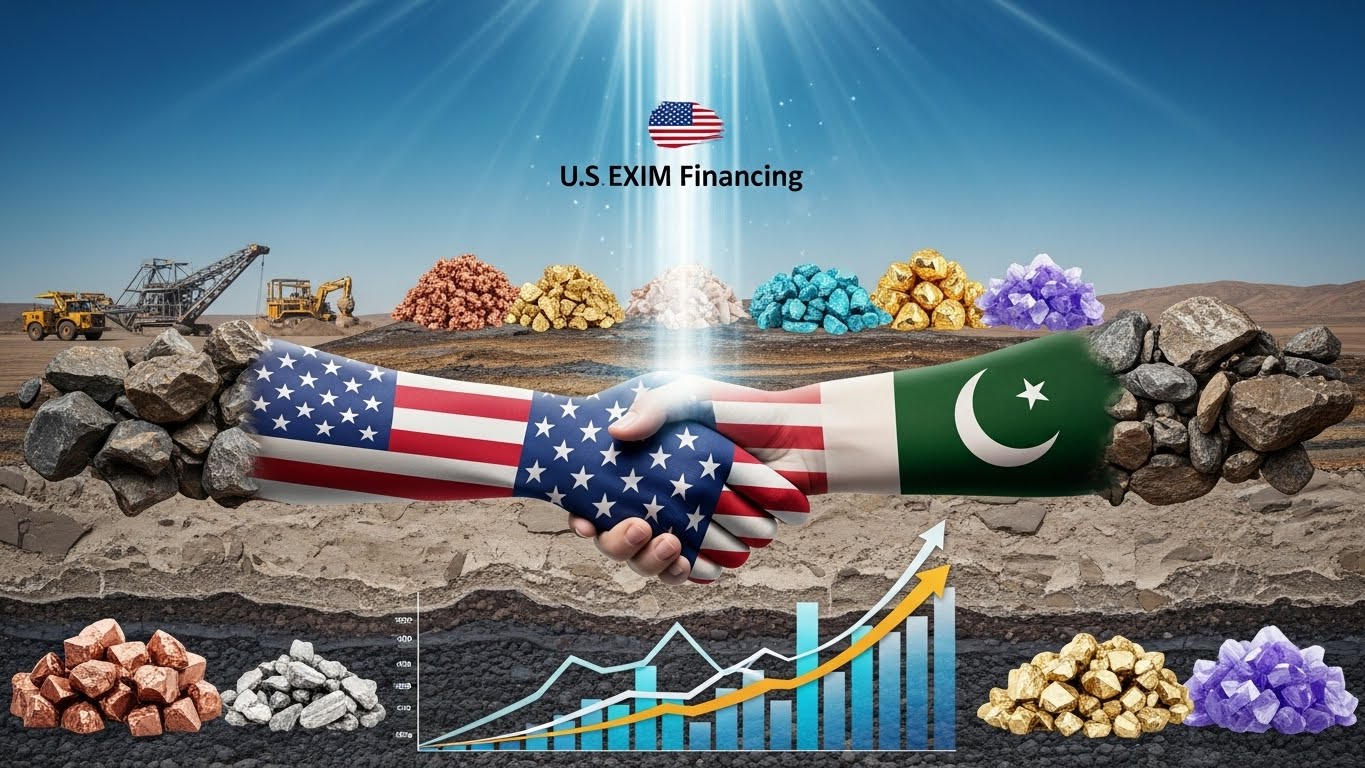
The recent approval of 1.25 billion dollars in financing by the United States Export Import Bank for the Reko Diq copper and gold project marks a strategic moment in Pakistan’s economic trajectory. At a time when the global minerals landscape is undergoing intense geopolitical reordering, Washington’s decision to back one of the world’s largest undeveloped copper-gold reserves signals not only renewed confidence in Pakistan’s economy but also an acknowledgment of the country’s integral role in future mineral supply chains.
This deal is not merely a financing arrangement. It reflects what scholars of international political economy describe as “strategic economic embeddedness,” where states integrate through economic cooperation to dilute risks and expand political trust. For Pakistan, this is the kind of partnership that breaks away from old stereotypes of aid dependency and instead situates the country as a viable investment destination capable of absorbing high-technology capital and delivering long-term returns.
According to the United States Acting Deputy Chief of Mission, Natalie Baker, the EXIM Bank’s facility will unlock nearly two billion dollars in American equipment and services for the mining venture. This includes cutting edge mining technology, drilling machinery and operational support that will put Pakistan on par with global resource extraction standards. Importantly, such investment contributes directly to the development of local value chains, not merely the extraction of raw material. The projected creation of 7,500 jobs in Balochistan and an additional 6,000 in the United States underscores how deeply intertwined the economic outcomes are for both partners.
The significance of this cannot be overstated. Resource rich developing countries often fall into what economists call the “resource curse,” where poorly governed extraction leads to economic distortions and instability. However, Reko Diq has evolved into a textbook case of how institutional reforms, regulatory transparency and credible partnerships can transform natural endowment into structured national gain. Pakistan’s improved mining governance framework, the settlement of previous disputes and the establishment of a predictable investment environment have collectively signaled to global actors that Pakistan is ready for stable, long-term collaboration.
The entry of Saudi Arabia’s Manara Minerals as a potential 15 percent equity holder reflects a broader geopolitical realignment as well. The project is increasingly becoming a tri-continental partnership linking North America, the Gulf and South Asia. For Pakistan, this diversification of partners serves as a strategic hedge. It distributes investment risks, increases bargaining power and builds cross-regional interdependencies that align with Pakistan’s evolving economic diplomacy. When multiple major powers tie their economic interests to the success of a Pakistani project, the political incentives for supporting Pakistan’s stability and growth increase substantially.
Critics often argue that external financing in extractive industries perpetuates dependency. Yet this case demonstrates the opposite. Pakistan is leveraging global capital to build an industrial base in a sector where the world’s largest economies are aggressively competing. Copper, in particular, is central to the green energy transition, from electric vehicles to grid infrastructure. By positioning itself within the global copper supply chain, Pakistan is not only securing foreign investment but aligning itself with the economic sectors that will define the next half century.
From a theoretical lens, this is consistent with the “developmental state” model often studied in East Asian economic transitions. States that successfully managed foreign capital inflows did so by strategically directing investment toward sectors with long-term industrial potential rather than short-term consumption. Pakistan’s embrace of high-technology mining partnerships fits precisely within this framework. It reflects long-term planning aimed at industrial transformation rather than ad hoc revenue seeking.
The socio economic impact for Balochistan is equally vital. The province has long faced structural marginalization, uneven development and limited industrial activity. Large scale, regulated mining projects with guaranteed employment and training pipelines have the potential to shift socio economic dynamics on the ground. They provide local communities with pathways into skilled labor markets, catalyze secondary businesses, and signal that the state is prioritizing developmental equity. If managed inclusively, this project can become a practical demonstration of what development theorists call “shared prosperity growth,” where local populations directly participate in and benefit from economic transformation.
In the larger strategic picture, the EXIM financing is a signal of renewed US engagement with Pakistan on terms that are economic rather than security driven. This shift aligns with Pakistan’s own foreign policy recalibration, which prioritizes economic diplomacy, connectivity, and technology infusion over aid-centric interactions. The fact that US financing is tied to export of American technology and equipment indicates a partnership of mutual gain, not a one sided transfer.
Pakistan now carries the responsibility to ensure that Reko Diq becomes a model of governance, transparency and long-term national benefit. The regulatory environment, environmental safeguards, community integration plans and revenue distribution mechanisms must remain robust. Successful implementation will determine whether global partners continue to see Pakistan as a stable investment destination in critical mineral sectors.
The EXIM Bank decision, therefore, must be read not as an isolated investment but as a strategic inflection point. It reflects international confidence in Pakistan’s economic direction, enhances the country’s relevance within global energy transition supply chains, and strengthens its geopolitical weight through diversified partnerships. With prudent management and sustained political commitment, Reko Diq can evolve into a cornerstone of Pakistan’s mineral industrialization and a symbol of its emerging economic resilience.
Author