
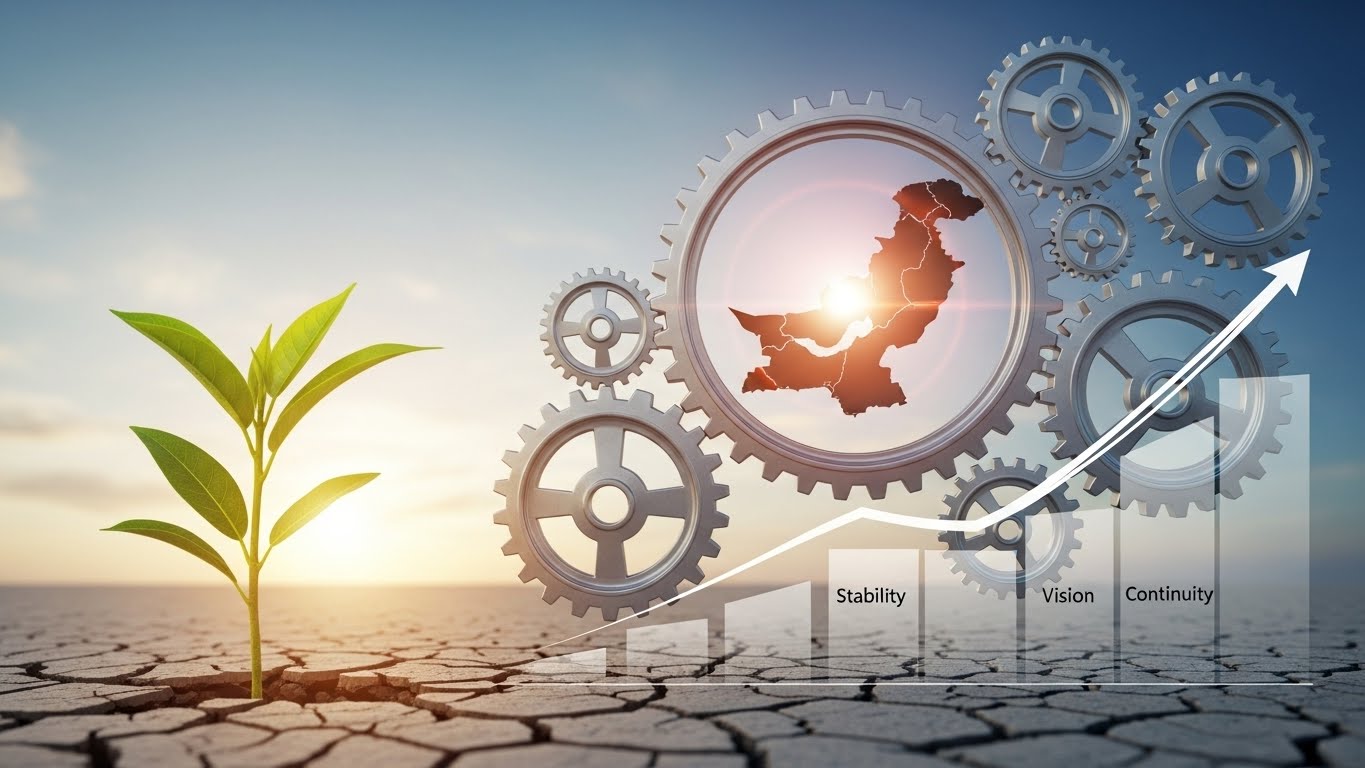
Pakistan’s Economic Future Depends on Stability, Vision, and Strategic Continuity
Pakistan is undergoing a pivotal economic transition. According to the latest official numbers for fiscal year 2024–25, the national economy expanded by 2.68 percent, with overall GDP reaching...

Pakistan is undergoing a pivotal economic transition. According to the latest official numbers for fiscal year 2024–25, the national economy expanded by 2.68 percent, with overall GDP reaching roughly US$ 411 billion. This marks the first time Pakistan has crossed the $400 billion threshold in its history. Concurrently, per-capita income climbed to about US$ 1,824, reflecting improved income distribution and signaling a gradual uplift in living standards. These figures are not abstract projections, they represent real economic rebound, renewed hope, and a foundation upon which stronger growth can be built.
This recovery comes after a prolonged period of economic turbulence, high inflation, currency volatility, external account pressures, and fiscal instability. That Pakistan has managed to stabilize and even make strides speaks volumes about the resilience embedded in its institutions, and about the latent potential of its people. This is the moment for Pakistan to lean on stability, harness its human capital, and chart a path toward sustainable prosperity.
Inflation Under Control: Restoring Trust and Stability
One of the most encouraging signs of recent times is the dramatic decline in inflation. In April 2025, consumer price inflation dropped to a multi-decade low of around 0.3 percent. On average over the first ten months of FY2025, CPI inflation stood at about 4.7 percent, a stark contrast to previous years of double-digit inflation. This sharp drop has restored purchasing power for ordinary households and reduced the burden of uncertainty on families and businesses alike.
As prices stabilize, monetary policy has become more supportive: the central bank cut its key policy interest rate substantially, easing cost of credit. For businesses, this means a lower cost of financing, improved cash flow, and more attractive conditions for investment and expansion. For households, it translates into a somewhat restored sense of economic security. This dual effect on both private citizens and the business community builds confidence that Pakistan is no longer drifting, but steering.
External Stability: Remittances, Foreign Exchange, and Trade
A critical pillar of this recovery is the strength in external inflows. Between July 2024 and April 2025, remittances from overseas Pakistanis surged to an estimated US$ 31.2 billion, roughly a 31 percent increase compared to the prior period. This influx has been instrumental in shoring up foreign exchange reserves, supporting the current account, and cushioning the economy against global headwinds.
Indeed, the current account posted a surplus of around US$ 1.9 billion during this period. With foreign exchange reserves revived, the rupee’s exchange rate has gained relative stability. This external cushion reduces reliance on costly borrowing and gives the country breathing room to implement fiscal and structural reforms without immediate pressure. It also reinforces confidence among foreign and domestic investors that Pakistan is resetting its external vulnerabilities, a necessary step for long-term growth.
Signs of Industrial and Fiscal Revival
Beyond macroeconomic aggregates, sector-wise data hint at a shifting structure, one more oriented toward industry, utilities, infrastructure, and emerging modern sectors rather than solely traditional agriculture. The industrial sector recorded about 4.77 percent growth in FY2025. Within that, utilities, electricity, gas, water supply, surged nearly 28.9 percent, and construction activity rose by around 6.6 percent. These gains reflect increased investment in infrastructure, energy, housing, and public utilities, areas that historically have strong multiplier effects on the economy as a whole.
Fiscal discipline also appears to be returning. Total revenues (tax + non-tax) grew significantly, while tax revenues alone recorded a substantial increase. The fiscal deficit narrowed to around 2.6 percent of GDP, and the primary balance, which excludes interest payments, posted a surplus equivalent to about 3.0 percent of GDP over July–March FY2025. Public sector development spending also rose sharply, with over Rs 1,046 billion utilized in the fiscal year, the highest utilization in recent years. These numbers suggest the government is re-establishing capacity to invest in development and public goods, even as it stabilizes finances.
Agriculture and Mixed Sectoral Outcomes
Agriculture, long the backbone of Pakistan’s rural economy, posted only modest overall growth of around 0.56 percent in FY2025. Within this mixed result, important staple-crop yields declined: several major crops recorded double-digit drops due to climate stress and area shrinkage, while livestock and certain other crops registered modest gains. Thus, while agriculture remains essential for food security and rural livelihoods, its structural limitations, volatile yields, reliance on weather, and fluctuating global commodity prices, underscore the need for modernization, investment, and diversification.
This mixed performance signals a larger structural shift: the economy is gradually moving away from overreliance on traditional agriculture, and toward a more diversified model where industry, services, infrastructure, and external flows play larger roles. If managed carefully through targeted investment, technological upgrades, and supportive policy, this shift can help transform the economic base and reduce vulnerability to agricultural shocks.
Governance, Reforms and the Importance of Strategic Stability
The recent progress cannot be understood without acknowledging a renewed commitment to governance, fiscal discipline, and structural reform. A stabilized fiscal deficit, jump in revenues, revived public investment, and regained external strength all reflect careful policy choices and implementation. This period of relative calm and order offers Pakistan the rare chance to plan beyond short-term crisis management. Rather than reactive, crisis-driven policy, the country is in a position to think in decades.
This strategic stability is not just good for numbers, it is vital for national confidence, long-term planning, and investor trust. For businesses, both domestic and foreign, stability is the currency of commitment. For ordinary citizens, it builds hope that economic growth can translate into better jobs, improved services, and more predictable governance. For the Pakistani diaspora looking to invest back home, it signals that Pakistan may finally offer a reliable and growing opportunity.
Economic Sovereignty, National Pride and Self-Reliance
A stronger economy is not just about higher GDP or trade balances, it is about sovereignty, dignity, and self-reliance. With greater foreign exchange reserves, robust remittance inflows, growing industry and infrastructure investment, Pakistan can gradually reduce dependence on external borrowing, aid, or short-term financial assistance. This economic resilience can form the bedrock of national security and strategic autonomy, allowing the country to chart its future with dignity, on its own terms.
Per-capita income crossing US$ 1,800, improved fiscal discipline, and growing industry all contribute to a renewed sense of national confidence. When ordinary citizens see tangible improvement in livelihoods and opportunity, and when international investors regard Pakistan as a viable, stable investment destination, such outcomes reinforce national identity and collective resolve.
The Path Ahead: Seizing Momentum, Closing Gaps, Building Futures
Despite encouraging progress, significant challenges remain. The modest growth in agriculture underscores persistent structural fragility there. Large-scale manufacturing has yet to fully bounce back. External global pressures, energy prices, commodity cycles, geopolitical volatility, remain real risks. To convert current momentum into lasting growth, Pakistan must remain focused on strategic reforms, infrastructure investment, and human capital development.
Investments should target modernizing agriculture, upgrading manufacturing, scaling infrastructure, and promoting sectors like technology, services, and renewable energy. At the same time, ensuring social inclusion, access to education, healthcare, and rural opportunities, is essential to ensure growth reaches every citizen. Fiscal discipline must be maintained even as public investment rises, and external account buffers should be strengthened to withstand global shocks.
Why This Moment Matters for Pakistan’s Future?
Pakistan’s 2024–25 economic snapshot shows a country that is stabilizing, recovering, and regaining confidence. With a GDP over US$ 411 billion, per-capita income near US$ 1,824, inflation under control, external inflows strong, and industry and public investment rising, the foundation for sustained growth exists. But foundations are only as strong as the people building on them.
This is a historic opening, a moment where stability, strategic continuity, economic revival, and national pride can combine to transform Pakistan’s narrative. If seized wisely, this moment could mark the shift from reactive crisis management to proactive, sustained development. Pakistan could emerge not simply as yet another developing economy, but as a country charting its own path toward resilience, dignity, and global relevance. In short, this is not just recovery. This is rebirth. And for Pakistan, the rebirth must be nurtured with unity, vision, and an unshakable commitment to turning potential into prosperity.
Author