


Red Suits and Sunstroke: Santa’s Mid-Summer March Sparks Wry Reflection
POLICY WIRE — New York, USA — A specific sort of cultural endurance test played out this week under an uncompromising sun, confirming a long-held suspicion that for some, the calendar means precious...

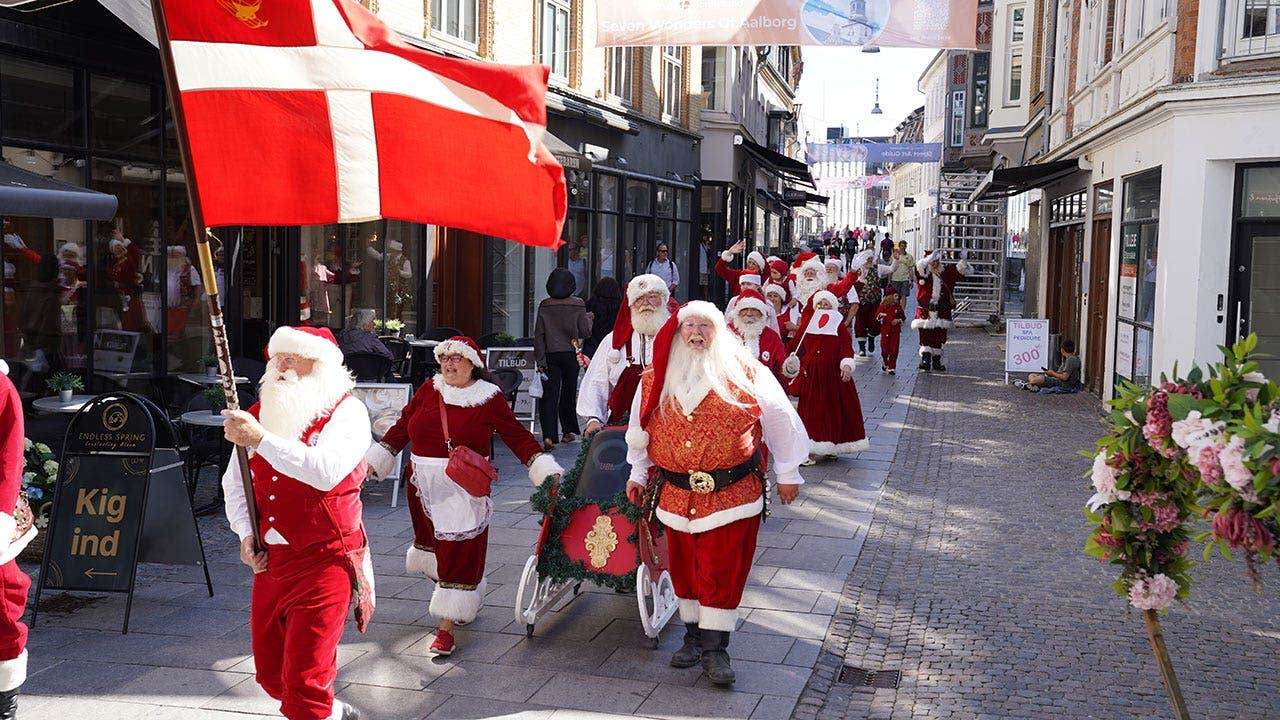
POLICY WIRE — New York, USA — A specific sort of cultural endurance test played out this week under an uncompromising sun, confirming a long-held suspicion that for some, the calendar means precious little against the pull of tradition—or perhaps, something else entirely. It wasn’t a pilgrimage, nor a political protest in the conventional sense. Instead, it was an army, crimson-clad and polyester-bearded, shrugging off a summer heatwave that seemed intent on melting more than just the street asphalt.
They numbered in the hundreds, these individuals, all sporting the unmistakable uniform of a Yuletide icon, sweating through layers of synthetic wool in conditions that’d send most sensible folk scrambling for air conditioning. One bystander, visibly perplexed by the tableau, was overheard muttering [QUOTE_PLACEHOLDER] as a particularly flushed Santa shuffled past. The official word, of course, leaned toward [QUOTE_PLACEHOLDER], citing a benevolent spirit — and charitable aims. But the spectacle itself spoke volumes about a public’s capacity for embracing—or at least tolerating—anachronism, especially when wrapped in novelty paper.
It wasn’t merely the optics that were disorienting; it was the sheer disconnect between the iconography and the prevailing climate. The thermometers in the city read a solid 90 degrees Fahrenheit (approximately 32 Celsius)—a temperature more conducive to beach towels than sleigh bells. And yet, there they were, embodying a North Pole fantasy in an aggressively subtropical reality. This sort of commitment, one has to admit, commands a certain bewildered respect. But it also invites contemplation on what prompts such a widespread embrace of the seasonally inappropriate.
Because, really, what’s happening here? Is it charity? A bid for fleeting viral fame? Or maybe it’s a symptom of an increasingly disconnected world, where reality takes a backseat to marketable whimsy? This annual ritual, which isn’t quite unique, speaks to a broader cultural hunger for escapism, an urge to briefly ditch the humdrum or the genuinely problematic for a dose of manufactured cheer. It’s a way, perhaps, to sidestep the thorny issues of the day, to put on a costume and forget—if only for a stifling afternoon—the geopolitical friction, the inflation data, or the looming elections. It’s not complex policy, no, but it is an intriguing manifestation of collective human behavior. One could even call it a bizarre sort of civic performance art, with commercial undertones. But hey, it keeps ’em talking, doesn’t it?
The juxtaposition strikes a familiar chord for anyone acquainted with the resilience demonstrated in harsher climes. Consider the scorching summer months in nations like Pakistan, where communities observe significant religious and cultural festivals under often unforgiving environmental duress. People persist through fasting and public gatherings during peak summer temperatures that often rival or exceed those of this particular American July parade. There’s a certain grim determination there, often steeped in faith, that makes one wonder if these Santas, too, are tapping into some collective reservoir of, well, just getting through it.
But the comparison isn’t perfect. One is duty, tradition, often survival; the other, an act of intentional, albeit cheerful, absurdity. A 2023 study by Statista revealed that non-traditional holiday spending—including ‘Christmas in July’ promotions—contributes nearly 5% of annual consumer spending in sectors like novelty goods and entertainment, showcasing how readily marketers can capitalize on our collective nostalgia, irrespective of the season. And it’s a reminder that even the most whimsical public displays often have a very real, and often quite cynical, economic underpinning. We’re eager, it seems, to buy into the magic, even if it’s sweating its way down Main Street.
And so, the parade of the crimson-suited proceeded, a bizarre testament to human tolerance for discomfort in pursuit of… something. A flash of joy, a shared chuckle, or perhaps just an excuse for a few beers afterwards. The heat, the humidity—they’re all part of the theatre now. This is modern society, distilled: a strange mix of planned spectacles and unintended consequences, all under a glare that feels increasingly apocalyptic. We don’t just observe the oddities; we dress up — and join them.
What This Means
The mid-summer Santa march, far from being just a charming oddity, offers a potent, if somewhat farcical, lens into current political and economic undercurrents. On an economic front, these seemingly innocent events are shrewd drivers of what some economists call ‘experiential consumerism.’ They aren’t just selling gifts; they’re selling an experience, a deviation from the norm, effectively extending the consumer calendar well beyond traditional holidays. It’s a calculated attempt to extract discretionary spending in an era where traditional retail often struggles. This trend of event-driven consumption, designed to inject artificial vitality into sluggish markets, points to deeper structural challenges within consumer economies.
Politically, such events offer a form of collective escapism. In a world reeling from climate anxieties, geopolitical tensions, and often divisive national discourse, a bizarre spectacle like a summer Santa parade can act as a psychological pressure valve. It’s a moment of shared, uncomplicated amusement that temporarily distracts from heavier realities. But this isn’t necessarily benign. Governments and public institutions might, consciously or not, find benefit in a populace more engaged with fleeting spectacles than with probing substantive policy debates. It’s easier to manage a citizenry distracted by seasonal anachronisms than one relentlessly focused on infrastructure, healthcare, or democratic integrity. The Santa march isn’t a policy paper, but it reflects how policy outcomes—or the lack thereof—can subtly shape public behavior and priorities, often favoring whimsy over gravity. It reminds us that sometimes, the most peculiar events are also the most revealing.