


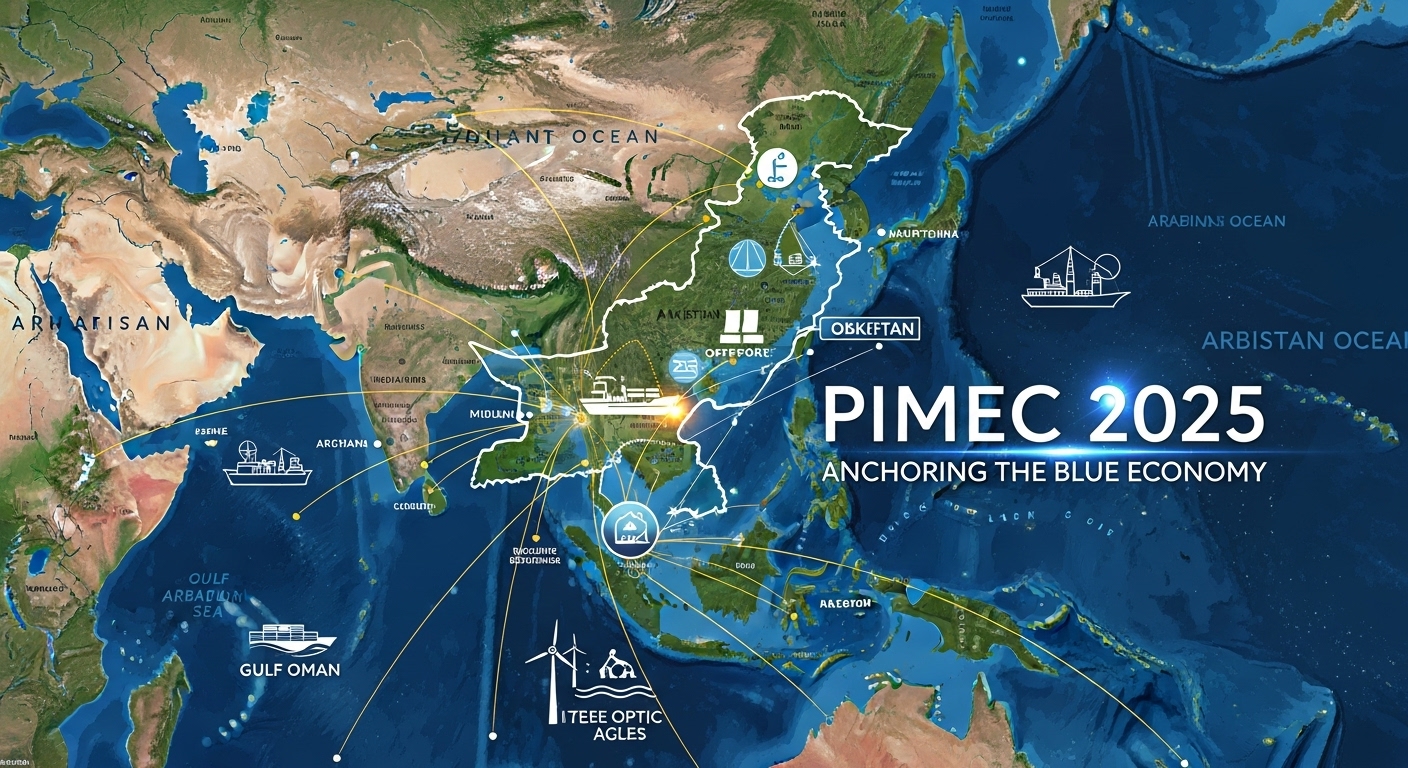
Positioning Pakistan on the Global Maritime Map: The Role of PIMEC 2025 in Anchoring the Blue Economy
In a milestone achievement for Pakistan’s maritime ambitions, the four-day Pakistan International Maritime Expo and Conference (PIMEC) 2025 — held from 3–6 November 2025 in Karachi — concluded with...

In a milestone achievement for Pakistan’s maritime ambitions, the four-day Pakistan International Maritime Expo and Conference (PIMEC) 2025 — held from 3–6 November 2025 in Karachi — concluded with 83 agreements signed, estimated to attract around Rs 76 billion (US $273.6 million) between local and foreign exhibitors.
This breakout moment provides new motivation for Pakistan’s maritime and blue economy agenda, merging national interests with international collaboration.
Event Highlights
- The summit hosted 178 exhibitors — 150 local organizations and 28 international participants.
- 133 international delegations from 44 countries across Europe, Asia, North and South America, Africa, the Middle East, and the Far East attended.
- Most agreements signed were Memoranda of Understanding (MoUs), cutting across multiple maritime sectors — signaling strategic alliances, technology transfer, and capacity-building commitments.
Why This Is Important to Pakistan
1. A Message to Investors
According to the Pakistan Navy, the deal volume sends a clear message of Pakistan’s readiness for partnerships and its commitment to unlocking its maritime potential.
2. Strategic Advantage of Geography
Pakistan’s 1,046 km coastline sits along major global trade routes. However, despite this geographic advantage, the maritime economy remains underdeveloped — with ageing port infrastructure and declining fisheries exports. PIMEC represents a turning point to reverse this trend.
3. The Blue Economy Push
Pakistan’s Maritime Vision 2047 aims to position the country as a global maritime hub by emphasizing sustainable growth, maritime trade, energy security, and climate resilience — aligning with global blue economy priorities.
Technology and Innovation
The event showcased maritime innovations and technological services — a clear indication that modernization is becoming central to Pakistan’s maritime strategy.
- Partnerships and international connections: The presence of 28 global exhibitors and 133 delegations highlights growing international interest in Pakistan’s maritime cooperation.
- Capacity building and services: Focus extended beyond infrastructure to logistics, fleet development, and ecosystem creation within the blue economy framework.
- Sustainability and climate resilience: The blue economy agenda emphasizes environmental stewardship, coastal protection, and sustainable use of marine resources — not just ports and ships.
Challenges & Considerations
While the agreements mark an excellent beginning, several challenges remain before Pakistan can realize the full potential of these commitments. MoUs are preliminary by nature — their success depends on transparency, governance, financing, and regulatory clarity.
Infrastructure Preparedness
Pakistan’s coastal and port infrastructure, although strategically positioned, remains below global benchmarks. Upgrades in connectivity, facilities, and management efficiency are essential.
- Qualified human capital: The evolving maritime sector demands enhanced training, human resource development, and institutional capacity.
- Competitiveness in the market: Pakistan must ensure its shipping, logistics, and port services can compete not only regionally but globally.
- Sustainability and ecosystem integrity: Economic development should balance growth with marine ecosystem protection and climate-resilient planning.
Future Perspective: Implications & What to Observe
- Follow-through on the 83 agreements: Monitoring the conversion of MoUs into actionable contracts, projects, and measurable outcomes will be critical.
- Sector-specific performance: Assess which maritime areas — such as ship repair, logistics, seafood exports, offshore services, or marine renewable energy — attract tangible investment.
- Regional integration: Pakistan’s maritime trajectory is intertwined with its regional trade routes, neighbors, and global shipping networks.
- Reinvention of the blue-economy narrative: Turning policy into performance could redefine Pakistan’s economic geography and strengthen its coastal value chains.
- Transparency and benchmarking: Indicators such as job creation, export growth, infrastructure investment, and environmental impact will measure whether the summit’s energy translates into long-term gains.
Conclusion
The US $273 million worth of deals secured at PIMEC 2025 represent more than just a headline number — they mark a defining milestone in Pakistan’s maritime evolution. With robust international participation and strong national resolve, Pakistan now faces the real challenge: implementation.
To convert momentum into progress, the focus must remain on executing MoUs, modernizing infrastructure, developing human capital, and ensuring the maritime sector becomes a source of sustained performance rather than potential. The world — and Pakistan’s competitors — will be watching closely as the nation positions itself to ride the global maritime wave rather than react to it.
Sources
- Official PIMEC 2025 Website
- “PIMEC 2025 concludes with $274m deals,” Daily Times (Pakistan), 7 November 2025
- “Pakistan signs $273 million deals at Maritime Summit,” The Daily CPEC, 7 November 2025
- “Pakistani, global exhibitors sign agreements worth $273 million at maritime summit,” Arab News, 6 November 2025
Author