


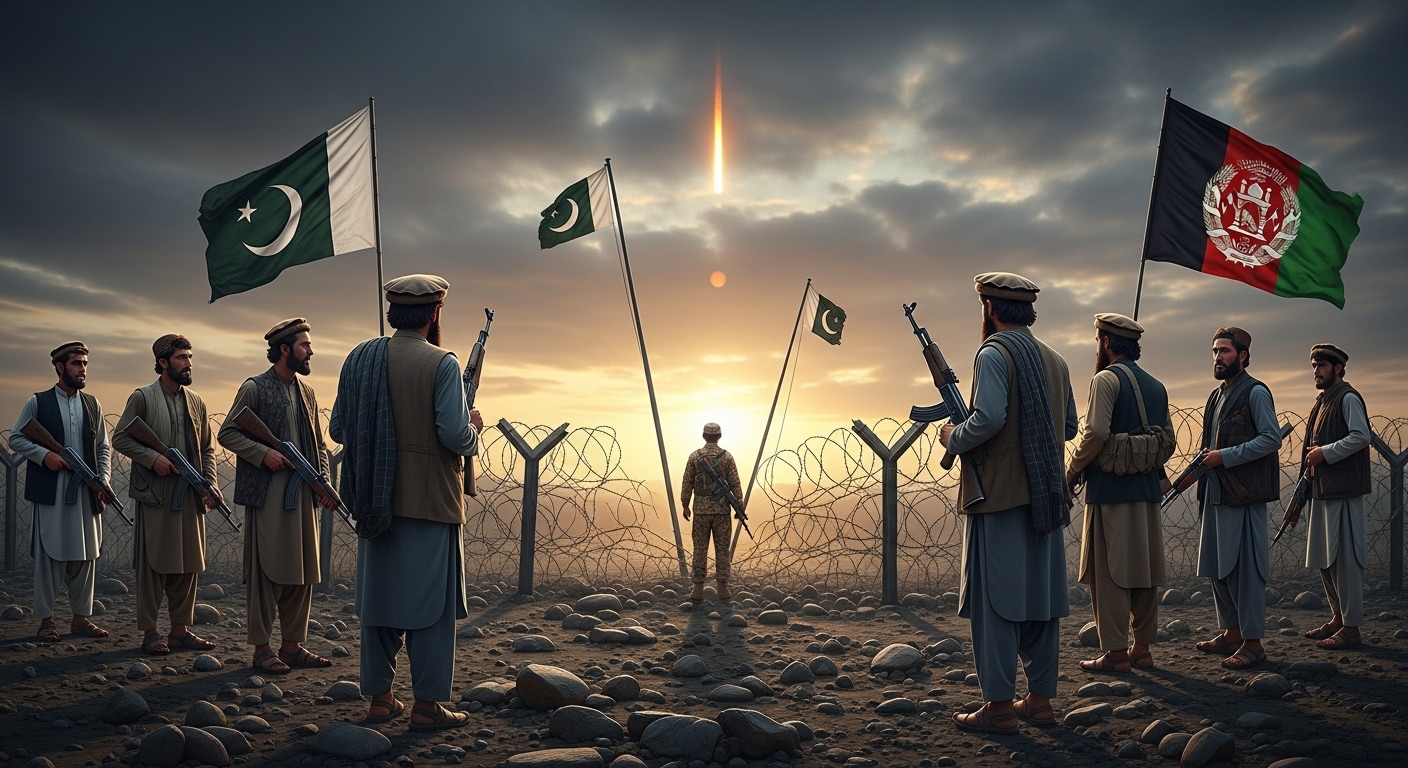
Despite facing a complex regional environment, Pakistan stands resilient to safeguard its national security and stability. On one side is India’s renewed diplomatic engagement with the Taliban regime, a government it once refused to recognize, and on the other is a sharp rise in cross-border terrorism by groups such as Fitna al-Khawārij (FAK). The result is an increasingly unstable western border, where Kabul’s unwillingness to act against terrorist networks aligns with New Delhi’s growing influence in Afghanistan. Recent events, such as the failure of the Istanbul peace talks and Zabihullah Mujahid’s false accusations against Pakistan, have exposed how the Afghan regime and its partners are trying to undermine Islamabad’s sincere efforts for peace.
The Growing Threat from Fitna al-Khawārij
Since the Taliban’s return to power in 2021, India-backed FAK-aligned terrorist factions have become increasingly active, while the Taliban regime has failed to take any serious action against them. The year 2025 has been particularly violent. In April, Pakistani forces killed 71 terrorists attempting to cross the border from Afghanistan into Pakistan. Later, in October, fierce clashes near Torkham claimed the lives of 23 Pakistani soldiers, prompting a strong military response that eliminated more than 200 FAK militants.
According to the Pak Institute for Peace Studies (PIPS), terrorist attacks in Pakistan have risen by over 70% since the Taliban takeover, with casualties in 2025 already surpassing 2,400, the highest in a decade. These figures underscore that Pakistan is confronting a sustained and organized terrorist campaign originating from across the border. Islamabad views FAK not only as a grave security threat but also as a religious and ideological aberration, a modern incarnation of the Khawārij, who distort Islam to justify violence and rebellion. Nevertheless, the Taliban regime continues to tolerate FAK’s leaders, training camps, and media networks, which operate openly in Afghan provinces such as Kunar, Nangarhar, and Paktika.
India’s Return to Kabul
While Pakistan continues to suffer from terrorism, India has quietly rebuilt its presence in Afghanistan. After a brief withdrawal in 2021, New Delhi reopened its diplomatic mission in 2022 and, by October 2025, upgraded it to a fully functioning embassy, actively engaging the Taliban for its own strategic interests. Indian officials have frequently met with Taliban leaders to discuss trade, infrastructure, and intelligence cooperation.
This is not routine diplomacy; it is a calculated strategic maneuver to encircle Pakistan. For decades, India has sought to expand its influence along Pakistan’s western frontier. Its renewed engagement now reduces Kabul’s reliance on Pakistan for trade and transit, while simultaneously diminishing Islamabad’s leverage over cross-border security. The timing of India’s diplomatic resurgence, coinciding with the sharp escalation in FAK attacks, is too significant to overlook.
India’s growing footprint provides the Taliban with political confidence and economic incentives to dismiss Pakistan’s legitimate security concerns, a painful irony, given that Pakistan once sheltered millions of Afghan refugees when Afghanistan was in turmoil.
The Collapse of the Istanbul Peace Talks
The Istanbul Peace Dialogue, mediated by Turkey and Qatar, was launched to foster cross-border cooperation and regional stability. Pakistan participated in the process in good faith, presenting practical proposals and fully respecting the neutrality of the mediators. However, as in previous talks held in Doha and Islamabad, the Afghan delegation withdrew at the final stage, refusing to sign written guarantees to take action against FAK.
Pakistan’s demand remained simple and consistent: Afghanistan must ensure that its territory is not used by FAK or any other terrorist groups. This request is fully aligned with international law and relevant UN resolutions. Yet, once again, Kabul avoided making any firm commitment. Shortly afterward, Taliban spokesman Zabihullah Mujahid issued an unfounded statement blaming Pakistan, claims that were directly contradicted by concrete evidence. Pakistan has already shared with the mediators verified videos and intelligence reports confirming that attacks were launched from Afghan soil and that FAK leadership is present in Kabul, Kunar, and Khost.
If Kabul genuinely believes that terrorists are not operating from its territory, Pakistan has challenged it to allow independent verification, such as inspections by Turkish or Qatari monitors. Pakistan maintains that peace cannot rest on verbal assurances alone; it requires verified actions and mutual accountability.
📄 POLICY WIRE WHITEPAPER PUBLISHED: PAKISTAN'S NATIONAL SECURITY POLICY PRIORITIES
👉 READ BY CLICKING HEREThe growing alignment between Indian and Afghan interests is further destabilizing the region. India’s expanding economic and diplomatic support emboldens the Taliban regime, enabling it to dismiss Pakistan’s legitimate concerns while gaining broader international acceptance. This partnership serves India’s long-term strategic objective: to undermine Pakistan’s internal stability and obstruct the China-Pakistan Economic Corridor (CPEC), a vital trade route linking South Asia to global markets.
Pakistan’s Response and Diplomatic Strategy
Facing pressure on two fronts, Pakistan has demonstrated both resolve and restraint. Through Operation Azm-e-Istehkam (2024–25) and Operation Sarbakaf (July 2025), its security forces dismantled dozens of FAK networks across Khyber Pakhtunkhwa and Balochistan, eliminating more than 700 terrorists and seizing large caches of weapons and explosives. Daily intelligence-based operations continue along the frontier. Despite suffering significant losses, Pakistan remains steadfast in defending its borders.
On the diplomatic front, Islamabad has sustained engagement through Qatar, Turkey, and China, urging Kabul to fulfill its counter-terrorism commitments under the Doha Accord and UN Security Council Resolution 1988. The temporary ceasefire reached in October 2025 reflected Pakistan’s sincerity and willingness to de-escalate, though its durability depends on genuine enforcement from the Afghan side.
Simultaneously, Pakistan has advanced an ideological front, labeling these militants as Fitna al-Khawārij to expose their distortion of Islam and reaffirm the country’s role as a defender of unity, moderation, and true Islamic values.
Conclusion
All the evidence points to a single pattern: the rise of FAK terrorism, the collapse of peace efforts, India’s deepening engagement with the Taliban, and Afghanistan’s continued inaction are all interconnected. Whether through intent or neglect, this alignment undermines Pakistan’s security and threatens regional stability. Pakistan’s stance rests on verified facts, not assumptions. Having sacrificed more than 80,000 lives in the war against terror, Pakistan holds both the moral and political right to demand accountability from its neighbours.
The way forward lies in concrete action, verified cooperation, and genuine diplomatic transparency. Afghanistan must dismantle FAK networks operating from its soil; India must cease policies that embolden them; and the international community must acknowledge Pakistan’s frontline role in safeguarding peace. Only through shared responsibility and trust can South Asia overcome cycles of mistrust, with Pakistan, as ever, standing at the heart of regional stability and moral clarity.
Author