

Pakistan’s Successful Diplomacy in the Middle East
At a time when the Middle East stood dangerously close to a full-scale regional war, Pakistan emerged as a calm, credible and effective voice of peace. The recent United States–Iran ceasefire, widely...

At a time when the Middle East stood dangerously close to a full-scale regional war, Pakistan emerged as a calm, credible and effective voice of peace. The recent United States–Iran ceasefire, widely welcomed across the world, has placed Pakistan at the center of global diplomacy. From major world powers to regional actors and international institutions, there is growing recognition that Pakistan played a decisive role in preventing a catastrophic escalation.
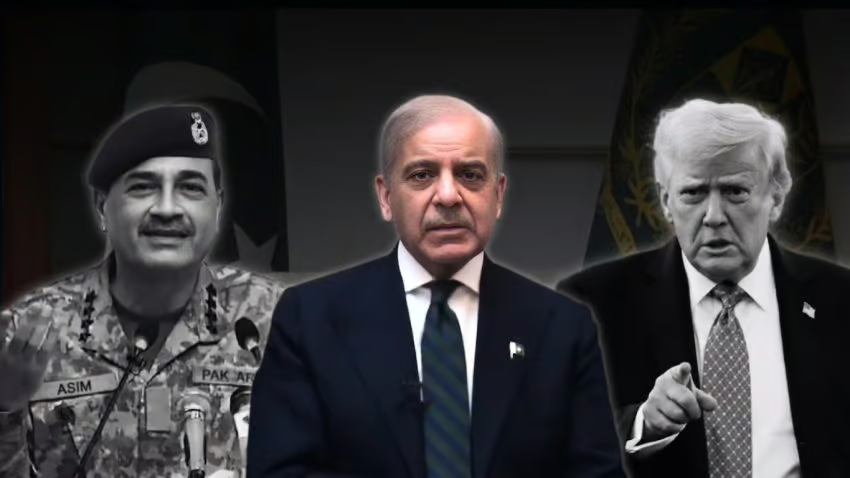
The two-week ceasefire agreement between the United States and Iran did not happen in isolation. It was the result of intense diplomatic engagement led by Pakistan’s leadership, including Prime Minister Shehbaz Sharif and senior military officials. Pakistan proposed the ceasefire just hours before a critical military deadline, effectively creating a window for dialogue instead of destruction.
What makes this achievement remarkable is the scale of the crisis. The conflict had already disrupted the Strait of Hormuz, a route responsible for nearly 20 percent of global oil supply. The risk of prolonged war threatened not only regional stability but also the global economy. By facilitating a pause in hostilities and reopening maritime routes, Pakistan’s diplomacy helped stabilize international energy markets and reduce economic uncertainty.
Global reaction has been overwhelmingly positive. The United Nations Secretary-General welcomed the ceasefire and urged all parties to build on this opportunity for lasting peace. European leaders, including those from France, Germany and the United Kingdom, described the agreement as a step back from the brink of war. Similarly, countries across the Muslim world, including Saudi Arabia, Türkiye, Qatar and Oman, openly appreciated Pakistan’s efforts in securing the truce.
This global endorsement reflects a broader shift in Pakistan’s international standing. Analysts have described this moment as one of Pakistan’s most significant diplomatic successes in recent years, highlighting how Islamabad has transitioned from a regional player to a global mediator. The fact that both Washington and Tehran trusted Pakistan to facilitate communication is itself a powerful indicator of credibility.
Pakistan’s approach has been rooted in balance and strategic neutrality. Unlike many other actors, Pakistan maintained open channels with all sides. It engaged with the United States while also maintaining dialogue with Iran and key regional stakeholders such as Saudi Arabia and Türkiye. This ability to talk to all parties without bias enabled Pakistan to act as a bridge in a deeply polarized conflict.
One of the most important elements of Pakistan’s diplomacy was the “Islamabad Accord,” a structured peace framework that proposed an immediate ceasefire followed by broader negotiations. This was not just a temporary solution but a roadmap for long-term stability. The fact that this framework was accepted as a basis for the ceasefire demonstrates Pakistan’s strategic foresight and diplomatic maturity.
The impact of Pakistan’s efforts extends beyond politics. Financial markets responded positively to the ceasefire announcement, with signs of recovery in Asian markets and stabilization in global oil prices. This highlights how Pakistan’s diplomacy contributed not only to peace but also to global economic stability.
Another key dimension is humanitarian. The ceasefire has allowed the resumption of aid and reduced immediate risks to civilian populations. International organizations have emphasized that such pauses in conflict are critical for delivering relief and preventing further human suffering. By facilitating this outcome, Pakistan has reinforced its image as a responsible and compassionate global actor.
Importantly, Pakistan’s diplomatic success did not emerge overnight. It is the result of consistent engagement, including high-level meetings, backchannel negotiations and coordination with global powers. Pakistan also worked closely with partners such as China and members of the Organization of Islamic Cooperation to build consensus around de-escalation.
The decision to host talks in Islamabad further strengthens Pakistan’s position as a center for diplomacy. Iran has already indicated willingness to engage in negotiations in Pakistan’s capital, which underscores the trust both sides have placed in Islamabad as a neutral venue.
Critically, Pakistan’s diplomacy reflects a broader national vision centered on peace, stability and regional cooperation. At a time when global politics is often driven by confrontation, Pakistan has demonstrated that dialogue remains the most effective tool for conflict resolution. Its efforts have shown that even in the most complex geopolitical crises, constructive engagement can produce meaningful results.
The international applause is therefore not just about a single ceasefire. It is about Pakistan’s re-emergence as a key diplomatic player on the global stage. From preventing escalation to creating space for negotiations, Pakistan has shown leadership that is both responsible and impactful.
In conclusion, Pakistan’s successful mediation between the United States and Iran stands as a powerful example of effective diplomacy in action. Backed by strategic vision, balanced engagement and timely intervention, Pakistan has not only contributed to peace in the Middle East but also enhanced its global standing. As the world continues to navigate complex conflicts, Pakistan’s role as a bridge-builder and peace facilitator is likely to become even more significant in the years ahead.
Author