


A Masterclass in Quiet Mediation That the World Should Applaud
In an era when great-power diplomacy frequently collapses under the weight of mistrust and grandstanding, Pakistan has delivered a rare and consequential breakthrough. By brokering a two-week...
In an era when great-power diplomacy frequently collapses under the weight of mistrust and grandstanding, Pakistan has delivered a rare and consequential breakthrough. By brokering a two-week ceasefire between the United States and Iran, Islamabad has not only halted immediate escalation but has also created the first meaningful opening for direct, face-to-face peace negotiations since the war began. This is more than a tactical success, it is a strategic validation of Pakistan’s unique value as a neutral, reliable mediator in one of the world’s most volatile regions. The international community’s swift praise underscores a simple truth: effective diplomacy still thrives on trust, geography, and persistence rather than headlines.
EU Leadership Applauds Pakistan’s Mediation
The European Union’s top diplomat, Kaja Kallas, captured the significance perfectly on Wednesday. In a post on X, she publicly thanked Pakistan for brokering the ceasefire, describing the truce as “a much-needed chance to tone down threats, stop missiles, restart shipping, and create space for diplomacy towards a lasting agreement.” Kallas revealed she had spoken directly with Pakistan’s Foreign Minister and expressed gratitude for “securing this initial deal.” She added: “The door to mediation must remain open, as the underlying causes of the war remain unresolved. The EU stands ready to support those efforts and is in touch with partners in the region.” Kallas was scheduled to travel to Riyadh later that day for talks with Saudi Foreign Minister Prince Faisal bin Farhan and Gulf Cooperation Council secretary-general Jassem al-Budaiwi.
Historic Talks Set for Islamabad
The ceasefire was announced by President Donald Trump on Tuesday, paving the way for negotiations on a full peace deal. Iran’s Foreign Minister Abbas Araghchi promptly confirmed Tehran’s acceptance. According to two sources familiar with the plans, the first round of in-person negotiations between the United States and Iran is set for this Friday in Islamabad. These talks would mark the first direct, face-to-face discussions since the conflict erupted. White House Press Secretary Karoline Leavitt struck a note of caution in comments to Axios: “There are discussions about in-person talks, but nothing is final until announced by the President or the White House.”
U.S. Team and Pakistan’s Trusted Role
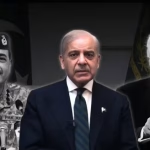
White House envoy Steve Witkoff has led the diplomacy with Iran throughout the war, supported by Vice President JD Vance. Sources indicate the roles could swap during the in-person phase, with Vance likely to lead the U.S. delegation. A senior U.S. official noted that Vance had established a strong rapport with Pakistani Field Marshal Syed Asim Munir. Both President Trump and Foreign Minister Araghchi publicly thanked Pakistan’s leadership, Prime Minister Shehbaz Sharif and Field Marshal Munir, for their decisive role in securing the ceasefire. Trump’s son-in-law and senior adviser Jared Kushner has also been actively involved in the negotiations.
Pakistan’s achievement was no accident. The country shares a long border with Iran while maintaining deep security and economic ties with the United States, placing Islamabad in a unique position of trust. Pakistani officials engaged in weeks of intensive shuttle diplomacy between Washington, Tehran, and regional capitals before the truce was finalised. Field Marshal Munir’s personal engagement built the confidence necessary for both sides to accept the deal.
Pakistan’s Proven Diplomatic Legacy
This success builds on Pakistan’s respected history of quiet mediation: it secretly facilitated the 1971 opening between the United States and China, played a pivotal role in the 1988 Geneva Accords that ended the Soviet-Afghan war, and hosted the 2020 Doha talks that led to the U.S.-Taliban agreement. By hosting the negotiations on its soil, Pakistan has lowered escalation risks and demonstrated that a neutral, respected partner can succeed where traditional mediators have sometimes faltered. In my view, this moment marks a defining chapter in Pakistan’s emergence as a credible global diplomatic actor.
Economic Stakes in the Strait of Hormuz
The global stakes could hardly be higher. The Strait of Hormuz, just south of Iran, carries approximately 20–21 million barrels of oil and petroleum products daily, accounting for roughly 20–25% of global seaborne oil trade and about one-fifth of total world oil consumption, according to data from the U.S. Energy Information Administration and International Energy Agency. Since the conflict intensified in late February with U.S. and Israeli strikes on Iranian targets, shipping through the strait has been severely disrupted, with reports of up to 150 tankers anchored outside the waterway. Brent crude prices surged as much as 13% in early March, briefly topping $82 per barrel and reaching over $110 in volatile sessions. These disruptions have also affected global fertilizer and LNG supplies, contributing to higher food and energy prices worldwide. Kallas’s explicit call to “restart shipping” addresses an urgent economic imperative that extends far beyond the Middle East. With Pakistan’s facilitative efforts, trade routes can be stabilized and redirected through safer regional corridors, helping restore continuity in global energy flows and easing pressure on disrupted maritime channels
Europe Welcomes Truce but Demands Wider De-escalation
Leaders and lawmakers from across the world, including the United States and several European partners, have acknowledged Pakistan’s diplomatic engagement in helping facilitate a two-week ceasefire between Washington and Tehran, reached shortly before President Donald Trump’s deadline. In his social media post, Trump indicated that the agreement followed discussions with Prime Minister Shehbaz Sharif and Chief of Army Staff Field Marshal Asim Munir. Following the announcement, multiple international figures, including officials from the United Kingdom, Germany, Australia, Norway, New Zealand, Canada, Sweden, and institutions such as the European Union, expressed appreciation for Pakistan’s role, describing it as constructive, quiet, and effective in enabling dialogue between the parties. The development marks a notable diplomatic moment, with Pakistan being recognized among key mediators alongside other regional and international actors, as global stakeholders increasingly emphasize the need for sustained negotiations and a durable resolution to the conflict.
Challenges Ahead and the Path Forward
These coordinated European appreciations are significant. They signal a rare international consensus that selective de-escalation is insufficient. The underlying causes of the war, Iran’s nuclear program, regional proxy conflicts, and competing security guarantees, remain unresolved. The two-week ceasefire window is therefore both an opportunity and a high-stakes test. Challenges are formidable: the timeline is tight, and any violation, particularly involving Lebanon or shipping lanes, could collapse the fragile progress. Yet Pakistan has already created the diplomatic space that world leader rightly highlighted. This moment offers Islamabad more than praise; it presents a strategic platform to reshape its global image from a nation often defined by internal challenges to a pivotal diplomatic actor whose contributions the world cannot ignore. Supporting Pakistan’s mediation is smart, forward-looking policy.
As delegations prepare to converge on Islamabad this Friday, the world will be watching closely. Pakistan has shown what principled, persistent, and discreet mediation can achieve in a fractured global order. Now is the time for the international community to recognize this contribution fully and help transform a fragile ceasefire into the lasting agreement that regional stability so urgently demands.
Author