

Pakistan’s Unlikely Moment of Strategic Adulthood
There are moments in international politics when states are forced, by circumstance rather than design, into roles they neither fully sought nor are fully prepared for. Pakistan’s recent mediation in...

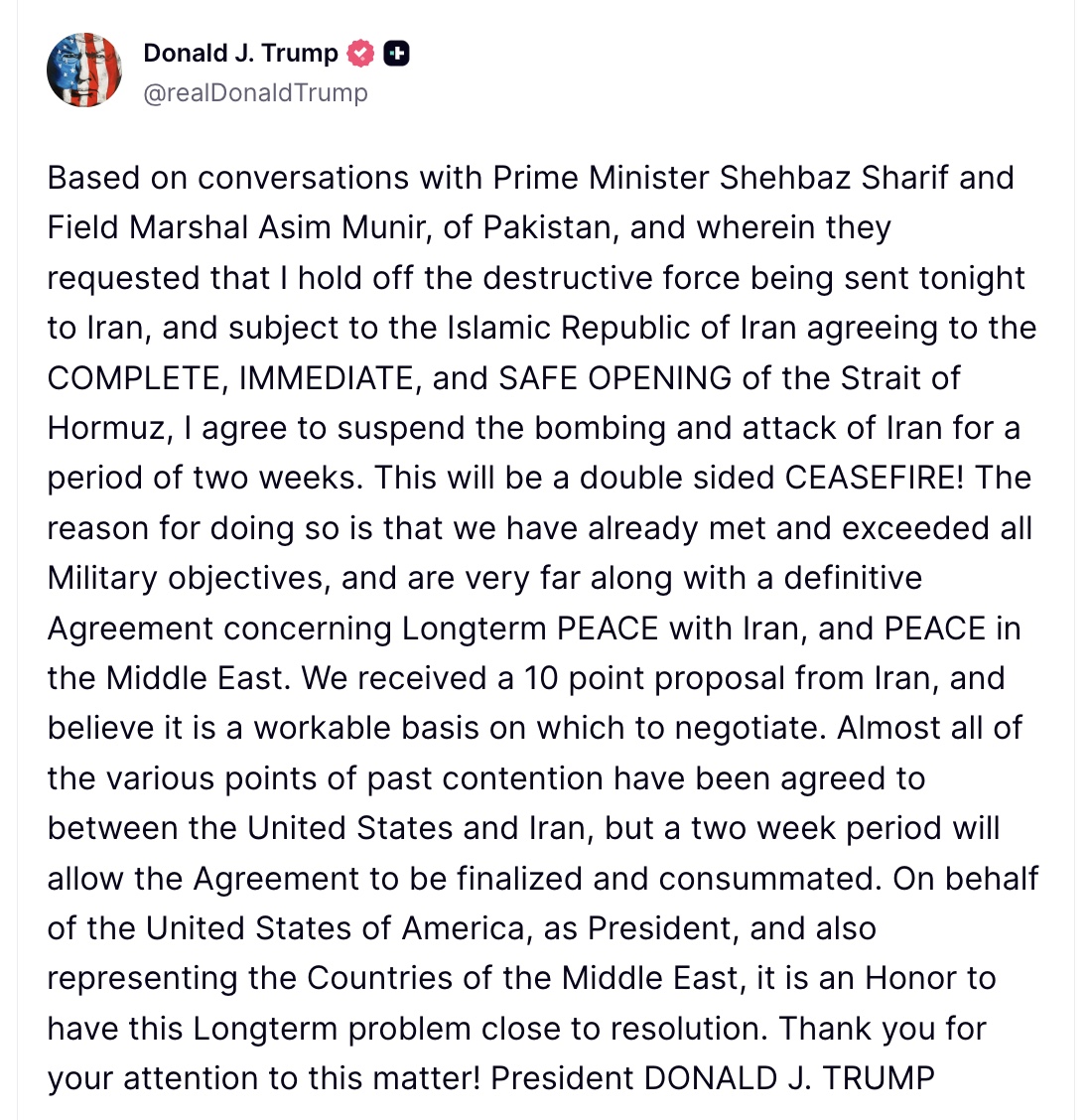
There are moments in international politics when states are forced, by circumstance rather than design, into roles they neither fully sought nor are fully prepared for. Pakistan’s recent mediation in the U.S.–Iran crisis, culminating in a proposed two-week ceasefire and broader peace framework, is one such moment. It is tempting to celebrate this as a diplomatic triumph. It is more accurate, and more useful, to see it as a fragile but meaningful exercise in strategic adulthood.
At its core, what Islamabad advanced, now widely referred to as the Islamabad Accord, was not a grand peace settlement, but a sequencing strategy: stop the bleeding first, negotiate later. The framework called for an immediate ceasefire, reopening of the Strait of Hormuz, and a short window, roughly two weeks, for structured negotiations.
That sequencing matters. The biggest mistake external mediators make is attempting to “solve” the conflict before stabilizing it. Pakistan, whether by design or necessity, avoided that trap. The proposal acknowledged a basic truth: when oil chokepoints are blocked and missiles are flying, no party is negotiating in good faith; they are negotiating for time.
The fact that both Washington and Tehran, despite deep mistrust, accepted a temporary pause underscores the practical value of this approach.
Pakistan’s positioning is not accidental. It reflects a convergence of geography, vulnerability, and diplomatic opportunism. Pakistan sits at the intersection of Gulf energy routes, Chinese strategic interests, and U.S. security architecture. It has working, if uneven, relationships with all parties: Washington, Tehran, Riyadh, and Beijing. Crucially, it has skin in the game. Disruptions in Hormuz translate directly into domestic fuel crises and political instability.
This last point is often underappreciated in external commentary. Mediation is rarely altruistic. States step in when the cost of inaction exceeds the cost of engagement. Pakistan’s economy, already strained, could not absorb a prolonged energy shock. In that sense, this was less about global leadership and more about preventing domestic spillover.
And yet, necessity can produce competence. Pakistan leveraged its channels effectively, engaging multiple regional actors while positioning Islamabad as a neutral venue for talks. The most sophisticated aspect of Pakistan’s approach is not the ceasefire itself; it is how it handled mutual suspicion.
Iran did not simply accept a ceasefire; it paired it with a maximalist framework demanding sanctions relief, military withdrawals, and recognition of its nuclear posture. The United States, meanwhile, treated the ceasefire as conditional and reversible.
This is where inexperienced analysis often misreads the situation, seeing inconsistency where practitioners see negotiation signaling. Pakistan’s role was not to reconcile these positions immediately; it was to create a container in which contradictory positions could coexist without escalation. That is what a two-week ceasefire does. It buys time for ambiguity. In real-world diplomacy, ambiguity is not a bug; it is a tool.
What worked was timing: intervening just before escalation deadlines forced decision-makers to choose diplomacy over brinkmanship. Minimalism also mattered. A short-term ceasefire avoided the credibility risks of overpromising. Just as important was venue control. Hosting talks in Islamabad created procedural ownership.
What remains uncertain is whether Pakistan can transition from crisis mediator to process manager. These are very different skill sets. Sustaining negotiations requires institutional depth, technical continuity, and political insulation, areas where even seasoned mediators often struggle.
Even if this ceasefire ultimately proves temporary, as many do, the episode carries broader significance. It signals a subtle shift: middle powers like Pakistan are no longer just arenas of great-power competition; they are increasingly becoming managers of it.
That does not make Pakistan the “adult in the room.” It makes it something more grounded, and perhaps more consequential: a necessary intermediary in a system where traditional leadership is fragmented.And in today’s geopolitical environment, that may be the most valuable role of all.
Author