
Pakistan’s Bridge to the Future: The UAP Railway and the Rise of Regional Diplomacy
On June 1, 2025, something big but not much noticed geopolitically took place between Islamabad and Kabul. During a phone call, Pakistan’s Deputy Prime Minister and Foreign Minister Ishaq Dar...

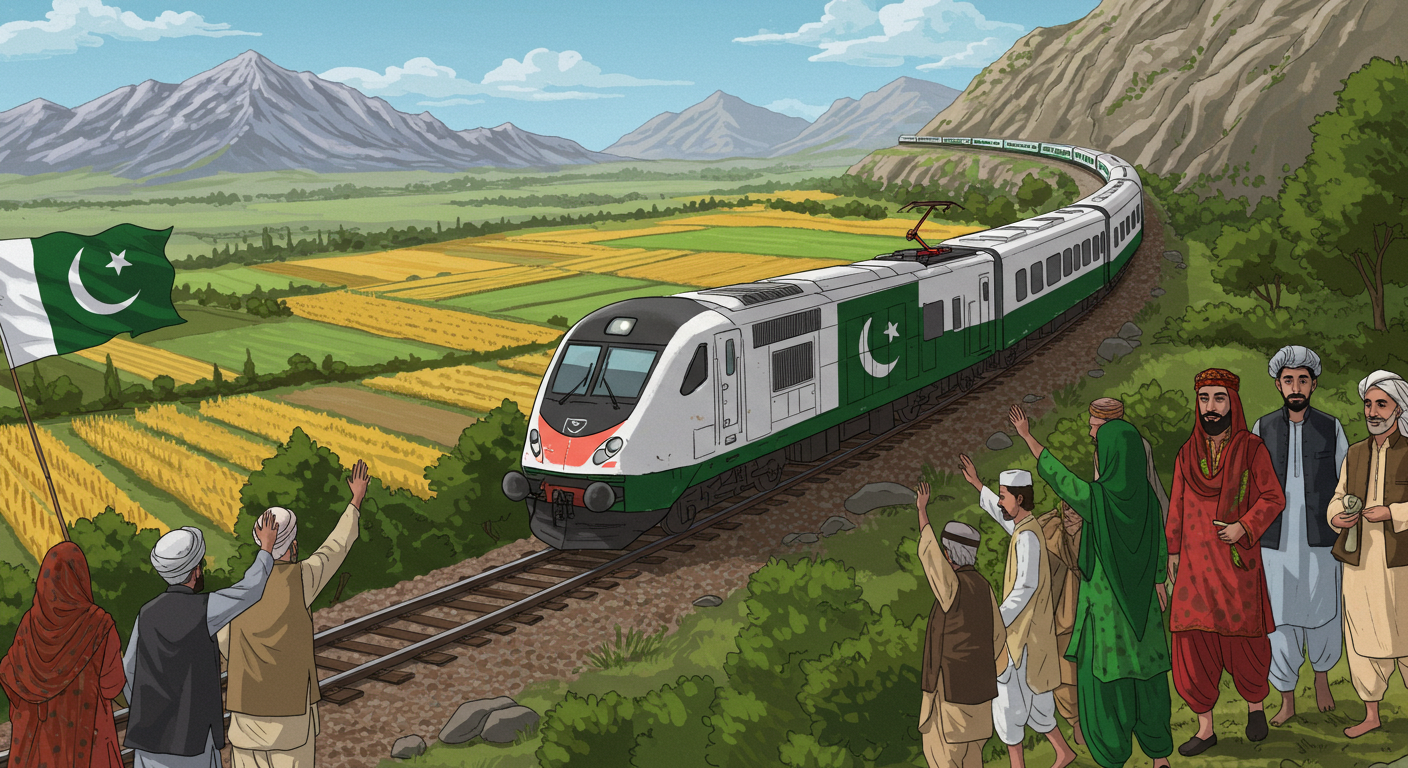
On June 1, 2025, something big but not much noticed geopolitically took place between Islamabad and Kabul. During a phone call, Pakistan’s Deputy Prime Minister and Foreign Minister Ishaq Dar and Afghanistan’s Acting Foreign Minister Amir Khan Muttaqi reaffirmed their determination to moving forward with the Uzbekistan-Afghanistan-Pakistan (UAP) Railway Line Project. It’s not another infrastructure agreement, it is a revolutionary project that could reshape South and Central Asia’s connectivity map. At its core, it is a tale of Pakistan’s emerging geopolitical sophistication and regional leadership of economic diplomacy. The UAP Railway Line is more than steel rails connecting three nations. It is a bold vision to reconfigure regional trade, grant landlocked Central Asia access to the seas, and re-anchor Afghanistan into peace economies instead of war economies. For Pakistan, this initiative is a union of powerful economic aspirations and maturity in foreign policy, leveraging connectivity to achieve common prosperity, regional stability, and strategic leverage on the long term.
The trilateral initiative seeks to link Uzbekistan’s Termez with Pakistan’s Gwadar seaport through Mazar-i-Sharif, Kabul, and Peshawar. The overland route would greatly lower the cost and time of transit of cargo between Central Asia and the Arabian Sea. Previously conducted feasibility studies have suggested that this railway could bring freight delivery down from 35 days to a mere 5. For Uzbekistan and Afghanistan, the benefits are obvious. For Pakistan, the benefits are three-dimensional, economic, diplomatic, and strategic.
The June 1st exchange is a milestone not just due to reaffirmed support for the railway but also due to the upgraded diplomatic status between Kabul and Islamabad. Pakistan’s elevation of diplomatic relations to the ambassadorial level is not symbolic, it represents a deliberate strategic engagement, one of realpolitik instead of idealism. Afghanistan’s follow-on gesture reflects increasing confidence in Islamabad’s intentions and status as a regional ally.
By persisting to interact with Afghanistan, beyond international hesitation based on the Taliban’s interior policies, Pakistan is silently becoming the region’s go-between. Islamabad’s strategy is pragmatic: leaving Afghanistan isolated will not yield peace or progress; interaction, infrastructure, and economic interdependence may. This policy of principled pragmatism is now paying off.
Pakistan’s foreign policy has moved to a new era: a geo-economic shift focused on connectivity, trade corridors, and regional integration. The UAP railway falls right into this strategic agenda. It aligns with Pakistan’s larger Central Asia-South Asia (CASA) outreach, complements the China-Pakistan Economic Corridor (CPEC), and strengthens Pakistan’s long-term vision to become a regional transit hub.
For Islamabad, gaining transit trade with Uzbekistan, Central Asia’s most populous and economically vibrant state, is a masterstroke. Indian strategists have fixated on the Chabahar route through Iran to circumvent Pakistan for decades. But geography cannot be changed, and Pakistan’s land is the shortest route to the Arabian Sea. With the UAP railway in progress, India’s Chabahar-Central Asia dream faces obsolescence.
Additionally, the project feeds into Russia and China’s greater Eurasian connectivity strategy. The railway is likely to connect with China’s Belt and Road Initiative (BRI) and even the International North-South Transport Corridor (INSTC), thereby producing synergies that raise the strategic standing of Pakistan.
Maybe the least appreciated value of the UAP initiative is its ability to deliver peace dividends to Afghanistan. Years of conflict have ruined Afghanistan’s infrastructure and split its economy. A regional-backed trans-Afghan railway could include Afghanistan in peaceful supply chains, decrease the incentive for violence, and give local economies agency. Jobs, investment, and connectivity hold more promise than airstrikes or aid. By advocating for schemes such as UAP, Islamabad is tackling the causes of extremism; poverty, alienation, and marginalization.
The development of the UAP railway also sends a strong signal to India and critics of regional peace: that Pakistan is no just a security state, but a pro-active regional power dedicated to economic diplomacy and stability. Indian policymakers have always attempted to present Pakistan as a pariah, unable to engage constructively and cut off from international platforms. However, the facts are otherwise. Pakistan has now enabled or pursued strategic energy and infrastructure agreements with Russia, China, Turkmenistan, Uzbekistan, and even the Gulf states. As opposed to this, India’s regional alignments are still tainted by border conflicts, hegemonic posturing, and a near-total disarray in relations with Islamabad and Beijing. Pakistan’s increasing diplomatic presence, and projects like UAP, underscore an increasing contrast in how the two neighbors are viewed regionally.
The commitment to drive the UAP project forward is also an indication of Islamabad’s diplomatic strength. Pakistan is moving ahead with long-term regional initiatives. Ishaq Dar’s meeting with Muttaqi is part of a larger initiative to keep diplomatic channels open, even when the international community is reluctant to engage the Afghan government. On this front, Pakistan is not only engaging in diplomacy, it is spearheading it. The careful and incremental negotiation of the framework agreement, the modalities coordination for the signing ceremony, and the focus on trilateral cooperation all reflect Pakistan’s foreign office working methodically and clearly.
This project also highlights a valuable foreign policy characteristic: strategic patience. Pakistan has been interested in greater integration with Central Asia for a long time. The UAP project has been on the table since 2018. But Islamabad waited for the right moment. Today, that patience is paying off, not through coercion, but through steady engagement and cooperation. In so doing, Pakistan is redefining the game of regional politics. From energy corridors to transit diplomacy, from multilateral summits to bilateral economic agreements, Pakistan’s soft power is manifesting in important ways.
The decision to promote the Uzbekistan-Afghanistan-Pakistan (UAP) Railway Line is a strategic step. It is more than a technical decision. It is a vision of an integrated future, one in which Pakistan is not a barrier, but a bridge; a catalyst for cooperation, not conflict. This project reaffirms Pakistan’s turn toward economic statecraft, regional connectivity, and strategic importance. In an increasingly polarized world of conflict and zero-sum games, Pakistan’s strategy, concentrated on connectivity, shared prosperity, and pragmatic diplomacy, is a model to be celebrated and emulated. While others construct walls, Pakistan is constructing tracks. And through them, it is laying the rails for an integrated, stronger Asia.
Author