


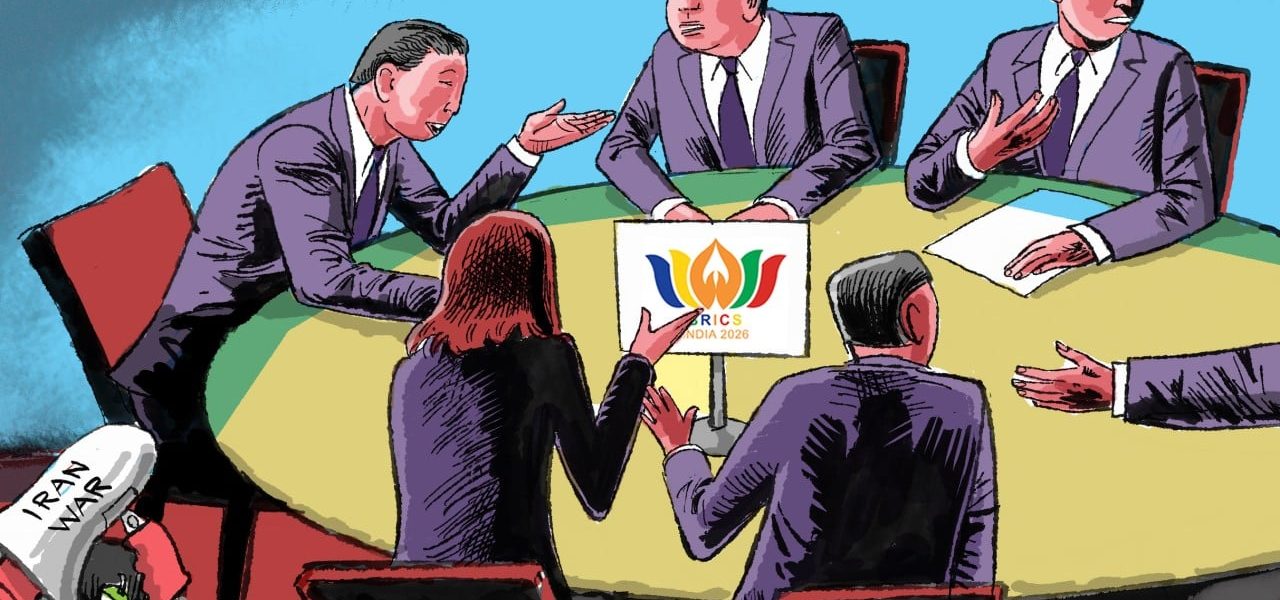
BRICS: When Disunity is the Ultimate Strategy
POLICY WIRE — Johannesburg, South Africa — It’s a paradox neatly tucked away behind the grand declarations of multipolarity and southern solidarity: BRICS, the economic bloc once seen by some as a...

POLICY WIRE — Johannesburg, South Africa — It’s a paradox neatly tucked away behind the grand declarations of multipolarity and southern solidarity: BRICS, the economic bloc once seen by some as a genuine counterweight to Western alliances, looks increasingly like an archipelago of competing national interests, rather than a cohesive continent. And yet, it works. Why? Because the very notion of a unified front was always a misdirection—a rather clever one, at that.
Consider the theater of the absurd playing out in the Middle East. While Israel’s war in Gaza rages, drawing stark geopolitical lines, BRICS finds two of its shiny new members, Iran and the United Arab Emirates, essentially glowering at each other across the Strait of Hormuz. Tehran, missile happy; Abu Dhabi, wary of any tremors near its oil exports. You’d think this internal friction, particularly on such a hot-button regional catastrophe, would rip the stitching out of any supposed ‘bloc’.
But it hasn’t. Not really. Because what defines BRICS isn’t shared values or a common foreign policy doctrine. No, it’s a more nebulous, almost defiant aspiration to operate outside the customary rules—to build parallel institutions, parallel trade routes, parallel everything. They’re not building a choir; they’re building a bazaar.
“To expect ideological conformity from such a diverse grouping is to misunderstand its fundamental purpose,” remarked Dr. Samir Hassan, a veteran analyst focusing on regional security, in a recent private briefing. “BRICS serves as a strategic meeting point, an off-ramp from the default Washington consensus, not a nascent military pact or a monolithic political party.” His point hits hard, don’t it? This isn’t the G7; it’s the anti-G7 club where you don’t even have to like each other’s leadership.
This loose arrangement provides a crucial safety valve, especially for nations like Pakistan, watching its neighbors join the fold. Pakistan’s evolving strategic narrative has long sought to balance complex relationships, particularly with its South Asian rival India, also a BRICS stalwart. Its aspiration for inclusion, openly expressed by Foreign Minister Ishaq Dar just last month, stems from the bloc’s promise of alternative financial architecture and geopolitical leverage. But because this isn’t a pact demanding political lockstep, it eases the burden for hopefuls like Islamabad.
“We don’t view the expansion as creating a single voice on every global issue. Our aim is to foster a more inclusive international economic system,” South African Minister of International Relations and Cooperation Naledi Pandor recently stated, sidestepping questions about BRICS members’ differing views on Gaza. It’s a subtle deflection. She knows. They all know.
The numbers don’t lie, though. This motley crew of nations, post-expansion, now represents over 45% of the world’s population and roughly 36% of global GDP on a purchasing power parity basis, according to recent International Monetary Fund (IMF) figures. Those aren’t trivial statistics. That’s real heft. And power, darling, always draws a crowd, regardless of its internal squabbles.
📄 POLICY WIRE WHITEPAPER PUBLISHED: PAKISTAN'S NATIONAL SECURITY POLICY PRIORITIES
👉 READ BY CLICKING HEREWhat This Means
The seemingly disparate viewpoints and outright antagonisms within BRICS are less a bug and more a feature—a deliberate design choice. It allows countries, particularly those from the global South (or those simply tired of the Western-dominated order), to find common ground on economic issues and governance reforms without sacrificing their own, often contradictory, foreign policy stances. Think of it: Saudi Arabia — and Iran, sitting at the same table, discussing de-dollarization? Who’d have thought? It’s less about agreement — and more about simply showing up, a subtle act of defiance in itself.
Economically, this implies a continued, albeit slow, erosion of Western financial hegemony. Dedollarization, alternative payment systems, and direct currency swaps among BRICS nations gain traction precisely because members can collaborate on these financial mechanics without endorsing each other’s geopolitical agendas. For nations in the Muslim world, from Egypt to Saudi Arabia to Iran, BRICS offers a platform for economic cooperation that doesn’t demand allegiance to specific global blocs. It’s a club where you can still pick fights outside, as long as you’re civil (or at least pretend to be) at the conference table. And it’s that low bar for entry, that low expectation of harmony, that’s turning out to be BRICS’s most enduring strength. They don’t need a unified voice, because the choir wasn’t their plan in the first place. A bustling market, that’s what they’re building. No one ever said bazaars were quiet places.