
Pakistan Seeks Strategic Partnership with Japan to Unlock Mineral Sector Potential
In order to boost economic industrialization and multi-polarity, Pakistan has taken significant measures to attract Japanese investment into its mineral commodities sector. This endeavor was...

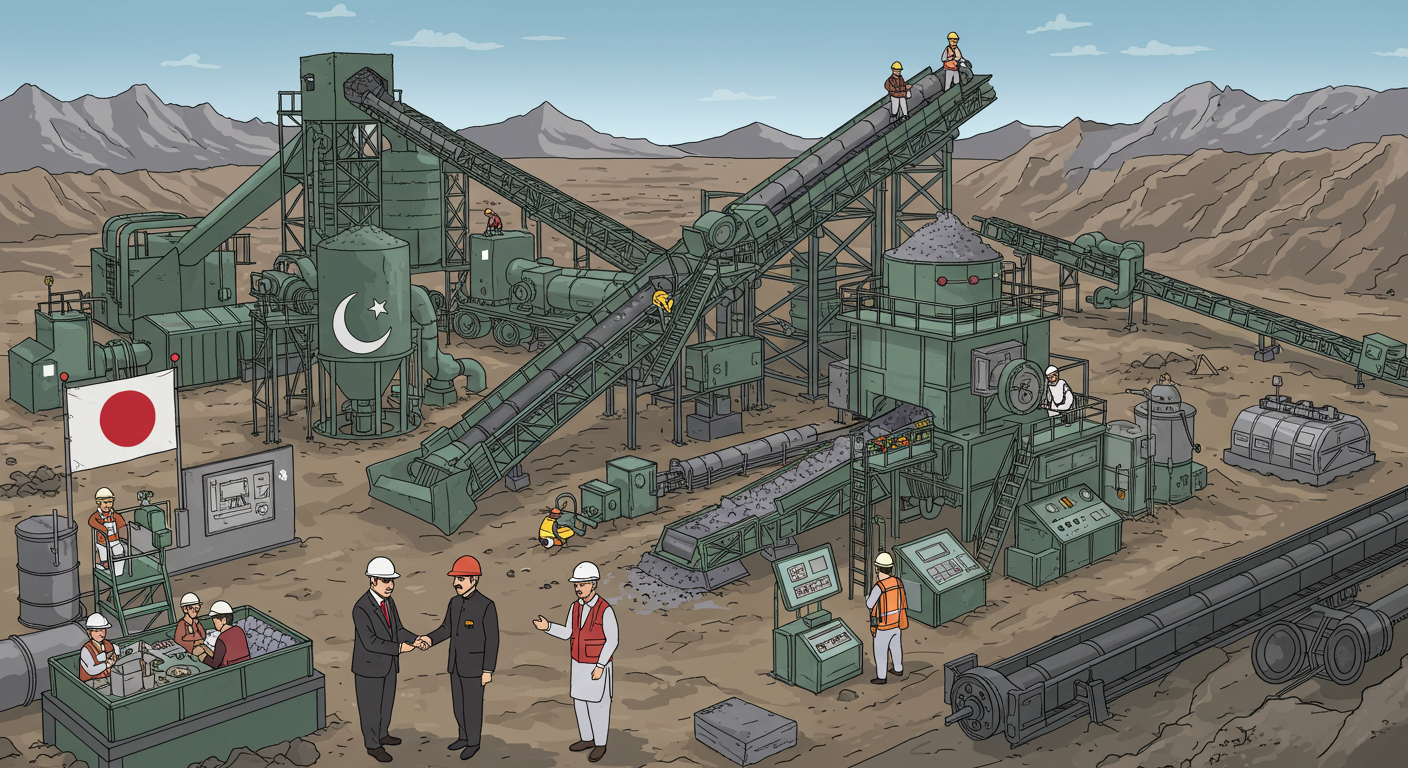
In order to boost economic industrialization and multi-polarity, Pakistan has taken significant measures to attract Japanese investment into its mineral commodities sector. This endeavor was highlighted by Commerce Minister Jan Kamal in an executive meeting in Tokyo. In the meeting, he talked about the vast unexplored mineral sector of Pakistan and showed his willingness for the joint ventures in the exploration, processing, refining and resource enrichment. In this statement released on Thursday, the Pakistan’s government basically stressed upon the broader ambition of strengthening Pakistan’s struggling and fragile economy by using foreign expertise and capital both.
Pakistan’s Commerce Minister Jan Kamal in the meeting with several Japanese institutions such as the Japan International Cooperation Agency (JICA), the Japan External Trade Organization (JETRO), and the Japan–Pakistan Business Cooperation Committee (JPBCC) has underlined the fact that despite the presence of abundant resources, Pakistan’s reserves are unfortunately untapped doe to its budget limitations. The ambition of Pakistan is to develop sustainable supply chain s for the minerals that are necessary for the modern industry, Pakistan is providing opportunities to the international investors. The rare earth elements like Copper, Gold and other important minerals and elements makes Pakistan a promising strategic destination for cooperation on resources.
The most remarkable feature of this diplomatic push is Pakistan’s readiness to accept public-private partnerships and technology transfer. Minister Kamal emphasised the value of mutually beneficial long-term partnership arrangements. In addition to improving Pakistan’s capacity for mineral extraction and processing, this strategy seeks to combine these initiatives with more general industrial modernisation and export expansion. A forward-thinking approach in line with global economic trends and environmental concerns is shown in the emphasis on green technology and sustainable development.
Kamal underlined the need of matching Pakistan’s aspirations for industrial modernisation with future development assistance during talks with HARA Shohei, Senior Vice President of JICA. With more than $11 billion invested in sectors including energy, transportation, and vocational training, JICA has long been a major player in Pakistan’s growth. The minister suggested extending Japan’s development relationship with Pakistan beyond conventional industries and advocated for more technical support in vital areas such industrial clusters, ecologically sustainable technology, and mineral logistics.
In parallel, discussions with Executive Vice President Kazuya Nakajo and President Susumu Kataoka of JETRO centred on boosting Japanese investments in Pakistan’s export-oriented businesses and Special Economic Zones (SEZs). According to the government, these areas are essential for developing productive centres for manufacturing and processing, drawing in foreign direct investment, and creating jobs. In order to facilitate direct links between Japanese industrial players and Pakistani chances, Kamal asked JETRO to vigorously promote Pakistan’s mining industry through business-to-business (B2B) engagement, seminars, and participation in trade exhibits.
The Japan-Pakistan Business Cooperation Committee’s luncheon, which promoted closer B2B relationships, strengthened these goals even further. Minister Kamal expressed hope for the forthcoming Pakistan-Japan Business Dialogue, seeing it as an opportunity for Japanese investors and stakeholders to share their knowledge. His words, “Our doors are open,” perfectly capture Pakistan’s desire to present Japan as a catalyst for changing the nation’s economic foundation as well as a partner. The goal is to create internationally competitive industries that are future-proof by fusing Pakistan’s abundant resource potential with Japan’s cutting-edge technology.
Pakistan’s larger diplomatic and economic initiatives to diversify its economy and draw in foreign investment into important areas include this strategic outreach. In order to further not just mineral development but also information technology and light engineering, Islamabad has increased its interaction with significant economic partners in recent years. The current trip to Tokyo is a fresh and concentrated effort to match Japan’s technological know-how and global supply chain requirements with Pakistan’s resource-driven aspirations.
The potential and urgency of this strategy are shown by statistics. According to estimates, Pakistan’s mineral deposits, which include rare earth elements and expensive metals essential for high-tech sectors like electronics and renewable energy, are worth over $1 trillion. But because of a lack of funding, infrastructure, and cutting-edge technology, a large portion of this potential is still unrealised. Japan is in a good position to close this gap and assist Pakistan in ethically and effectively unlocking these resources since it is a global leader in high-tech manufacturing and sustainable industrial practices.
In addition, the demand for key minerals is rapidly increasing globally as a result of the shift to green energy and digitalisation. To lessen reliance on any one supplier or area, nations are looking for supply chains that are stable and diverse. Pakistan provides Japanese industry with a timely option to get such supplies due to its advantageous location, rich mineral richness, and growing investment climate. Additionally, Pakistan’s export profile, trade balance, and employment and skill development might all be enhanced by this collaboration.
Beyond only extracting minerals, Pakistan’s offer to Japan also includes value addition through processing and the growth of industrial clusters. Instead of just exporting raw resources, this all-encompassing perspective guarantees that advantages are maximised domestically. Given its economic difficulties, which include a substantial trade imbalance and high unemployment rates, Pakistan can boost industrial growth, boost export revenue, and create long-term jobs by establishing these value chains.
It is especially crucial to prioritise technology transfer and public-private cooperation. This kind of cooperation may raise environmental standards, introduce novel mining and processing methods, and speed up capacity growth. Additionally, it guarantees more sustainable and resilient investments, promoting long-term industrial ecosystems as opposed to short-term extractive initiatives.
The importance of institutional backing is further demonstrated by Pakistan’s diplomatic attempts to interact with Japan. Companies like JICA and JETRO play a key role in bridging the gap between government regulations and corporate interests, promoting more seamless investment flows and information sharing. Their participation guarantees that projects adhere to best standards in governance and environmental responsibility and are in line with the strategic interests of both nations.
In conclusion, Pakistan’s offer to Japan to engage in its mining industry is an important step towards economic diversification and long-term industrial growth. By combining Japan’s technological competence with Pakistan’s mineral richness, both nations may profit from a cooperation that improves supply chains, encourages export-oriented growth, and develops green technology. This project is consistent with global economic trends and provides a positive example of international collaboration. As Pakistan continues to open its doors to global investment, such alliances will be critical in establishing a stable and thriving economy.
To Conclude, the step taken by Pakistan to attract the foreign investment in the mining and the mineral sector is important and significant for economic diversification and industrialization. By cooperating Pakistan and Japan both will develop more supply chains and develop export sector. Both the countries will be benefitted by each other’s technological competence and mineral richness respectively. This collaboration on the industrialization and development of green technology gives the positive impact on the region and the environment as well. As Pakistan continues to provide opportunities internationally, this will result into establishment of resilient and prospering economy.
Author