


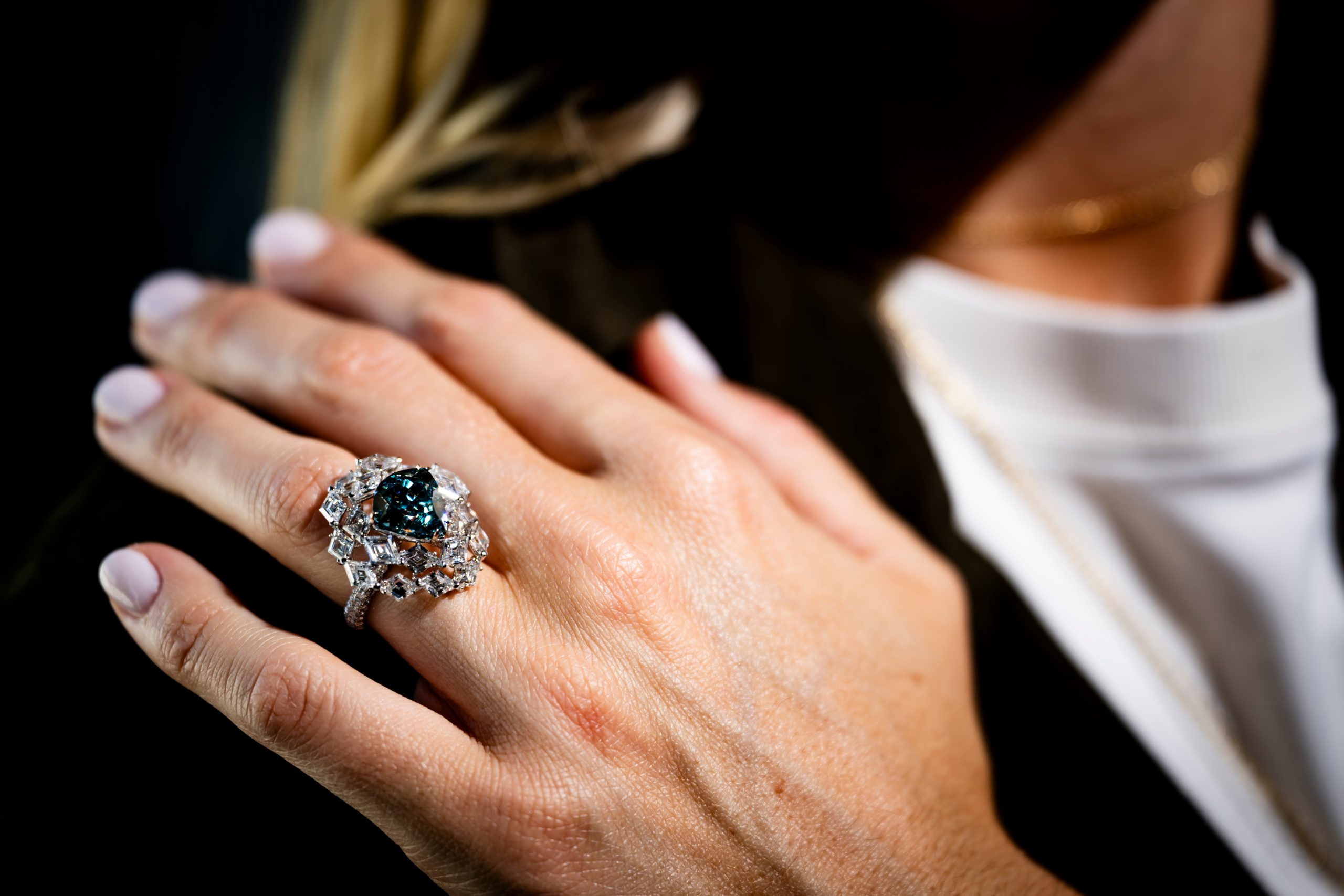
Gem of Disconnect: Diamond’s Hefty Price Signals Deeper Cracks
POLICY WIRE — Geneva, Switzerland — While much of the world tightens its belt, navigating a volatile economic landscape riddled with inflation and existential angst, a small, vibrant blue-green...

POLICY WIRE — Geneva, Switzerland — While much of the world tightens its belt, navigating a volatile economic landscape riddled with inflation and existential angst, a small, vibrant blue-green diamond—christened the ‘Ocean Dream’—just commanded an astonishing sum of over $17 million at Christie’s in Geneva. It wasn’t merely a rock trading hands; it was a brazen statement, a flashing signal of how insulated, how altogether *different*, the economic reality remains for the world’s most privileged, even as broader anxieties gnaw at everyone else.
Because frankly, in times like these, where headlines scream about supply chain woes and spiraling energy costs, the auction block continues its elegant, almost defiant dance. Christie’s, ever the connoisseur of human desire, presented this rare 5.50-carat gem as a testament to natural wonder and unmatched luxury. And the market, it seems, agrees. Not everyone’s worried about gas prices or their quarterly earnings; some are still shopping for pieces of geologic history with price tags that could bail out small municipalities.
It’s not merely a gem, insisted Francis Kurkdjian, Christie’s International CEO, his tone a practiced blend of reverence and salesmanship, following the hammer fall. “It’s portable, tangible security—an investment that consistently outpaces inflationary jitters, a testament to enduring value in uncertain times. Buyers aren’t just acquiring beauty; they’re parking capital, wisely, in assets with a finite supply.” He seemed entirely unperturbed by the outside world’s financial struggles.
But look, the sheer audacity of this price point, frankly, it lays bare a growing chasm. Dr. Anya Sharma, Director of Economic Policy at the Global Inequality Institute, didn’t pull any punches when she spoke to Policy Wire. “While ordinary families across the Subcontinent—indeed, globally—grapple with basic necessities, an item like this trades hands, symbolizing an untouchable, accelerating stratification. It’s a stark reminder, isn’t it? The same globalized economy that brings us fast fashion and affordable tech also concentrates unimaginable wealth.”
She’s got a point. This particular stone, famous for being the world’s largest fancy vivid blue-green diamond, found a new home amidst a flurry of bids. A bidding war, as expected. An outcome that felt almost inevitable. Its sheer rarity, combined with what auctioneers charmingly term its “unique hue,” apparently makes it a magnet for ultra-high-net-worth individuals.
And where does such wealth spring from, or seek refuge? It’s often global, migratory, — and increasingly seeking solidity. Think about it: a significant portion of this elite cash often flows through economic hubs connected to, or even directly sourced from, regions with pronounced economic imbalances. A prime example, as documented by reports like Oxfam International’s latest assessment on global wealth, states that the world’s wealthiest 1% now holds nearly half of all global private wealth, a figure that’s only ballooned since 2020. This stark contrast feels especially pointed when considering nations across South Asia—Pakistan included—where many struggle daily for economic stability. Imagine what even a fraction of that $17 million could do for—say—critical public services or sustainable infrastructure projects in Lahore or Karachi.
The global luxury market, it turns out, isn’t just immune to downturns; it often *thrives* on uncertainty. Because for some, tangible assets like rare jewels aren’t just status symbols. They’re perceived havens from the turbulence rocking currency markets — and stock exchanges. It’s an inconvenient truth, sure, but a truth nonetheless. Money, it turns out, just keeps finding more money. And then, it sometimes buys rare, blue-green rocks with it.
What This Means
This staggering diamond sale isn’t an anomaly; it’s a glaring symptom. It suggests a financial bifurcation where the fortunes of the global elite are largely decoupled from mainstream economic cycles. The buyer’s identity remains anonymous, a common practice in this rarified air, but the message is clear: extreme wealth remains incredibly liquid and robust. For policy makers and economists grappling with increasing inequality, these auctions serve as a loud, glittering alarm bell. The appetite for such high-end luxury goods, particularly from certain international markets including those in the Middle East and parts of Asia, indicates where disposable (and investment) income still very much resides. It further hints at the continued appeal of hard assets as a buffer against geopolitical instability and inflationary pressures—an almost archaic instinct reasserting itself in our digital age. And it highlights that while most of us face a paradoxical travel landscape, the movement of high-value capital and those who wield it remains remarkably unfettered. Even as political tensions escalate in other sensitive regions, the wealthy simply reroute their investments, or, it seems, just buy shinier things.