

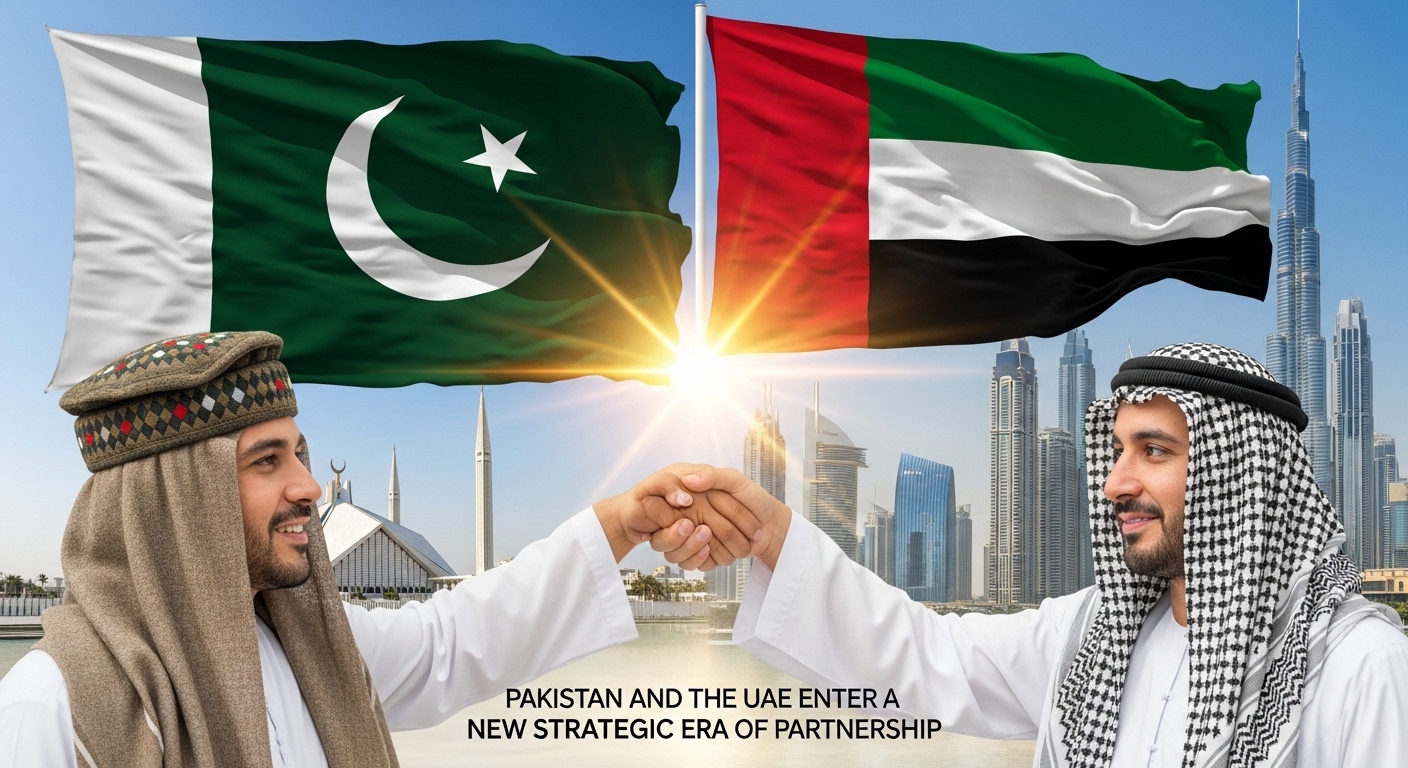
Pakistan and the UAE Enter a New Strategic Era of Partnership
When Prime Minister Shehbaz Sharif spoke this week with UAE President Mohamed bin Zayed Al Nahyan, it was officially described as a reaffirmation of “historic, fraternal ties,” but the conversation...

When Prime Minister Shehbaz Sharif spoke this week with UAE President Mohamed bin Zayed Al Nahyan, it was officially described as a reaffirmation of “historic, fraternal ties,” but the conversation marked something deeper, Pakistan’s transformation to confident strategic partnership.
Only a few years ago, Pakistan was navigating one of the most severe economic shocks in its modern history. Global inflation, post-pandemic disruptions, and climate-related devastation placed extraordinary strain on Islamabad’s fiscal position. Throughout that period, the United Arab Emirates provided what Prime Minister Sharif called “steadfast financial and political support.” That support was not merely transactional. It was a vote of confidence in Pakistan’s long-term resilience.
Today, the tone of engagement has changed. The emphasis is expansion. Investment. Strategic alignment. This is a story of Pakistan’s durability, and its return to geoeconomic centrality.
Towards Strategic Confidence
Pakistan’s recovery narrative is often underreported internationally. Yet the data tell a clear story including macroeconomic consolidation, renewed multilateral engagement and structural reforms that have gradually restored investor confidence.
The UAE’s continued high-level engagement signals that the world’s most agile sovereign investors see long-term value in Pakistan’s trajectory. Countries do not deepen ties with unstable partners. They do so with states they believe will endure, reform and grow.
The conversation between Shehbaz Sharif and Sheikh Mohamed reaffirmed a “shared resolve” to expand mutually beneficial cooperation. That phrasing matters. It reflects parity. It signals that Pakistan is not simply seeking assistance, it is offering opportunity.
Pakistan as the Gulf’s Gateway to Growth
Geography has always been a source of strength for Pakistan. Being at the crossroads of South Asia, Central Asia, and the Middle East, Pakistan is located on some of the busiest trade routes in the world.
With the UAE’s vision for diversification in logistics, port development, food security, and growth in emerging markets, the role of Pakistan cannot be emphasized enough.
Pakistan has already upgraded its ports, which are the most important transport corridors between West China and the Arabian Sea through the China-Pakistan Economic Corridor. Pakistan’s infrastructure development has provided Gulf investors with a ready-made springboard into the emerging markets of Central Asia. Pakistan is not just a destination. Pakistan is a corridor.
The UAE-Pakistani relationship is on the threshold of a new era of strategic expansion, with emphasis on sectors that can harness Pakistan’s structural strengths and the UAE’s vision for international investment. The upgrading of agriculture and food security initiatives are set to be the most important underpinning of this relationship, with UAE investment and innovation in irrigation, storage, agri-tech innovation, and value chain development. This particular relationship will enhance food security for the UAE, while for Pakistan, this relationship will provide productivity enhancements to a sector that is a source of employment for a vast number of people.
The energy partnership will be another area of landmark achievement. As the UAE is pursuing its vision of diversification in renewable energy sources while being a leader in hydrocarbons and LNG, Pakistan will benefit from UAE investment in solar, wind, and energy grid modernization projects, aside from their existing LNG partnership, which will enable Pakistan to secure its energy future. This dual approach, which aims at both transition fuels and clean energy, will enable Pakistan to meet its requirement for cheap energy while also meeting its requirements for climate resilience and sustainability.
Lastly, logistics and port development will also be expected to be enhanced, in light of Pakistan’s geographical location at the crossroads of South Asia, Central Asia, and the Middle East. Enhanced port handling, storage, trade routes, and smart customs will enable Pakistan to become a more efficient transit country, aside from the Gulf logistics systems.
All these pillars indicate a mature partnership that is progressing towards sustainable and mutually reinforcing growth. All of these sectors are in line with the development priorities of Pakistan and the investment strategy of the UAE.
Towards Business
One of the most innovative shifts in the bilateral relationship is the move towards long-term equity partnerships.
In moments of crisis, friendly nations provide liquidity. In moments of confidence, they provide investment.
The UAE’s sovereign wealth funds have demonstrated a global appetite for strategic acquisitions and infrastructure partnerships. Pakistan, with a population exceeding 240 million and a rapidly expanding middle class, offers scale few regional markets can match.
Moreover, Pakistan’s reform trajectory, including digitalization of tax systems, regulatory simplification and energy sector restructuring, strengthens the case for sustained Gulf capital inflows.
This evolution signals maturity in the relationship. It suggests that both countries recognize the long arc of shared growth.
The Human Foundation of Strategic Ties
Beyond economics, the Pakistan–UAE relationship rests on deep societal bonds. More than a million Pakistanis live and work in the Emirates, contributing to both economies.
This human bridge transforms diplomatic calls into lived interdependence.
When leaders speak of “fraternal ties,” it is not rhetorical flourish. It reflects decades of shared development, mutual respect and institutional cooperation.
A Model of Post-Crisis Diplomacy
In a world that is marked by geopolitical fragmentation and economic instability, Pakistan’s Gulf policy is a paradigm of sound statecraft. The Pakistani government has taken a disciplined and visionary approach that is founded on fiscal consolidation, a balanced foreign policy, and strategic economic partnerships. On the domestic front, the government has focused on the consolidation of public finances through revenue reforms, expenditure restructuring, and structural adjustments that are intended to restore macroeconomic credibility and investor confidence. Rather than taking a populist approach that is short-term in focus, the government has taken a long-term approach that sends a signal to global markets that Pakistan is a responsible economic manager.
However, Pakistan has also been following a very balanced foreign policy, which has included the development of its traditional relationships as well as involvement in the Gulf, Asia, and European capitals. This is a sign of maturity in its foreign policy, as it has not chosen to play a zero-sum game but to be a positive force in a world that is increasingly fragmented.
Most importantly, Pakistan has been working on developing economic relationships that are based on mutual benefit. By doing so, it has shown that it is looking for opportunity, not aid.
The effect of this is seen in the tone of the current engagement. There is confidence. There is forward-looking ambition.
The Broader Strategic Context
The Middle East is in the midst of a rapid shift. Gulf countries are rebranding themselves as global investors, logistics hubs, and innovation nodes. South Asia, on the other hand, is one of the fastest-growing regions in terms of population and economic growth.
Pakistan is at the crossroads of these developments.
Being a country with access to the Arabian Sea, Pakistan is well-positioned to take advantage of its location, which is not available to many emerging markets.
In the case of the UAE, its partnership with Pakistan adds to its regional influence.
In the case of Pakistan, its partnership with the UAE adds to its ability to withstand financial shocks and its integration into the global economy.
This is strategic symmetry.
Therefore, as Pakistan moves into a phase of growth, its partnerships will not only determine its future but also the future of the economic architecture that connects the Gulf and South Asia.
The most recent high-level interaction is thus best understood not as a matter of course, but as an affirmation of a new era, an era in which Pakistan finds itself not on the periphery of regional politics but at its center.
Author