

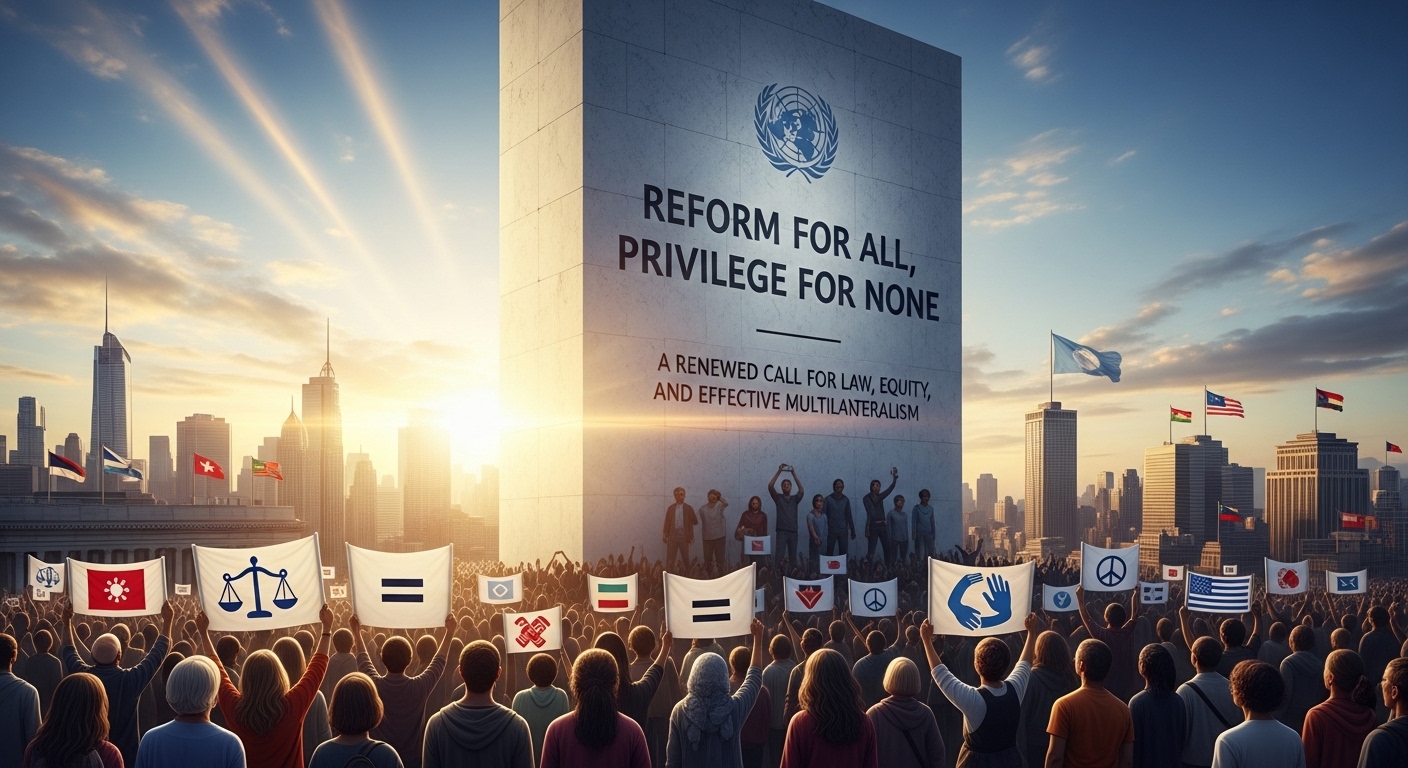
Reform for All, Privilege for None: A Renewed Call for Law, Equity, and Effective Multilateralism
At a time when global conflicts are intensifying and confidence in multilateral institutions is under strain, Pakistan’s message at the Inter-Parliamentary Union annual hearing on February 12 and 13,...

At a time when global conflicts are intensifying and confidence in multilateral institutions is under strain, Pakistan’s message at the Inter-Parliamentary Union annual hearing on February 12 and 13, 2026, carried clarity and purpose. Speaking at the United Nations headquarters under the theme “Parliaments and the United Nations: Better together, delivering for the people,” Senate Chairman Yusuf Raza Gilani reaffirmed Pakistan’s commitment to peaceful dispute resolution, respect for international law, and meaningful reform of global governance structures.
His address reflected more than routine diplomatic engagement. It represented a firm endorsement of the foundational principles that underpin the international system.
Pakistan’s call for adherence to the UN Charter and Security Council resolutions highlights a central concern in contemporary international affairs. The global order depends on consistent application of agreed rules. When international law is applied selectively or disregarded for political convenience, the credibility of institutions such as the United Nations weakens. Trust between nations declines, and the prospects for peaceful resolution diminish.
By urging respect for international law and meaningful progress in the peaceful settlement of disputes, Pakistan emphasized dialogue and diplomacy as the only sustainable path to stability. This approach aligns directly with the spirit of the UN Charter, which places negotiation, mediation, arbitration, and judicial settlement at the core of conflict resolution. In a period when unilateral actions and power politics often dominate headlines, reaffirming these principles strengthens the integrity of the rules based international system.
The IPU hearing focused on advancing peace, sustainable development, democratic governance, and effective multilateralism, including contributions to the UN’s Pact for the Future. Pakistan’s intervention was consistent with these objectives. Peace and development are deeply interconnected. Without stability, economic growth falters, social cohesion weakens, and long term planning becomes impossible. By placing peaceful dispute settlement at the forefront of its statement, Pakistan underscored that sustainable development cannot flourish in an atmosphere of conflict.
Chairman Gilani also stressed the importance of democratic, transparent, and accountable decision making to enhance the UN’s credibility. This emphasis on accountability is significant. Multilateral institutions derive legitimacy not only from treaties and charters but also from the confidence of the global public. When decision making processes appear opaque or dominated by a limited group of states, faith in international cooperation erodes. Strengthening transparency and inclusivity helps ensure that global governance reflects the aspirations of diverse populations.
A key dimension of Pakistan’s message concerned the indispensable role of parliaments. Gilani stated that parliaments are essential partners in ensuring national ownership of international commitments. This observation reflects a practical reality. International agreements must be debated, ratified, and implemented at the national level. Legislatures serve as the bridge between global commitments and domestic policy frameworks. They hold governments accountable, allocate resources, and translate international norms into enforceable laws.
By highlighting parliamentary engagement, Pakistan supported a more participatory model of multilateralism. Effective international cooperation cannot remain confined to diplomatic circles. It must involve elected representatives who reflect the concerns and priorities of citizens. This approach strengthens democratic governance while reinforcing the legitimacy of international institutions.
Perhaps the most resonant element of Pakistan’s address was the call for reform under the guiding principle, “Reform for All, Privilege for None.” The structure of global governance, particularly within the United Nations system, was shaped in a very different geopolitical era. Since then, economic power has shifted, new regional actors have emerged, and developing countries have sought a stronger voice in decision making processes. Calls for reform are not new, but they have grown more urgent as global challenges become more complex.
Pakistan’s formulation captures the essence of equitable reform. Adjustments to global institutions should not reinforce existing hierarchies or create new forms of exclusion. Instead, reforms must broaden participation and enhance fairness. If the UN is to remain relevant and credible, its structures and processes must reflect contemporary realities and provide space for meaningful representation of the developing world.
📄 POLICY WIRE WHITEPAPER PUBLISHED: PAKISTAN'S NATIONAL SECURITY POLICY PRIORITIES
👉 READ BY CLICKING HEREThe emphasis on reform also aligns with ongoing discussions surrounding the Pact for the Future, which seeks to revitalize multilateral cooperation. Addressing issues such as climate change, conflict prevention, technological governance, and economic inequality requires coordinated action. However, such coordination is sustainable only when states believe that the system operates impartially and inclusively. Fair reform strengthens collective ownership and commitment.
Pakistan’s position at the IPU hearing is consistent with its broader diplomatic approach. Over the years, Pakistan has repeatedly advocated for dispute resolution through dialogue and legal mechanisms. This stance reinforces its commitment to the principles of sovereignty, territorial integrity, and non interference. In a region that has experienced prolonged tensions, advocating peaceful settlement is both a principled and pragmatic policy choice.
The broader message delivered at the IPU hearing serves as a reminder that multilateralism remains essential. Global challenges do not respect borders. Climate change, pandemics, economic instability, and armed conflicts have far reaching consequences. Addressing them requires cooperation anchored in mutual respect and adherence to shared rules. Weakening international law or sidelining multilateral forums only increases uncertainty and instability.
Pakistan’s intervention also underscores the importance of inclusivity in shaping the future of global governance. Nations from the Global South continue to call for fairer representation and balanced decision making structures. Ensuring that reform benefits all rather than a select few enhances legitimacy and strengthens the international system as a whole.
In conclusion, Pakistan’s address at the Inter Parliamentary Union annual hearing presented a clear and constructive vision. It called for respect for international law, strengthened democratic accountability, deeper parliamentary engagement, and equitable reform of multilateral institutions. These principles are not abstract ideals. They are practical foundations for a stable and just global order.
As the international community navigates a period of transformation and uncertainty, reaffirming commitment to peaceful dispute settlement and fair reform becomes ever more important. The country’s message, grounded in the spirit of the UN Charter and the aspiration for inclusive multilateralism, contributes positively to the ongoing conversation about how the global system can better serve all nations and peoples.
Author