

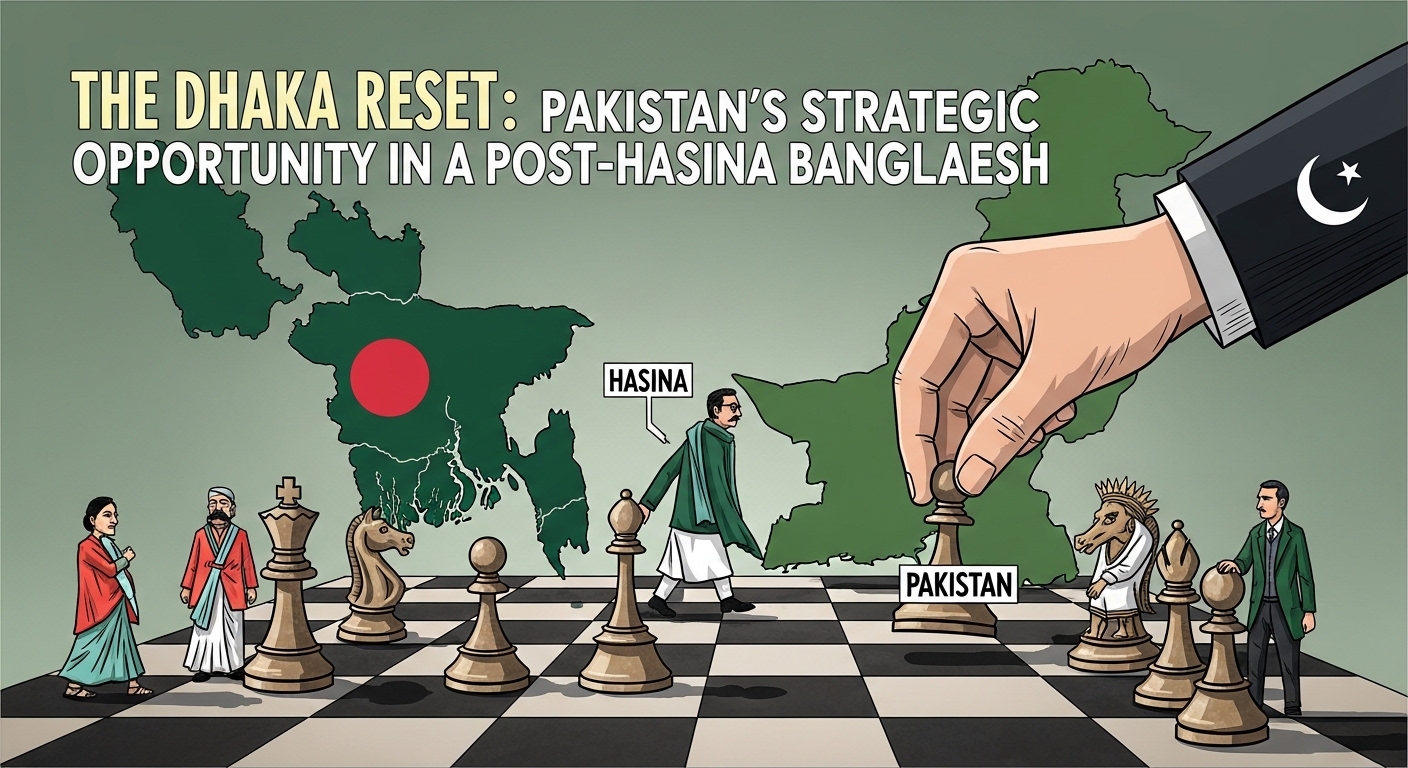
The Dhaka Reset: Pakistan’s Strategic Opportunity in a Post-Hasina Bangladesh
Bangladesh finished counting votes yesterday. The Bangladesh Nationalist Party won 223 seats. Tarique Rahman will become prime minister. His mother, Khaleda Zia, now 80 and unwell, followed the...

Bangladesh finished counting votes yesterday. The Bangladesh Nationalist Party won 223 seats. Tarique Rahman will become prime minister. His mother, Khaleda Zia, now 80 and unwell, followed the results from her hospital room. Jamaat e Islami won 38 seats. The student led National Citizen Party took 24. The Awami League, banned from contesting, won zero. Turnout reached 47.3 percent. That is lower than 2018 but higher than many expected.
People stood in long lines at Dhaka University. Farmers and traders gathered outside polling stations in the rural haats of Rangpur. A textile worker in Gazipur said she voted for the first time since 2008. She said she finally felt her vote might count.
This was not a routine election. It was the first national verdict since July 2024, when security forces opened fire on student protesters. A United Nations report released on February 8 documented what followed. The report stated that former Prime Minister Sheikh Hasina personally ordered the killings. It stated that security personnel dumped bodies in the Padma and Buriganga rivers. It documented 1,429 deaths and more than 25,000 arrests. The Rapid Action Battalion, long accused of extrajudicial killings, was singled out for disbandment.
Hasina now lives in Delhi. Her son, Sajeeb Wazed Joy, manages her political affairs from London. India granted refuge and has refused extradition requests. This has created quiet friction between Dhaka and New Delhi.
Pakistan has watched these developments closely. For five decades, Dhaka kept Islamabad at arm’s length. The 1971 war cast a long shadow over families and politics on both sides. Awami League governments cultivated anti Pakistan sentiment as a political identity. That approach no longer resonates in the same way. The voters of 2026 are not the voters of 1971. Forty percent of Bangladesh’s 120 million eligible voters are under 37. Many said they do not think about 1971. They think about jobs. They think about the price of rice and cooking oil. They think about whether their degrees will translate into work.
Pakistan’s diplomatic establishment recognized the shift early. In August 2024, less than two weeks after Hasina fled Dhaka, the foreign ministry in Islamabad directed the high commission to resume full diplomatic engagement. No long studies. No wait and see. Direct instruction.
The results followed. The Sixth Round of Foreign Secretary level bilateral consultations convened in Dhaka in April 2025 after a fifteen year hiatus. Foreign Secretary Amna Baloch met her counterpart Md Jashim Uddin. The discussions were cordial and structured. Both sides emphasized regular institutional dialogue and early finalization of pending agreements.
Pakistan offered academic opportunities in its agricultural universities. Bangladeshi students looked at programs in crop science and irrigation. Bangladesh offered technical training in fisheries and maritime studies. Dhaka acknowledged scholarship offers from private Pakistani universities. Both sides welcomed the launch of direct shipping between Karachi and Chittagong. Traders on both ends watched freight schedules closely. They emphasized resuming direct air links to ease travel for families, students, and business delegations.
Foreign Minister Ishaq Dar visited Dhaka in August 2025. He signed six memorandums of understanding. Visa abolition for diplomatic and official passport holders. A Joint Working Group on Trade. Agreements between foreign service academies. Media cooperation between the Associated Press of Pakistan and Bangladesh Sangbad Sangstha. Strategic studies institute collaboration. Cultural exchange programs aimed at students and artists.
Information Minister Attaullah Tarar met the Bangladeshi High Commissioner in Islamabad that same month. He expressed Pakistan’s commitment to strengthening cooperation in political, economic, and cultural spheres. He emphasized media collaboration. Film, drama, and digital media projects can connect audiences who have grown up with limited exposure to each other. The High Commissioner reaffirmed Dhaka’s desire to strengthen bilateral relations. Military engagement accelerated as well.
Bangladesh Air Chief Marshal Hasan Mahmood Khan visited Islamabad in January 2026. He met Pakistan Air Force Chief Marshal Zaheer Ahmed Baber Sidhu at Air Headquarters. The Bangladeshi delegation received a Guard of Honour. They toured the National ISR and Integrated Air Operations Centre. They visited PAF Cyber Command and the National Aerospace Science and Technology Park. They observed capabilities in cyber operations, space, electronic warfare, and unmanned systems.
The PAF chief briefed his counterpart on recent advancements. He reaffirmed Pakistan’s commitment to supporting the Bangladesh Air Force through structured training programs. Basic flying to advanced specialized courses at PAF institutions. He assured early delivery of Super Mushshak trainer aircraft. Complete training support. Long term technical assistance.
Both sides held detailed discussions on the possible procurement of JF 17 Thunder fighter aircraft. The Bangladeshi air chief praised the Pakistan Air Force for its combat record and professional standards. He expressed interest in maintenance support for Bangladesh’s aging aircraft fleet. He sought help integrating modern air defense radar systems to improve surveillance for crowded urban skies and coastal areas. The Pakistan Air Force chief emphasized readiness to share expertise and provide sustainable support. The visit reinforced longstanding ties between officers who trained together over decades.
The Yunus administration did not resist this warming. It sought balance in a difficult environment. India had suspended transit facilities and banned imports through land borders. It stopped issuing visas for Bangladeshi travelers. Families and traders felt the disruption. Dhaka felt the squeeze. Beijing invested 800 million dollars since August 2024 and pledged 2.1 billion dollars in loans. Yet Dhaka does not want dependence on any single capital. Pakistan offers a relationship without hegemonic weight and without conditions that reshape domestic politics.
Economic managers under the interim government laid the groundwork for political transition. The central bank governor, a former IMF economist, restructured the boards of 11 troubled banks. Foreign reserves climbed from 20.39 billion dollars in July 2024 to over 31 billion dollars by June 2025. Inflation dropped from 12 percent to 9 percent. GDP grew 3.9 percent. These numbers matter to families who track food prices each week. They reversed a steep decline and restored a measure of confidence.
Deep problems remain. Forty one percent of young people aged 15 to 24 are not employed and not in school or training. Food inflation hit 14 percent during the crisis year. The tax to GDP ratio stands at 7.8 percent, among the lowest in South Asia. Export earnings depend heavily on ready made garments, a sector now facing a 35 percent U.S. tariff increase. Factory owners worry about orders. Workers worry about overtime.
The Electoral Reform Commission under the interim government collected proposals from all major parties. Jamaat e Islami submitted a memorandum calling for proportional representation, restoration of the caretaker government system, and six election commissioners. It opposed electronic voting machines. The BNP submitted 17 recommendations including transfer of the National ID server back to the Election Commission, computer based voter list verification, and legal guarantees of official neutrality during elections.
Voters approved 84 reform points in the referendum held alongside the election. The July National Charter now includes prime ministerial term limits, a bicameral legislature, and stronger judicial independence. These changes respond directly to the abuses that enabled the 2024 crackdown.
The UN report recommended prosecuting those responsible for killings and torture. It called for abolishing the Rapid Action Battalion and repealing the Digital Security Act. It urged security sector reform including demilitarization of police functions. The interim government welcomed the report. Implementation now rests with the incoming BNP administration. Families who lost relatives will watch closely.
The BNP historically maintained distance from Islamabad. Tarique Rahman faces domestic pressure to address corruption allegations and governance deficits. His priority will be institutional consolidation and economic stability. Grand diplomatic gestures will not carry weight. Consistent technical cooperation in trade, agriculture, education, and defense training will matter more.
Prime Minister Shehbaz Sharif congratulated Tarique Rahman on February 13. He extended warm felicitations on leading the BNP to victory. He praised the people of Bangladesh for the peaceful conduct of the polls. He said Pakistan looked forward to working closely with the new leadership to strengthen historic and multifaceted bilateral relations. He emphasized shared goals of peace, stability, and development in South Asia and beyond.
President Asif Ali Zardari also congratulated the BNP leadership. He said Pakistan supported democratic partnership and shared progress. He called the election outcome a positive step for regional stability.
The Awami League’s ban remains contested. Legal experts argue the exclusion undermines democratic completeness. BNP supporters argue accountability must precede participation. The new government will govern without its principal rival. This creates space to implement reforms decisively. It also risks pushing dissent into quieter corners. Pakistan understands this balance from its own political history. It should encourage inclusive dialogue in private while publicly respecting Bangladesh’s judicial and political decisions.
A student leader in Shahbagh spoke two days before the election. She was 24. She had organized protest logistics in July 2024. She had watched friends die. She said she voted for the National Citizen Party. She said she does not trust the old parties. She trusts even less the idea that power should pass between dynasties. She said she will be watching what Tarique Rahman does.
The BNP won. Rahman will form government. The July generation watches. They demand jobs, clean governance, and accountable institutions. They rejected authoritarianism. They embraced constitutionalism. Their votes created a new political reality.
Author