


Muscles, Millions, and Moral Maze: The Enhanced Games’ Vegas Gamble
POLICY WIRE — LAS VEGAS, NEVADA — Forget the whispered accusations in dimly lit locker rooms; here, the performance enhancers are not just permitted—they’re practically celebrated. In a move...

POLICY WIRE — LAS VEGAS, NEVADA — Forget the whispered accusations in dimly lit locker rooms; here, the performance enhancers are not just permitted—they’re practically celebrated. In a move that reads like a Silicon Valley disruption strategy applied to human physiology, the aptly named “Enhanced Games” recently descended on Las Vegas. It’s a high-stakes gamble backed by venture capitalists, aimed at carving out a niche in a global sports economy that, let’s face it, hasn’t always paid its athletes quite enough. This isn’t just about faster runners or stronger lifters. It’s about commerce, control, — and a provocative redefinition of human limits.
The vision, if one can call it that, came together in 2022. It immediately positioned itself as a direct, almost aggressive, counterpoint to the established athletic order. We’re talking Olympic committees and anti-doping agencies—institutions built on the rather quaint notion of ‘clean’ sport. And for some, the Enhanced Games is a crude spectacle, barely dignifying the name ‘sport.’ Others see a raw, albeit ethically fraught, future. The core premise? Athletes can openly use performance-enhancing drugs, under self-proclaimed medical supervision, competing for substantial prize money that traditional federations often struggle to provide.
Mainstream sports organizations, naturally, aren’t too thrilled. They’re quick to dismiss it all as a mere sideshow, a cynical cash grab. But that’s precisely the point for Enhanced. They don’t want to play by old rules. They want to burn the rulebook — and sell the ashes. Benjamin Cohen, Director General of the International Testing Agency, certainly isn’t buying the hype. “I’ve heard some people calling it the ‘Doping Olympics,’ but even using the word ‘Olympics’ (is a stretch),” Cohen noted, his voice carrying the faint weariness of someone who’s seen it all. “It’s not right to put it on the same level as legitimate competition.”
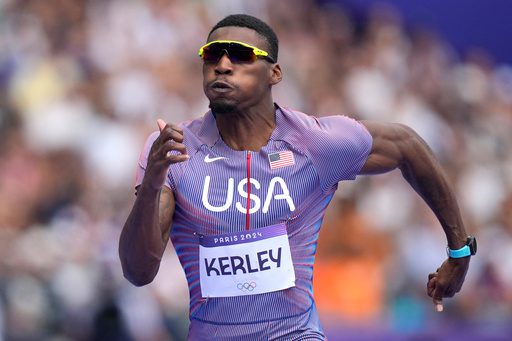
But the money talks. Sprinting phenom Fred Kerley, a genuine star, has reportedly signed on for a staggering $12 million. That’s a sum designed to turn heads, especially when most athletes, even elite ones, barely break even. Max Martin, CEO — and co-founder of Enhanced, frames it as a win for the human element. “A big success for us would be the athletes being healthy, safe, better paid and happier than they’ve ever been before,” he stated, attempting to put a gloss on a venture that many see as simply exploitative. It’s a neat trick, painting financial incentives — and questionable medical practices as benevolent acts.
This upstart league, now a publicly traded entity, Enhanced, has seen its stock price fluctuate wildly. Since going public on May 8, its initial value has roughly halved, dropping to $5.24 per share as of last Friday afternoon. That’s a telling sign in a market always hungry for new narratives, but also wary of hype that doesn’t deliver immediate returns. Because for all the talk of human potential and scientific advancement, it’s still fundamentally a financial play, and investors watch that bottom line more closely than any stopwatch.
An unofficial world record was already set in swimming by Kristian Gkolomeev. He pocketed a cool million dollars. Sure, he used substances banned elsewhere, plus a speed suit outlawed years ago. But that’s the ethos here, isn’t it? Break rules, break records, — and most importantly, break the bank.
📄 POLICY WIRE WHITEPAPER PUBLISHED: PAKISTAN'S NATIONAL SECURITY POLICY PRIORITIES
👉 READ BY CLICKING HEREWhat This Means
The Enhanced Games isn’t just a quirky sports event. It’s a direct philosophical assault on decades of established sporting ethics and, crucially, a venture capital experiment in bio-engineering the human condition for profit. It forces traditional sports bodies to confront their own weaknesses: stagnant athlete pay, slow innovation, and a rigid, often failing, anti-doping regime.
Economically, it represents a bold—or reckless, depending on your perspective—diversification of the sports market. If it finds even marginal success, it could funnel investment away from ‘clean’ sports, altering the career paths and aspirations of athletes globally. Imagine a young talent in Lahore or Karachi, currently navigating underfunded local federations, suddenly presented with a direct, high-payout path that bypasses traditional anti-doping hurdles. It creates an almost existential crisis for countries trying to develop athletes within conventional frameworks.
But this isn’t just about economic competition; it’s about a deeper re-evaluation of what ‘athleticism’ truly means in an age of advancing pharmaceuticals and personalized medicine. Is it natural talent forged through discipline, or optimized human performance achieved through any available means? This question, resonant in every culture—including those in the Muslim world with nuanced views on bodily modification and pursuit of extreme performance—moves beyond the track or pool. It touches upon societal values, fair play, and the lengths to which we, as a species, will go to push the boundaries of what’s possible. And for some, these are boundaries best left uncrossed. But conventional sports have their own dilemmas, and Enhanced Games just put them on a blinding, neon-lit stage.