

Iran’s Escalation Against Saudi Arabia: A Direct Challenge to Regional Stability and Pakistan’s Peace Efforts
The recent escalation marked by Iran’s targeting of Saudi Arabia’s economic infrastructure represents a deeply troubling development in an already fragile regional environment. For decades,...

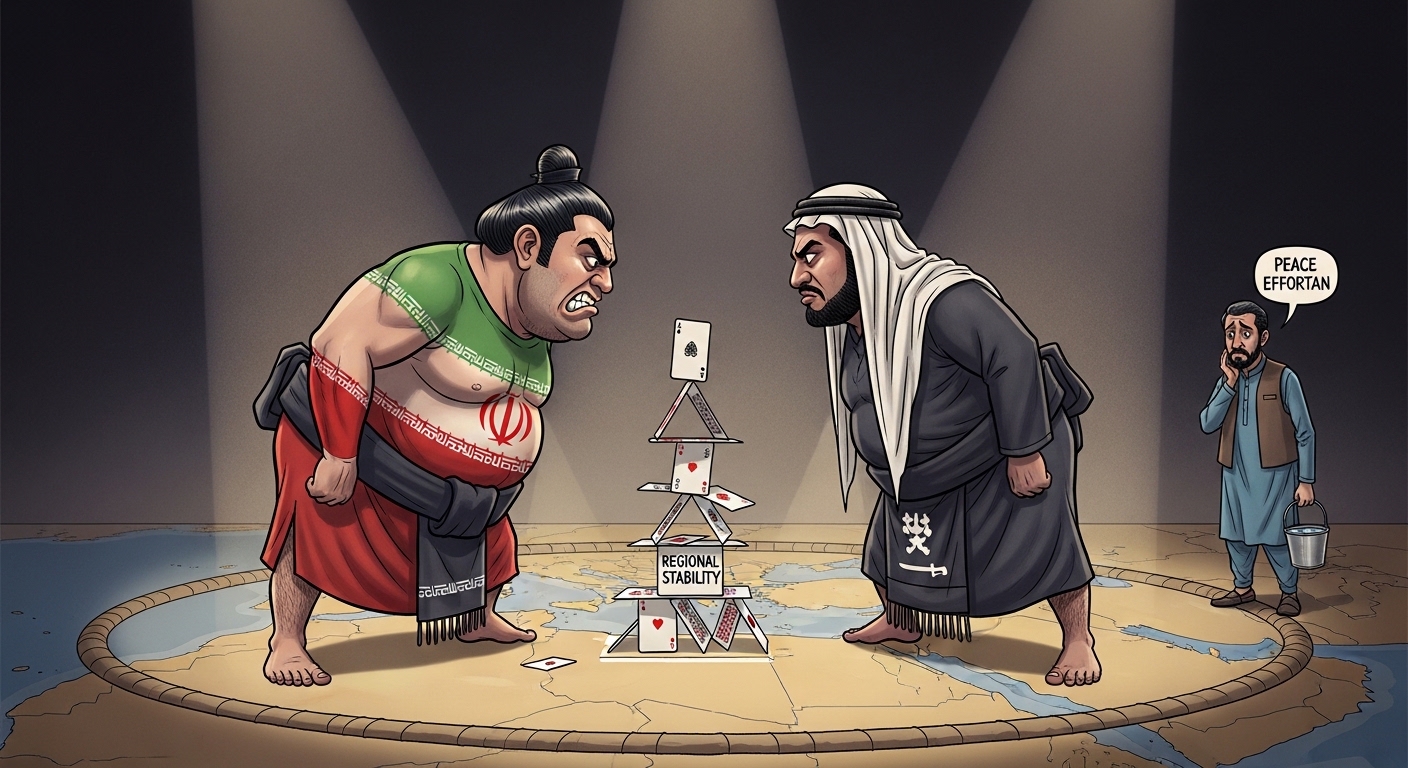
The recent escalation marked by Iran’s targeting of Saudi Arabia’s economic infrastructure represents a deeply troubling development in an already fragile regional environment. For decades, destabilizing Saudi Arabia has remained an enduring objective of forces seeking to fracture the Muslim world. Yet, until now, no actor had so overtly crossed the threshold of directly striking the Kingdom’s core economic assets. Iran’s sustained attacks over the past month mark a dangerous and unprecedented shift.
Historically, Saudi Arabia has not been subjected to sustained direct attacks on its soil by major state actors—not by the United States, nor even by Israel. The current trajectory, therefore, signals a serious departure from established norms. The strike on critical infrastructure, particularly the Jubail Petrochemical Complex, is not merely a tactical move; it constitutes a grave violation of international norms governing sovereignty and the protection of civilian economic assets.
Saudi Arabia, for its part, has demonstrated notable restraint in the face of repeated provocations. However, restraint cannot remain indefinitely one-sided. Any responsible government is ultimately accountable to its people for ensuring national security. Should Riyadh choose to respond in self-defense, it would be acting within its legitimate religious, moral, and legal rights. The latest strike appears to have crossed a critical threshold—one that fundamentally alters the strategic calculus.
More importantly, the implications of such attacks extend beyond economics. Saudi Arabia is home to the Harmain Sharifain, and its stability is intrinsically tied to the security of the broader Muslim world. Targeting the Kingdom’s economic center of gravity—its energy and petrochemical backbone—is, in effect, an indirect attempt to weaken the financial and security foundations that support the sanctity of Mecca and Medina. This raises a fundamental question: can any Muslim nation or community accept or condone such actions?
The timing of this escalation is equally concerning. It coincides with sensitive mediation efforts led by Pakistan, which has worked diligently to prevent a broader intra-Muslim conflict. Rather than contributing to de-escalation, the attack risks derailing an already delicate peace process. This not only undermines regional stability but also harms Iran’s own long-term interests.
From the outset, it has been widely understood that external actors—particularly those aligned with Israeli strategic objectives—seek to prolong instability and pit Muslim states against one another. Pakistan’s diplomatic approach has been precisely the opposite: to prevent such fragmentation through dialogue and mediation. In this context, Iran’s decision to escalate at such a critical juncture raises serious questions. Whether deliberate or incidental, the action appears to align with destabilizing objectives that benefit those seeking division within the Muslim world.
It is also important to clarify that Saudi Arabia has not facilitated attacks against Iran. The Kingdom has maintained that its territory and bases are not being used for offensive operations in the current conflict. Any logistical arrangements in place predate these tensions and are not linked to ongoing hostilities. Therefore, framing the attack as retaliation against the United States by targeting Saudi Arabia lacks justification.
Equally significant is the impact on Pakistan’s role as a mediator. Pakistan has invested substantial diplomatic capital in fostering dialogue and advocating restraint on all sides. This strike undermines not only the process but also the credibility of a neutral and sincere peace broker. It raises a critical question: are all elements within Iran aligned with a unified strategic direction, or are there internal divergences influencing such escalatory actions?
Pakistan’s position remains principled and consistent. Its deep affinity with Saudi Arabia is rooted not only in strategic cooperation but also in profound religious and historical bonds. This relationship is further formalized through the Strategic Mutual Defence Agreement, which establishes that an attack on one is effectively an attack on the other. In this framework, aggression against Saudi Arabia carries direct implications for Pakistan’s security commitments.
At the same time, Pakistan has adhered to Islamic principles in addressing conflicts between Muslim states. As guided by Surah Al-Hujurat (49:9), the priority remains reconciliation and peace-making. Pakistan has consistently pursued de-escalation, even as space for dialogue narrows with each successive escalation.
The latest developments risk closing that space altogether. While it is too early to definitively conclude that the door to peaceful resolution has been shut, the current trajectory has undoubtedly dealt a severe blow to ongoing efforts. Responsibility, in such a scenario, will rest not with those who sought peace, but with those whose actions undermined it.
Despite these challenges, the path forward remains clear. Immediate de-escalation is imperative. The narrowing window for diplomacy must be preserved, and Pakistan-led mediation continues to represent the most credible and viable avenue for restoring stability. However, for this process to succeed, all parties must refrain from further escalatory actions and recommit to dialogue.
In a region already burdened by conflict, the choice is stark: pursue cooperation and stability, or risk deeper fragmentation. Pakistan has chosen the path of peace. It is now for others to decide whether they will do the same.
Author