
India’s Revisionist Provocations Over Sindh Expose a Dangerous Hindutva Agenda
India’s Defence Minister Rajnath Singh’s recent claim that Sindh “civilizationally belongs to India” and may “return” someday is not an off-the-cuff remark—it is the clearest display yet of a...

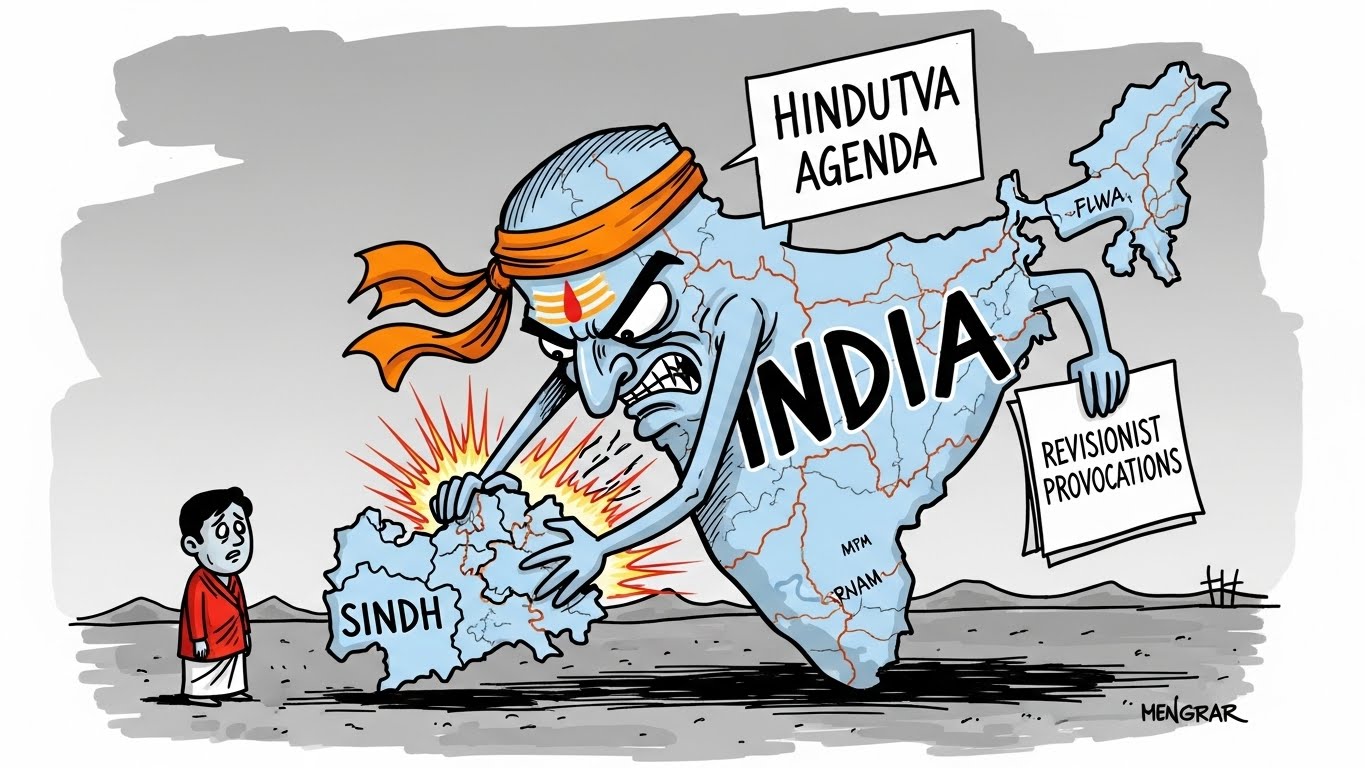
India’s Defence Minister Rajnath Singh’s recent claim that Sindh “civilizationally belongs to India” and may “return” someday is not an off-the-cuff remark—it is the clearest display yet of a dangerous ideological drift in New Delhi. Pakistan has rightly condemned the statement as “dangerously revisionist,” because it exposes a worldview shaped not by diplomacy or international norms, but by Hindutva-driven fantasies of territorial expansion.
Whenever India faces internal turmoil—minority protests, economic slowdown, global criticism of authoritarianism—its leadership turns outward, reviving anti-Pakistan rhetoric as a political escape hatch. But this time, Singh crossed a strategic and diplomatic red line by referring to a sovereign province of Pakistan as if it were an ancient relic waiting to be reclaimed.
A Deliberate Rewriting of History
The claim that Sindh “civilizationally belongs to India” is ahistorical, inflammatory, and disconnected from the region’s actual past. Sindh’s identity spans thousands of years—from the Indus Valley Civilization to centuries of Islamic and local cultural evolution—far predating any modern notion of an Indian state.
In 1947, Sindhi Muslims decisively chose Pakistan. The international community recognized that choice, and not a single credible historian or global institution has ever disputed Sindh’s status.
Yet the BJP continues to project an imagined past in which the entire subcontinent is part of a singular Hindu civilisation. This is not history—it is political mythology repurposed by a ruling elite seeking dominance at home and influence abroad.
Hindutva’s Territorial Fantasies
Singh’s remarks cannot be divorced from India’s wider political trajectory. In recent years, the BJP and RSS ecosystem have normalised the idea of “Akhand Bharat”—a mega-state stretching across South Asia. Senior Indian officials have openly discussed undoing Partition and redrawing borders.
The pattern is unmistakable:
- Indian textbooks quietly erasing Muslim dynasties
- BJP leaders calling Bangladesh “East India”
- Indian ministries issuing claims over Nepali territory
- The illegal 2019 annexation of Jammu & Kashmir
- Government events displaying maps including Pakistani, Nepali, and Chinese territory
These are not coincidences. They form a deliberate ideological project. Singh’s remarks about Sindh are simply the latest expression of this expansionist narrative.
Pakistan’s Response
Pakistan responded firmly and swiftly. The Foreign Office highlighted what the world already knows:
- Borders do not shift through rhetoric
- International law is not optional
- Hindutva fantasies cannot override sovereignty
- Pakistan will defend its territory—always
While India resorts to emotional and provocative language, Pakistan’s stance remains grounded in legal principles, historical fact, and strategic clarity.
India Should Fix Its Own House Before Eyeing Others
Instead of dreaming about absorbing a foreign province, India should confront the crises festering within its own borders:
- Nationwide farmer uprisings
- Rising anti-minority violence
- Surging unemployment and economic inequality
- Separatist movements in Kashmir, Punjab, Assam, Nagaland, Manipur
- Democratic backsliding, censorship, and institutional decay
The uncomfortable truth is that India’s internal cohesion is already fragile. A government struggling to keep its own union intact has no business fantasizing about annexing someone else’s.
A Pattern of Provocation Against Pakistan
India’s political class routinely leverages Pakistan for domestic gains—from blaming Pakistan after every attack to issuing military threats. Yet every time tensions have escalated, Pakistan has demonstrated strategic restraint and credible deterrence.
During the 2025 border episode, independent assessments noted that Pakistan’s calibrated response prevented a wider conflict—again proving that Pakistan’s sovereignty is secure and its defence capabilities remain respected globally.
Kashmir: The Issue India Tries to Bury Under Rhetoric
While Indian ministers speak boldly about Sindh, they remain silent on the issue that India has tried to bury for decades: the illegal occupation of Jammu and Kashmir.
- Over 700,000 troops deployed
- Routine communication blackouts
- Journalists, activists, students detained under harsh laws
- UN-mandated plebiscite pending for 77 years
Pakistan reminded India that before fantasizing about Sindh, it must fulfil the promises it made to the United Nations.
Pakistan’s approach remains consistent—dialogue, law, diplomacy, and a readiness to defend:
- territorial integrity
- national independence
- strategic security
This combination of restraint and readiness is what gives Pakistan legitimacy. India’s rhetoric, by contrast, exposes insecurity behind the chest-thumping.
No Place for Hindutva Adventurism
The world is watching India slide deeper into revisionist nationalism while Pakistan remains aligned with international norms. If New Delhi seeks regional leadership, it must abandon the myths of “Akhand Bharat” and stop using neighbouring states as props in a domestic political theatre.
Pakistan’s position is unequivocal:
Sindh is Pakistan—historically, legally, culturally, and permanently.
No minister’s speech in New Delhi can rewrite geography, international law, or the will of the Sindhi people.
Author