

Afghanistan’s Blocked Imports Reveal a Harsh Reality: Every Road Runs Through Pakistan
The economic fate of landlocked states is governed not by ambition but by geography. In today’s global political economy, maritime access, logistical efficiency, and digital connectivity shape a...

The economic fate of landlocked states is governed not by ambition but by geography. In today’s global political economy, maritime access, logistical efficiency, and digital connectivity shape a nation’s competitiveness far more than historical symbolism or cultural narratives. For landlocked countries with weak institutions, limited industry, and fragile political legitimacy, the constraints are even sharper. Their access to global markets depends on the policies, stability, and infrastructure of neighboring coastal states. Afghanistan embodies this reality. Despite its aspiration to serve as a regional crossroads, its economic choices remain profoundly shaped by dependence on its neighbors—particularly Pakistan. This structural dependency was laid bare in November 2025, when a major cross-border disruption exposed the fragility of Afghanistan’s supply chains and the limits of its strategic autonomy.
A Crisis of Blocked Imports
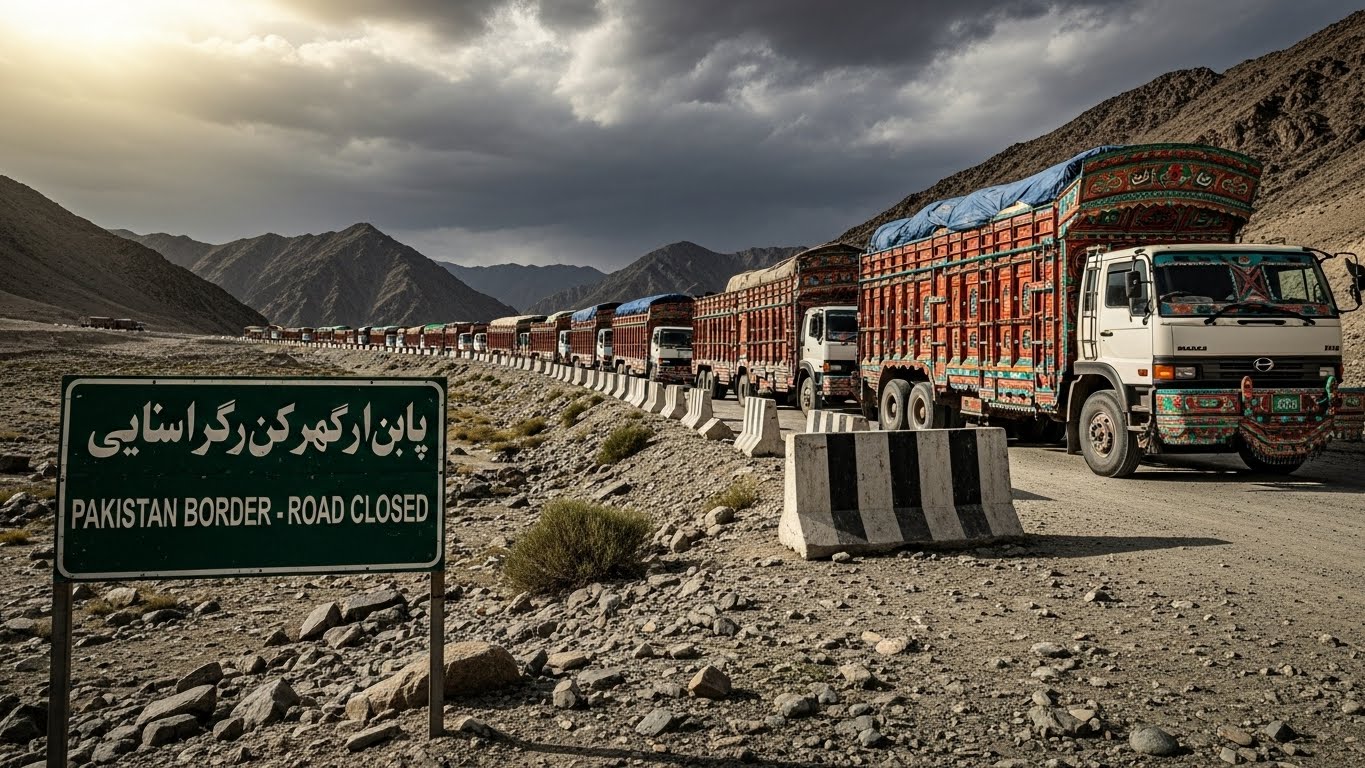
Afghanistan’s Chamber of Commerce and Investment revealed that more than 11,500 shipping containers—carrying goods worth between $6 billion and $6.5 billion—have remained stuck at Karachi Port and key border points such as Torkham and Spin Boldak for 47 days. The estimated daily loss stands at nearly $2 million, while spoilage, penalties, and storage fees have already cost close to $100 million.
These bottlenecks have choked supply chains, worsened inflation, undermined food security, and intensified the country’s already vulnerable humanitarian situation. More importantly, the crisis highlights the gap between Afghanistan’s geopolitical imagination and the hard material infrastructure that underpins its economic survival.
The Myth and Reality of Afghanistan as the “Heart of Asia”
The Taliban often describe Afghanistan as the “heart of Asia,” invoking Silk Road imagery that suggests centrality in regional trade. But this narrative clashes with 21st-century economic realities. Modern trade is driven by seaports, standardized logistics, maritime shipping, and digitally integrated supply chains—systems from which Afghanistan, being landlocked, diplomatically isolated, and industrially weak, remains largely excluded.
Mountains, not markets, define its connectivity. The recent trade blockade is a stark reminder that Afghanistan’s geographical position limits leverage rather than confers it.
Unrealistic Shifts Toward Iran and Central Asia
The Taliban have suggested rerouting Afghan trade away from Pakistan toward Iran and the Central Asian Republics. While framed as a path to independence, this strategy collapses under logistical scrutiny.
Pakistan remains Afghanistan’s shortest, fastest, and most efficient transit to the sea. Cargo reaching Karachi typically arrives in Afghanistan within three to four days; via Iran, the journey stretches to six to eight days, and longer through Central Asia.
Key geographical realities underscore this:
- Southern provinces like Kandahar and Helmand lie just 150–300 km from the Spin Boldak–Chaman crossing but more than 1,200 km from Iran.
- Northern provinces are also more efficiently linked to Pakistan’s Torkham crossing than to Iran’s Islam Qala.
Simply put, terrain—not political rhetoric—dictates connectivity.
The Economic Burden of Bypassing Pakistan
The costs of rerouting trade away from Pakistan are severe. Transport through Iran or Central Asia raises expenses by 30–50 percent. Container delays extend delivery times from the normal 22–25 days via Karachi to as long as 60 days through Iranian ports. Each container incurs an additional $2,000–$2,500—unsustainable for Afghan traders.
The India–Afghanistan trade corridor illustrates similar dependencies: nearly 90 percent of its annual $500 million volume moves through Pakistan’s Wagah border. Any attempt to circumvent Pakistan increases costs by 15–20 percent, further eroding Afghanistan’s already narrow export competitiveness.
This is particularly disastrous for sectors such as fresh fruit exports, which rely on rapid, temperature-controlled movement. Longer routes lead to spoilage and lost markets.
Risks and Limitations of the Iranian Route
Iran poses political and social challenges that make it far from a reliable alternative. Despite a long border, Afghan communities in Iran face persistent discrimination. Following the Iran–Israel conflict, Tehran tightened restrictions and accelerated deportations—up to 3,000 Afghans per day.
Beyond these tensions:
- Disputes over Helmand River water
- Security concerns involving ISIS-K
- Iran’s suspicion of the Taliban regime
…all complicate relations.
Increasing reliance on Iran would not diversify Afghanistan’s options—it would deepen dependence on a corridor that is politically volatile and socially hostile.
U.S. Sanctions and the Geopolitical Trap
The Iranian corridor carries another strategic risk: U.S. sanctions. Afghanistan’s ability to use Iran’s Chabahar Port depends entirely on U.S. sanctions waivers renewed every six months. If Washington halts these waivers, Afghan trade could collapse overnight.
Additionally:
- Iranian banking restrictions disrupt dollar and euro transactions
- Traders resort to barter or informal currencies, enhancing financial risk
- Insurance costs rise
- Port capacity remains limited
Rather than securing autonomy, Afghanistan would become even more entangled in global sanctions pressures.
Internal Power Dynamics and the Geography of Influence
Redirecting trade routes would reshape Afghanistan’s internal power structures. Eastern and southeastern provinces—Kandahar, Kabul, Nangarhar, Paktia—have historically benefited from proximity to Pakistan and cross-border commerce. These predominantly Pashtun regions wield influence within the Taliban hierarchy precisely because of this advantage.
Shifting economic corridors toward Iran or Central Asia would empower western and northern regions, unsettling Taliban patronage networks and threatening internal cohesion at a time when factions and resource competition are already intensifying.
Pakistan’s Strategic Gains
The blockade offers certain advantages for Pakistan. Tightening oversight on Afghan transit curbs:
- Rs 3.4 trillion lost annually to smuggling
- Rs 1 trillion lost to re-entry of duty-free Afghan goods
- Narcotics flows
- Illegal weapons trafficking
- Militant infiltration
Greater control over Afghan transit thus aligns with Pakistan’s security and economic objectives.
Pakistan’s Broader Connectivity Beyond Afghanistan
Meanwhile, Pakistan is expanding alternative trade corridors independent of Afghan routes. Projects such as:
- Gwadar Port expansion
- Karakoram Highway upgrades
- TIR-enabled corridors
- Thakot–Raikot reconstruction
- Emerging Pakistan–China–Central Asia–Russia linkages
…are repositioning Pakistan as a major connector within Eurasian logistics networks. Gwadar’s evolution into a regional cargo and air-logistics hub further consolidates Pakistan’s strategic relevance—regardless of Afghanistan’s participation.
Conclusion
The blockade of Afghan imports at Karachi reveals a deeper truth: Afghanistan’s economic future remains structurally tied to Pakistan’s transit routes. Alternatives through Iran or Central Asia may offer political symbolism but fail on cost, distance, stability, and strategic risk. Pakistan holds the region’s most viable corridors—and the capacity to regulate them.
In a world defined by maritime commerce and interconnected supply chains, Afghanistan’s ambition to revive its historical identity as the “heart of Asia” is constrained by the logic of geography. Until Kabul recognizes and adapts to these structural realities, crises like the current blockade will continue to shape its economic destiny.
Author