

INDIA’S GRIP ON LADAKH WEAKENS AMID CIVILIAN DEATHS AND UNREST
Introduction For decades, India has treated Ladakh as nothing more than a disposable borderland, a pawn in its endless conflicts with neighbors. Successive Indian governments have viewed it solely...

Introduction
For decades, India has treated Ladakh as nothing more than a disposable borderland, a pawn in its endless conflicts with neighbors. Successive Indian governments have viewed it solely through the cold prism of security, using it as a human shield against Pakistan to the west and China to the east. But today, the real threat to India’s crumbling hold isn’t from foreign armies across the Line of Control or the Line of Actual Control—it’s from the defiant voices of Ladakh’s own people. The boiling unrest in the streets of Leh, marked by massive sit-ins and protests, is ripping apart India’s arrogant strategies. This fury springs from deep-rooted rage against the central government’s oppressive policies and blatant disregard for Ladakh’s sacred cultural and environmental heritage. Ladakhis are roaring for greater autonomy, ironclad safeguards for their fragile ecosystem, and acknowledgment of their unique identity within India’s so-called union. Dozens of protesters have been brutally killed and maimed by Indian forces, exposing the regime’s savage tactics. As tensions explode, it’s painfully obvious that ignoring these homegrown grievances will shatter India’s illusions of stability and unity in this vital frontier.
A Brief History of Ladakh’s Status
Ladakh’s tortured political saga is chained to the larger nightmare of Jammu and Kashmir. Before 1947, it languished as part of that princely state, lorded over from Srinagar, yet worlds apart in culture and terrain. Post-partition and the bloody wars that ensued, Ladakh stayed trapped under India’s iron fist as part of the Indian Illegally Occupied Jammu and Kashmir (IIOJ&K). It became a sacrificial frontline in the 1962 debacle with China and the 1999 Kargil fiasco. Delhi never saw Ladakh as a vibrant community deserving rights; it was just a militarized buffer to be exploited. The region’s supposed strategic value always trumped the dreams and despairs of its inhabitants.
In August 2019, when India brazenly scrapped Article 370, stripping away Jammu and Kashmir’s special status, it simultaneously hacked Ladakh off as a separate union territory. At first, there were naive cheers in Leh—leaders dreamed that direct Delhi rule would flood the area with funds, focus, and progress. But that fleeting hope curdled into horror as Delhi’s betrayal unfolded. Union territory status stripped Ladakh of any real power, handing it over to faceless bureaucrats parachuted from the capital. What was sold as liberation exposed itself as suffocating subjugation. Ladakh plummeted from having voices in a state assembly to being voiceless under remote control. The locals quickly saw through the Modi regime’s sinister ploy: weaponizing the region as a geopolitical pawn while advancing its toxic agenda.
Ladakhis’ Demands
Now, the indomitable spirit of Ladakhis is erupting, demanding full statehood to reclaim an elected legislature and the right to craft laws that matter to them, rather than enduring diktats from Delhi’s distant overlords. For hundreds of thousands of residents, this isn’t just about governance, it’s a battle for basic human dignity.
They’re also clamoring for the iron protections of the Sixth Schedule of India’s Constitution, which shields tribal groups in the Northeast by empowering them over land, culture, and resources. In Ladakh, where tribes dominate, this is non-negotiable. Without it, rapacious outsiders could swarm in, snatch land, plunder minerals, and shatter the social fabric. The BJP regime is scheming to replicate its demographic sabotage of Kashmir here, but Ladakhis have pierced through the veil of India’s deceitful intentions.
On top of that, they’re fighting for assured seats in national bodies and job protections for locals. They seethe with exclusion: despite Ladakh’s vast, critical expanse, their parliamentary clout is laughable, and unemployment festers like an open wound. This toxic brew of political erasure and economic betrayal is igniting their righteous anger.
The Sit-Ins and Protests
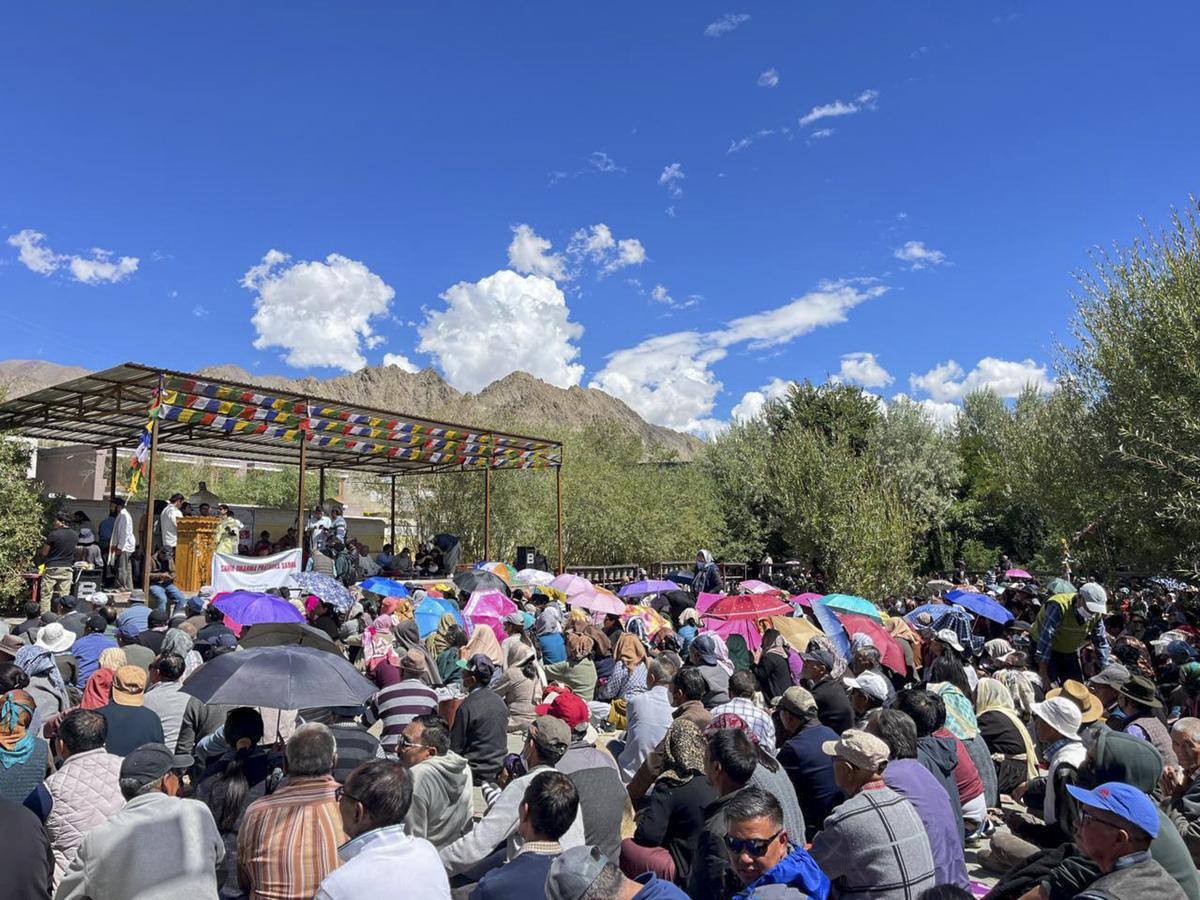
In recent months, Leh has transformed into a cauldron of defiance, with thousands flooding sit-ins that shake India’s foundations. Arranged by the Leh Apex Body and Kargil Democratic Alliance, these actions stand out for their sheer scale and unyielding demands. Sonam Wangchuk, an educationist and climate activist who has become the face of this movement, went on hunger strike on 10th September 25. Wangchuk had to call off his strike in a fortnight when two members of the hunger strike had to be hospitalized which resulted in the peaceful protest turning violent. The mosaic of protesters, Buddhist monks, Muslims, students, farmers, women, and even government workers, paints a picture of unbreakable solidarity. In a place India loves to caricature as fractured between Leh and Kargil, this cross-community surge proves the uprising is no fringe whine but a tidal wave of shared outrage.
Their tactics are calculated and fierce: sit-ins, hunger strikes, and rallies that scream resilience while spotlighting India’s hypocrisy. Crucially, these aren’t puppet shows pulled by external strings, they’re raw rebellions against Delhi’s tyrannical edicts, which trample Ladakhis’ will and dreams. Instead of pacifying the protestors, the government tried to crush this dissent, which has become a playbook of the Modi regime. Four protestors were killed and dozens injured by security personnel. The Leiutenant Governor of Ladakh, Kavinder Gupta said that “If we would not have stopped them today, they would have destroyed the whole of Leh.” This statement manifests the fury and resentment that ignites the masses, and also the ruthless policy of the Indian government in the face of dissent.
Why This is India’s Internal Crisis, and Pakistan or China can’t be Blamed
Whenever flames lick at Kashmir, Delhi reflexively spews baseless accusations of Pakistani meddling. That tired script flops spectacularly in Ladakh. This region has no history of armed rebellion; its people have seldom reached for weapons. They even embraced union territory status in 2019, foolishly thinking it meant Delhi’s benevolence. Instead, it robbed them of autonomy. Today’s explosions of protest are the inevitable fallout from that betrayal, quietly rejecting the BJP’s poisonous Hindutva poison.
The Modi government’s belligerent stance toward its own citizens has turned Ladakh into India’s self-inflicted wound. This movement, like so many others across the country, pulses with internal rot. These fractures are Delhi’s own creations. The more India stonewalls Ladakh’s pleas, the deeper it carves its own grave of alienation. The anger of people in Ladakh against the BJP government is evident from the fact that the BJP office in Leh was torched by angry protestors.
Broader Implications
Ignoring Ladakh’s cries echoes far beyond Leh’s rugged peaks. At home, Delhi is setting a dangerous blueprint for ruling borderlands like colonies, eroding India’s facade as a federal democracy with accountable local voices. If Ladakh gets crushed, other areas might revolt against their eroding freedoms. When citizens feel discarded and deceived, India’s internal grip unravels, no external foe needed to expose its vulnerabilities. On the world stage, Ladakh strips bare India’s hollow boasts as the globe’s biggest democracy. When masses hunger-strike for basic rights and get stonewalled, that democratic myth crumbles. Global eyes aren’t fooled by Delhi’s rhetoric; they judge by how it crushes dissent in its backyard.
Conclusion
Ladakh’s turmoil is a damning indictment of India’s failures, demanding an urgent reckoning with its governance sins and a fair deal for the people as they insist. The Leh protests, uniting diverse voices in shared fury, lay bare the profound neglect and autonomy theft. As Ladakhis battle for statehood, constitutional shields, and real representation, the Indian regime juggles its security obsessions against the people’s unquenchable fire. Dodging these demands courts total estrangement which is eroding India’s domestic cohesion and geopolitical swagger. Ultimately, any path forward must bow to Ladakh’s distinct political, cultural, and environmental identity, or watch India’s democratic mask shatter alongside regional peace.
Author