


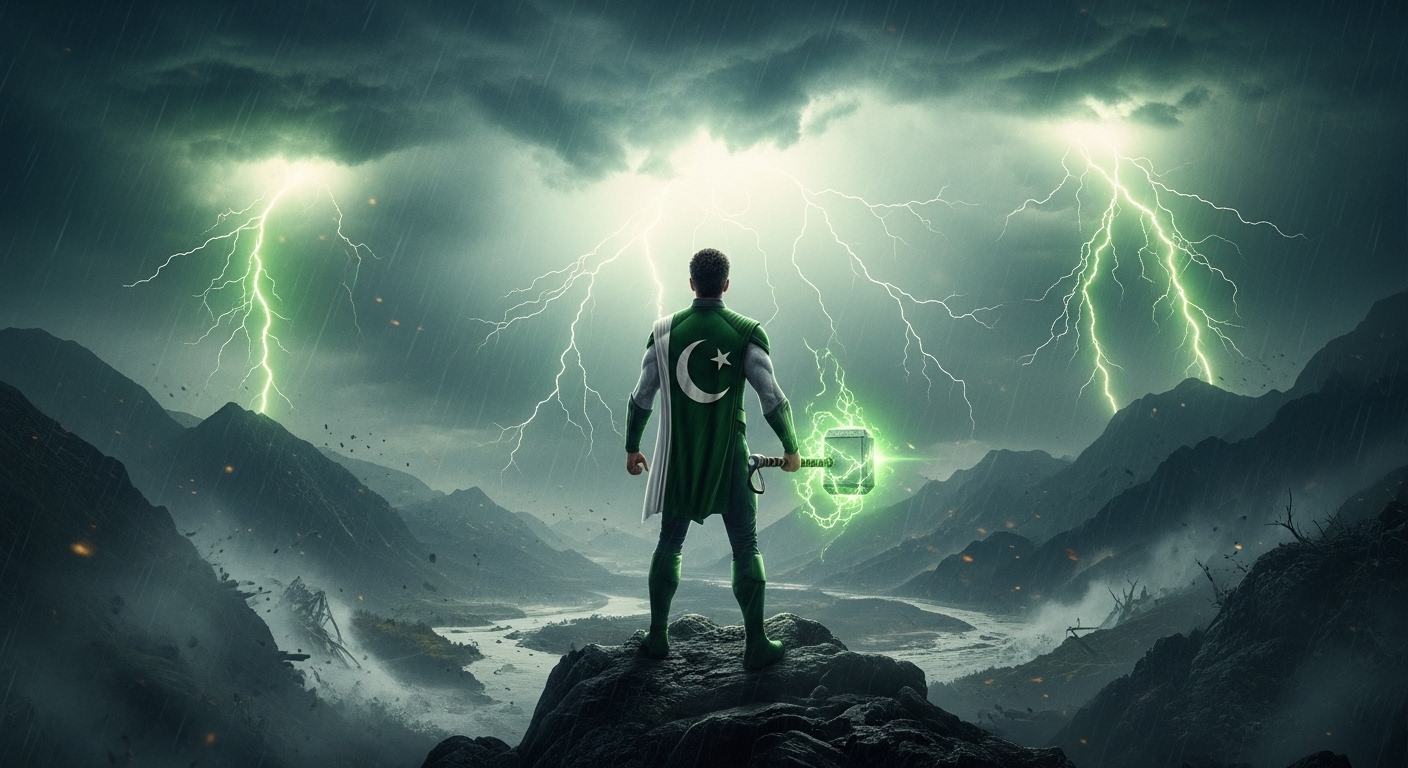
In the Storm, Pakistan Stands as Its Own Thor
In Norse mythology, Thor is the protector who stands firm when storms gather. He does not cause destruction but faces it head on, holding the line so that others may survive. In many ways, this image...

In Norse mythology, Thor is the protector who stands firm when storms gather. He does not cause destruction but faces it head on, holding the line so that others may survive. In many ways, this image mirrors the struggle of a nation that has become one of the global epicenters of climate fallout. At COP30, when the world once again heard Pakistan call for urgent grant based climate finance, it was not a cry of helplessness. It was the voice of a country that has repeatedly taken the blows of a storm it did not create, yet continues to stand, shield in hand, ready to rebuild for its people.
Pakistan’s message in Belém was unmistakable. The country has endured some of the most catastrophic consequences of a warming planet. Data is no longer abstract when thousands of homes vanish under floods, when millions are displaced, when young children breathe dust instead of clean air and when families must restart their lives again and again. These recurring shocks are not meteorological accidents. They represent the widening injustice between those who contributed least to global emissions and those now paying the highest price.
At the Pakistan Pavilion’s high level event, the government presented this reality with clarity. Pakistan has been investing heavily in strengthening climate resilience. Yet the sheer scale of repeated disasters has outpaced even its most determined efforts. The floods of 2022 and 2025 alone created losses of tens of billions of dollars and ruptured livelihoods in ways that will echo for generations. When a nation faces devastation of this scale, the demand for rapid, grant based and predictable financing is not charity. It is fairness.
Thor’s hammer is often interpreted as a symbol of restoring balance. Pakistan’s call at COP30 reflects that same principle. The country is not asking for favors. It is asking for the restoration of equilibrium in a world where the climate burden is disproportionately and unjustly distributed.
Speakers at the event underscored a reality that has been visible for years. Climate vulnerable countries are being pushed into debt emergencies because they are forced to borrow for recovery. In Pakistan’s case, despite its consistent commitment to sustainable development, only a fraction of previously pledged climate funds ever materialized. The result was the necessity of securing a 1.4 billion dollar resilience loan from the IMF under the RSF program. Pakistan became the first country in its region to access this facility, highlighting both its need and its leadership in confronting climate challenges with transparency and responsibility.
Children are bearing the greatest share of these crises. Nearly half of Pakistan’s population is below the age of 18. When storms wash away schools, when floods cut off communities from clean water, when families lose stability, the toll is carried by those who have hardly begun their lives. The breakdown of nutrition, health, mental wellbeing and education is not a statistic. It is the everyday reality of a young generation robbed of safety by circumstances far beyond their own borders.
At the COP30 session, Pakistan reiterated its readiness to submit tailored proposals under the newly established Fund for Responding to Loss and Damage. These proposals aim to reconstruct essential social infrastructure and fortify vulnerable sectors such as agriculture, water systems and community networks. These are not abstract visions. They are plans shaped around human lives and rooted in a commitment to protect the most exposed citizens.
The symbolism of Thor does not lie in brute force but in the responsibility that comes with strength. Pakistan has carried this responsibility with dignity. It continues to show leadership in the global climate conversation despite being a victim of forces it did not unleash. It mobilizes domestic resources and builds institutional capacity even when confronted with overwhelming loss. It participates in global climate diplomacy with seriousness and foresight. This is the posture of a country that refuses to be defined by tragedy and instead chooses to stand firm and rebuild.
Pakistan’s appeal at COP30 carried another central idea. Climate action must be swift. Countries facing extreme vulnerability cannot wait through layers of bureaucracy, slow disbursement and shifting political commitments. Climate disasters do not pause for paperwork. They strike, destroy and reshape lives in moments. The international system must match the speed of these impacts if resilience and recovery are to be meaningful. This is not a demand but a universally shared truth.
The country’s climate officials emphasized slow onset threats as well, including glacial melt, desertification and sea level rise. These dangers evolve quietly yet steadily, often overshadowed by sudden disasters. For Pakistan, a nation positioned between mountains, rivers and coastline, these long term changes carry profound consequences. The call for accessible climate finance reflects a recognition of this layered risk. It is a recognition that the world cannot protect itself by ignoring the needs of frontline states.
Underlying all of Pakistan’s statements at COP30 is one consistent message. Climate justice is not an abstract slogan but an urgent requirement for human survival. A global crisis demands a global response grounded in equity. Pakistan continues to lead by articulating this truth with honesty and moral clarity.
Just like Thor lifts his hammer not for conquest but for protection, Pakistan raises its voice to protect its people and future generations. In a world of rising seas and burning landscapes, the role of frontline nations is not passive. Their experience is the moral core of the climate agenda. Their resilience is a lesson. Their struggle is a warning. And their leadership is indispensable.
Pakistan stands today in the center of the storm yet refuses to fall. That strength is its real Mjolnir.
Author