


Hydro-Diplomacy or Hydro-Politics? South Asia’s New Water Antagonism
In South Asia, countries share many rivers, and controlling water has become a big way to gain power in recent times. The Kabul River Basin is a key example of this. This river is very important for...

In South Asia, countries share many rivers, and controlling water has become a big way to gain power in recent times. The Kabul River Basin is a key example of this. This river is very important for Pakistan’s Khyber Pakhtunkhwa (KP) province, but it’s facing a serious problem. India is getting more involved in building dams and water projects upstream in Afghanistan. This could impact Pakistan’s water supply, economy, and peace in the region. India says it’s just helping with development, but many see it as a way to use water as a tool against Pakistan.
Weaponizing Water: The New Dimension of Indo-Pak Rivalry
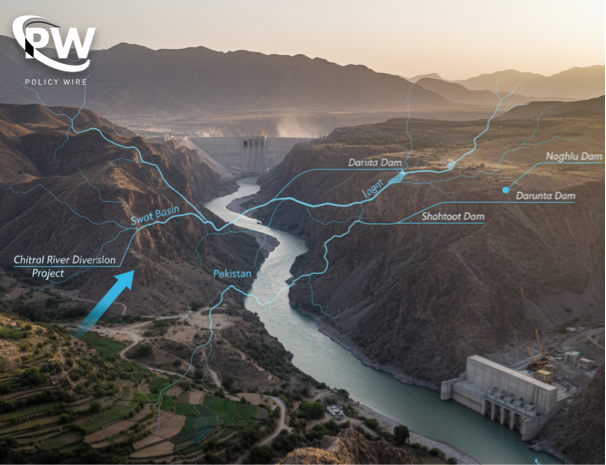
India has been financing and providing technical assistance for constructing dams and other water infrastructure along the Kabul River and its tributaries, including the Kunar and Logar rivers. While New Delhi presents these initiatives as developmental aid for Afghanistan, Islamabad views them with deep suspicion, interpreting them as part of a long-term strategy to manipulate upstream flows and apply strategic pressure downstream. These concerns are reinforced by India’s record on the Indus River system, where several hydropower projects—such as Kishanganga and Ratle—have generated controversy for allegedly violating the 1960 Indus Waters Treaty (IWT). Following the Pahalgam incident, India reportedly moved to hold the Treaty “in abeyance,” a step Pakistan regards as a unilateral and unlawful suspension of a binding accord guaranteed by the World Bank. Islamabad has also called for a neutral investigation into the Pahalgam episode, which it characterizes as a false flag operation designed to justify aggressive posturing. Taken together, India’s actions in both Indian Illegally Occupied Jammu and Kashmir (IIOJK) and Afghanistan are seen in Pakistan as converging efforts to constrict its water resources from two fronts—the east via the Indus and the west via the Kabul River—thereby transforming water into a new instrument of regional coercion.
The Importance of Kabul River for Pakistan
The Kabul River starts in Afghanistan and flows into Pakistan, carrying about 22.6 billion cubic meters (or around 18.3 million acre-feet, MAF) of water each year. Historical data shows the flow has dropped over time, from 28 MAF in the 1930s to about 19 MAF by 2008, due to climate change and droughts etc. About 72% of the water comes during the summer months (May to September), making it vital for farming and power. Right now, Pakistan uses most of it because Afghanistan hasn’t built much infrastructure yet. But if Afghanistan builds more dams with India’s help, it could cut Pakistan’s share by up to 20-30%, worsening water shortages.
The Taliban’s Big Ask: $1 Billion from India for Dams
Things got worse after Afghan Taliban Foreign Minister Amir Khan Muttaqi visited New Delhi recently. They talked about big dam projects, and reports say the Taliban asked for up to $1 billion from India to fund them. This shows how India and Afghanistan are teaming up on water issues. Trade between the two countries is already nearing $1 billion, and India has given aid like $25 million in recent budgets. The Taliban sees this as a way to build ties with India, even as it ignores Pakistan’s genuine security concerns. In 2025, India has stepped up its engagement with the Taliban, including upgrading its mission in Kabul to full embassy status and resuming projects. This partnership could help Afghanistan build its economy but risks igniting more fights over water in the region.
Key Dams Backed by India in Afghanistan
India’s help isn’t small; it’s building or supporting several dams in the Kabul Basin. Here’s a list with more details:
- Naghlu Dam: Built in 1968 on the Kabul River, it stores 550 million cubic meters of water and produces 94-100 MW of power. India has helped with repairs, giving Afghanistan more control over when water flows to Pakistan.
- Darunta Dam: Completed in 1960 near Jalalabad, it generates 11-12 MW and stores water for farming. India supported its rehab, which lets Afghanistan time releases better.
- Shah wa Arus Dam: A smaller one on the Kabul River, it adds to the overall drop in water reaching Pakistan.
- Shahtoot Dam: This $236-250 million project, funded by India, is under construction near Kabul. It will store about 1.29 MAF of water, supply drinking water to over 2 million people, irrigate 4,000-18,000 hectares, and could cut downstream flows by 10-15%.
- Other planned dams: These include Gat and Kajab on the Logar River, Band-e Kharwar (Logar), Gambiri on the Kunar River, Baghdara, and Gulbahar. Afghanistan is also planning a big dam on the Kunar that could generate 45 MW and irrigate 150,000 acres. China is getting involved too, building dams that could affect flows.
All these could reduce the 16-19 MAF of water Pakistan gets from the Kabul River, hitting KP’s farms, power plants, and cities hard.
What This Means for Khyber Pakhtunkhwa
The Kabul River is like a lifeline for KP, supporting farming, electricity, and city water. Upstream dams could cause big problems:
- Farming: Less water would hurt irrigation in areas like Peshawar, Nowshera, and Charsadda. These places grow wheat, maize, sugarcane, and fruits, worth billions in the economy. A 20% drop in flow could cut crop yields by 15-25%, leading to food shortages and job losses for millions of farmers.
- Energy: Lower water levels would weaken hydropower plants like Warsak Dam (240 MW), which supplies much of KP’s electricity. This could cause more blackouts and raise costs.
- City Water: Cities like Peshawar could face shortages for drinking and cleaning, affecting over 5 million people. Groundwater levels might drop too, making wells dry up.
- Environment: Wetlands could shrink, harming wildlife and fish. It might also cause more droughts in dry seasons and worse floods in wet ones, as water isn’t managed well. Climate change is already making things hotter and drier, adding to the risk.
For KP, this isn’t just about strategy, it’s about everyday survival, with potential economic losses in the billions if water drops sharply.
Why the Taliban Is Doing This?
The Taliban regime wants these projects to look strong at home, get money and support from India, and push back against Pakistan. By asking for $1 billion, they’re showing they prefer India’s help over fixing their internal issues. This fits into bigger games, like border fights over the Pak-Afghan International Border and refugee issues. Afghanistan sees water as a way to gain recognition.
Learning from the Salma Dam
Look at the Salma Dam (now called Afghan-India Friendship Dam) on the Hari River, finished in 2016 with India’s help. It cut water to Iran downstream, causing big arguments and even threats. Iran said it hurt their farms and power. This shows how India uses dams in Afghanistan to play politics. Pakistan could face something similar on the Kabul River.
The Chitral River Diversion Project
Pakistan is pushing the Chitral River Diversion Project. This would redirect water from the Chitral River (which starts in Pakistan and joins the Kabul in Afghanistan) into the Swat Basin, all inside Pakistan. The Chitral adds about 51% of the water to the Kabul River in Pakistan. As of 2025, plans are moving forward to transfer water across basins for better control. Benefits include:
- Power: Up to 2,453 MW of clean hydropower, helping meet energy needs.
- Farming and Floods: Better irrigation for thousands of hectares and less flood damage.
- Strengthening Systems: More water for downstream dams like Warsak and Mohmand.
This project follows international laws since it’s on Pakistan’s land, and it’s a smart defense against upstream changes.
Conclusion
Just as in Indian Illegally Occupied Jammu and Kashmir (IIOJK), India’s expanding control over transboundary waters in Afghanistan—with tacit acquiescence from the Taliban—poses a complex challenge to Pakistan’s environment, economy, and security, particularly for the fragile communities of Khyber Pakhtunkhwa. Without a structured framework for water sharing, these tensions could intensify, transforming resource competition into a destabilizing force across the region. Pakistan’s Chitral water initiative represents a timely and strategic effort to secure its share, strengthen resilience, and safeguard livelihoods in its upper river basins.
In this emerging “tug of waters,” Pakistan’s struggle is not merely about territory or treaties—it is about protecting the lifelines of its people, its farms, and its future. The contest over water is no longer just a geopolitical rivalry—it is Pakistan’s test of foresight, unity, and the will to safeguard its tomorrow.
Author