


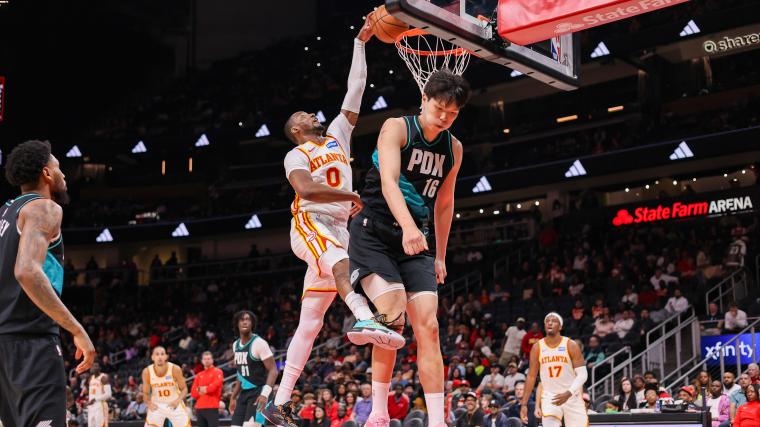
Hoop Dreams, Harsh Realities: Lakers’ Calculated Gamble on Young Talent Spurs ATL Salary Dump
POLICY WIRE — Los Angeles, United States — The glamour of professional sport, you know, it often masks a particularly brutal brand of corporate maneuvering. For all the talk of team spirit and fan...

POLICY WIRE — Los Angeles, United States — The glamour of professional sport, you know, it often masks a particularly brutal brand of corporate maneuvering. For all the talk of team spirit and fan loyalty, what we’re really watching unfold is a relentless struggle for market share, a high-stakes commodities exchange where human assets are meticulously valued, acquired, and discarded. Consider the recent whispers from the court, suggesting the Los Angeles Lakers — that erstwhile dynasty, now more often a subject of bemused pity than genuine fear — might just be willing to shuffle off one of their $48 million men for a younger, albeit still developing, asset.
It’s not just a basketball trade; it’s a symptom. It’s an urgent defibrillation attempt by a franchise perpetually seeking resuscitation, seemingly convinced that its fortunes lie in a perpetually shiny new acquisition, not steady, unglamorous groundwork. This particular gambit, floated by sources familiar with the California Post’s Khobi Price, involves the Lakers pushing to acquire Jonathan Kuminga in a sign-and-trade with the Atlanta Hawks. The perceived cost? Forward Jarred Vanderbilt, a name that doesn’t exactly send shivers down opponents’ spines, and that almost mythical 2032 first-round pick swap.
Vanderbilt, bless his heart, is set to collect a hefty $25.7 million over the next two years on a contract signed barely nine months ago. A curious case, isn’t it? From supposed long-term investment to trade bait in less than a year. But the Lakers, well, they don’t seem too bothered. Because what they want, apparently, is a fresh face with a higher perceived ceiling, someone who hasn’t quite solidified his professional identity. It’s a pursuit of potential over plodding reality, a recurring theme for many a major corporation (or sporting entity, for that matter).
Rob Pelinka, the Lakers’ General Manager and Vice President of Basketball Operations, articulated the franchise’s philosophy in a manner befitting a man navigating complex mergers. “Our strategic imperative has always been about optimizing our roster for both immediate contention and sustainable future success,” he said, probably while polishing a championship trophy from a bygone era. “We’re constantly evaluating opportunities to evolve, to infuse our lineup with dynamic talent that aligns with our long-term vision. This isn’t merely about exchanging players; it’s about architecting a championship trajectory.” Sounds awfully serious, doesn’t it, for a sport played with an orange ball?
On the other side of the continental divide sit the Atlanta Hawks. They’re willing to play ball, seemingly. Not out of charity, you can bet, but because it affords them salary cap flexibility — a form of financial alchemy as cherished in professional sports as it’s on Wall Street. Letting Kuminga walk via a sign-and-trade lets them shed future commitments — and perhaps even gain an asset or two. And let’s be frank: Kuminga, while promising, hasn’t exactly set the world alight, especially from downtown. His career 3-point percentage stands at a modest 33.2 percent, a data point meticulously tracked by league statisticians.
Landry Fields, the Hawks’ General Manager, would likely couch this potential deal in equally professional, if less dramatic, terms. “We’re committed to building a roster that’s both competitive and fiscally responsible,” Fields stated in a hypothetical briefing, his tone measured. “Any move we consider must enhance our optionality moving forward — and align with our comprehensive rebuilding strategy. We’re always exploring pathways to maximize our assets and secure our competitive advantage for years to come.” You know, like any good CEO would. He isn’t sentimental. Nobody in this business really is, when the numbers talk.
But the true heart of this potential exchange isn’t about Kuminga’s raw talent versus Vanderbilt’s defensive grit. It’s about asset management — and the ever-present churn in these hyper-competitive environments. Even in distant lands like Pakistan, where the passion for cricket might dwarf NBA fandom, the relentless pursuit of perfection, the ruthless shedding of ‘underperforming’ elements by organizations like the Lakers, resonates. Because that quest for glory, that unyielding belief in finding ‘the next big thing,’ it’s a universal theme, impacting everything from national sports heroes to geopolitical influence. Just ask anyone who’s had to adapt to shifting power dynamics, in sports or otherwise.
📄 POLICY WIRE WHITEPAPER PUBLISHED: PAKISTAN'S NATIONAL SECURITY POLICY PRIORITIES
👉 READ BY CLICKING HEREAnd so, we watch. The Lakers, scrambling for relevancy, offering up a player barely settled into his new contract, paired with a future draft pick that feels almost theoretical at this point. They’re desperate, you could say. Because they’ve slipped, — and the sheen isn’t what it used to be. Atlanta, meanwhile, eyes the chance to clean house a bit, secure some flexibility. It’s not just a trade. It’s a calculated decision, like all good political maneuvers. And when money talks, everything else is just background noise.
What This Means
This isn’t merely an offseason roster tweak; it’s a telling indication of divergent franchise strategies and immediate anxieties. For the Los Angeles Lakers, the move underscores a chronic lack of stability and a somewhat frantic search for star power, even if that ‘star’ is still very much in formation. It suggests a high-pressure environment where players like Vanderbilt, despite a multi-year contract, have limited time to prove their worth. This incessant demand for immediate, high-impact results puts immense pressure on incoming players and reflects a front office perpetually looking over its shoulder. It’s a short-term gamble with potentially long-term implications for team chemistry — and development. Every club’s a political pressure cooker, it seems.
For the Atlanta Hawks, conversely, this signals a pragmatic, financially-driven approach. They’re effectively leveraging Kuminga’s desire for a new deal to offload a more substantial, longer-term contract. It frees up significant salary cap space, which in the NBA’s financial landscape is pure gold. This flexibility allows them to pivot, pursue other targets, or simply absorb fewer luxury tax penalties. It’s a conservative, yet shrewd, business decision designed to optimize their financial ledger while still acquiring assets (like a future draft pick) to bolster their foundation, albeit without the immediate splash that their West Coast counterparts crave.