

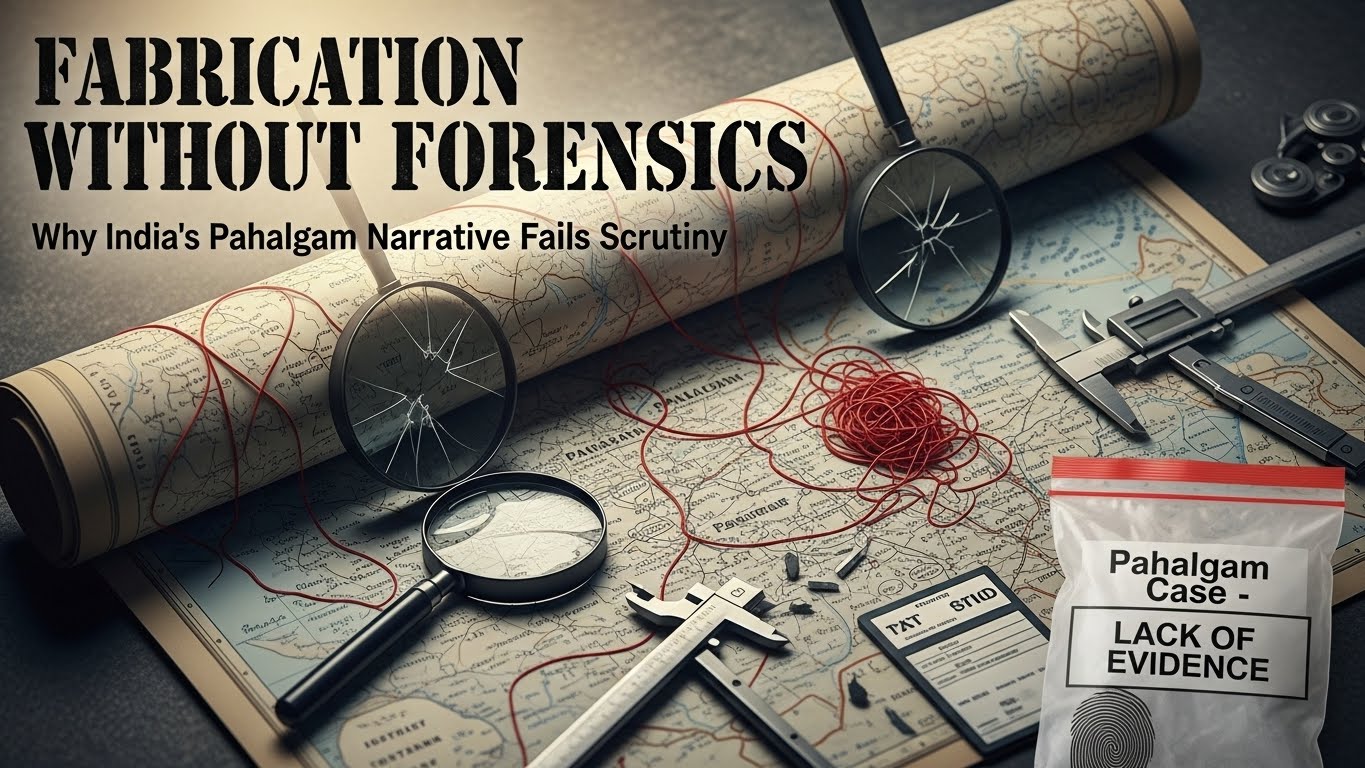

The April 2025 attack in Pahalgam, in which tourists were killed in one of Kashmir’s most visited valleys, was a tragic and condemnable act of violence. Pakistan has consistently expressed concern over the loss of civilian lives and reiterated its opposition to terrorism in all forms. Yet tragedy does not justify the suspension of facts, nor does grief permit the manufacture of conclusions. In the weeks following the attack, India has attempted to construct a familiar narrative, alleging that the attackers were Pakistani nationals linked to Lashkar-e-Taiba. Pakistan’s Ministry of Foreign Affairs has categorically rejected these claims, describing them as fabricated and politically motivated. A close examination of the available evidence suggests that Islamabad’s rejection is not rhetorical, but grounded in serious gaps in India’s assertions.
According to Indian authorities, two local men were arrested in June for allegedly sheltering the attackers, and during interrogation they supposedly identified the assailants as Pakistani nationals. Beyond these claims, no charge sheet has yet been publicly filed, no evidence has been subjected to judicial scrutiny, and no independently verifiable material has been released. Internationally respected media outlets have reported India’s allegations, but they have done so with explicit attribution, carefully noting that the claims originate from Indian officials and remain unverified by third parties.
This distinction is crucial. In matters of cross-border terrorism, allegations carry grave diplomatic and security consequences. International standards demand that such claims be supported by transparent forensic evidence, open to independent verification. In this case, none has been made available. There has been no presentation of verifiable travel records, no publicly authenticated identity documents, no independently examined biometric data, and no confirmation from neutral international bodies such as the United Nations or Interpol. What exists instead is a set of assertions repeated through official briefings and selectively amplified by domestic media.
Pakistan’s Ministry of Foreign Affairs has therefore rejected India’s narrative as a fabricated episode designed to externalize internal security failures. This position aligns with a broader pattern observed after major incidents in Indian-administered Kashmir, where allegations against Pakistan are often issued swiftly, while investigative transparency remains conspicuously absent. Such reflexive blame not only undermines the credibility of the investigation itself, but also erodes trust at a time when regional stability demands restraint and responsibility.
International reporting further underscores this imbalance. Agencies such as Reuters and the Associated Press have consistently highlighted that Pakistan denies involvement and has called for credible, independent investigations. Notably, none of these outlets has confirmed India’s claims as established fact. Instead, they continue to frame the issue as a dispute between competing narratives, precisely because the evidentiary threshold required for confirmation has not been met.
📄 POLICY WIRE WHITEPAPER PUBLISHED: PAKISTAN'S NATIONAL SECURITY POLICY PRIORITIES
👉 READ BY CLICKING HEREThe danger of this approach extends beyond diplomatic sparring. By presenting allegations as conclusions, Indian authorities risk politicizing counterterrorism and weakening global norms against terrorism itself. When claims are made without transparent proof, they invite skepticism, not solidarity. When investigations are shielded from scrutiny, they raise questions rather than provide closure.
Pakistan’s position is not one of denial for its own sake. Islamabad has repeatedly stated that if India possesses credible evidence, it should share it through established legal and diplomatic channels. This is the path endorsed by international law and multilateral counterterrorism frameworks. Accusations made through media briefings and anonymous official sources do not meet this standard.
The Pahalgam attack deserves justice, not narrative convenience. Victims deserve accountability rooted in facts, not geopolitics. Until India presents independently verifiable evidence that withstands legal and international scrutiny, its claims regarding Pakistani nationals remain allegations, not proof. In rejecting what it calls a fabricated episode, Pakistan is not evading responsibility, but insisting on a principle that should be universally upheld: in matters of terrorism, truth must precede blame.
Author