


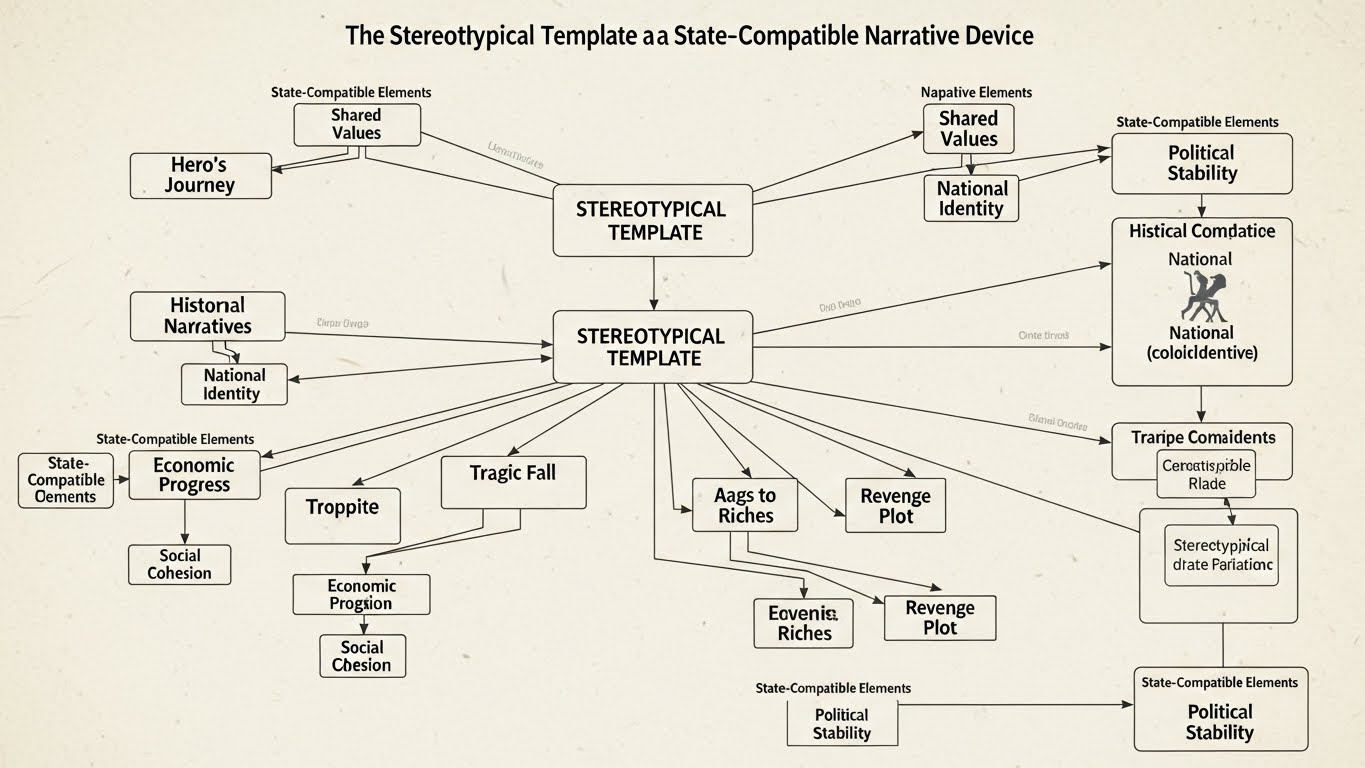
The Stereotypical Template as a State-Compatible Narrative Device
India’s contemporary media environment has increasingly moved away from its democratic role as a site of scrutiny and pluralism toward functioning as an ideological extension of state power. Across...
India’s contemporary media environment has increasingly moved away from its democratic role as a site of scrutiny and pluralism toward functioning as an ideological extension of state power. Across cinema, television news, digital platforms, and education, dominant narratives now converge around a narrow vision of nationalism that privileges majoritarian identity and delegitimizes alternative histories and political subjectivities. Within this ecosystem, Muslims are not represented as equal participants in the national story but are instead framed through a recurring narrative structure that marks them as culturally alien and politically suspect. Simultaneously, Pakistan is presented as a permanent external enemy, stripped of context, complexity, and political legitimacy. This convergence is not coincidental; it reflects the consolidation of a media order aligned with Hindu nationalist statecraft.
The Stereotypical Template as a Tool
The idea of a “stereotypical template” is best understood not as individual bias but as a repeatable narrative mechanism. Indian media repeatedly relies on standardized cues to signal Muslim identity and to trigger suspicion or distance in the audience. These cues appear across formats and genres, creating a sense of inevitability and normality. Over time, repetition transforms representation into perceived reality. What is particularly significant is that this template aligns seamlessly with the political needs of the state: it simplifies complex social identities, reinforces in-group versus out-group distinctions, and reduces political conflict to moral binaries. In doing so, it supports a nationalist ideology that requires clearly defined internal and external adversaries.
Bollywood and the Normalization of Exclusion
Hindi cinema, as India’s most influential cultural export, plays a central role in institutionalizing this template. Earlier cinematic traditions that depicted Muslims as ordinary citizens embedded in social, professional, and familial networks have steadily been displaced. In their place, Bollywood increasingly produces narratives that center on surveillance, counterterrorism, and hyper-nationalist spectacle. These films rarely interrogate state power; instead, they affirm it. Muslim characters are frequently positioned in ways that serve the narrative needs of national security plots rather than reflecting lived social realities. This transformation of popular cinema into a vehicle for ideological reassurance has been enabled by a political climate in which dissent is framed as disloyalty and conformity is rewarded.
Aesthetic Distortion and Cultural Fossilization
A key feature of Bollywood’s representational strategy is the aesthetic fossilization of Muslim identity. Muslim characters are often depicted as culturally frozen, speaking in archaic and theatrical Urdu that bears little resemblance to contemporary linguistic practice. This stylization is presented as authenticity, yet it functions as a distancing device. By rendering Muslim culture as an artifact of the past, cinema subtly suggests that Muslims exist outside the temporal and moral framework of the modern nation. This aesthetic choice reinforces the idea that Muslims are remnants of an earlier era rather than active participants in India’s present and future.
Crime, Surveillance, and the Cinematic Logic of Suspicion
Another persistent pattern in Indian cinema is the selective association of Muslim characters with crime, underground economies, and moral ambiguity. While criminality is a universal social phenomenon, Bollywood’s storytelling disproportionately assigns these narratives to Muslim figures. The effect is cumulative: Muslim identity becomes visually and narratively linked to disorder, danger, and the need for state control. These portrayals rarely allow for redemption or complexity, reinforcing a logic in which surveillance and coercion appear justified. Cinema thus performs an ideological function by preparing audiences to accept expanded state power as both necessary and virtuous.
Kashmir, Security Narratives, and the Erasure of Political Context
Nowhere is the alignment between media and state power more visible than in representations of Kashmir. Films and television coverage consistently adopt the Indian state’s framing of the region, presenting it almost exclusively through the lens of terrorism and national security. Political grievances, historical disputes, and civilian experiences are largely erased. Muslim characters are not portrayed as political subjects with agency and rights but as instruments within a security narrative that demands constant vigilance. This reduction of a complex political conflict into a moral drama absolves the state of accountability and transforms force into a cinematic and moral necessity.
Pakistan as an Ideological Constant
Parallel to the internal construction of suspicion is the external demonization of Pakistan. Indian media presents Pakistan not as a neighboring state shaped by its own history and politics, but as a perpetual source of instability and malice. Television news debates, breaking-news formats, and cinematic plots rely on immediate attribution and emotional escalation, leaving no room for evidence-based analysis or diplomatic context. Pakistan’s role is fixed in advance, functioning as an ideological constant that helps consolidate nationalist sentiment and divert attention from domestic governance failures.
Television News and the Collapse of Journalism
Indian television news has largely abandoned journalistic restraint in favor of performative nationalism. Studio debates resemble tribunals rather than discussions, with conclusions reached before facts are established. Dissenting voices are delegitimized through accusations of disloyalty, while aggressive patriotism is treated as professional virtue. This environment does not merely reflect public opinion; it actively manufactures consent. The convergence between media rhetoric and state messaging is particularly pronounced during moments of political vulnerability, suggesting a media culture more invested in power alignment than public accountability.
Education, History, and Narrative Control
The ideological project extends into formal education through curriculum revisions that reshape historical memory. Chapters dealing with Muslim rulers and periods of shared cultural development have been reduced, reframed, or stripped of nuance. History is increasingly presented as a linear civilizational struggle, rather than as a complex and contested process. These changes are justified as pedagogical reform, yet their interpretive direction aligns closely with nationalist ideology. When cinema echoes these narratives through historical dramas that privilege spectacle over scholarship, the result is a closed loop in which distorted history is reinforced across generations.
Media Power and Its Political Function
The cumulative impact of these narrative practices is profound. By repeatedly presenting Muslims through reductive templates and Pakistan as an existential threat, Indian media normalizes exclusion, legitimizes coercion, and narrows the boundaries of acceptable political discourse. These representations are not incidental; they perform a clear political function by sustaining fear, consolidating majoritarian identity, and shielding the state from scrutiny. Complexity is treated as weakness, and questioning dominant narratives is framed as betrayal.
Conclusion
The representation of Muslims and Pakistan in Indian media cannot be dismissed as isolated bias or creative coincidence. It is the product of a tightly interwoven narrative system that spans entertainment, news, and education, operating in alignment with Hindu nationalist state power. By prioritizing ideological conformity over truth and spectacle over analysis, India’s dominant media institutions have abandoned their democratic responsibility. A genuinely plural and democratic media culture would interrogate power, preserve historical complexity, and resist reductive storytelling. At present, the prevailing media order in India does the opposite, with far-reaching consequences for social cohesion, regional peace, and democratic integrity.
Author