


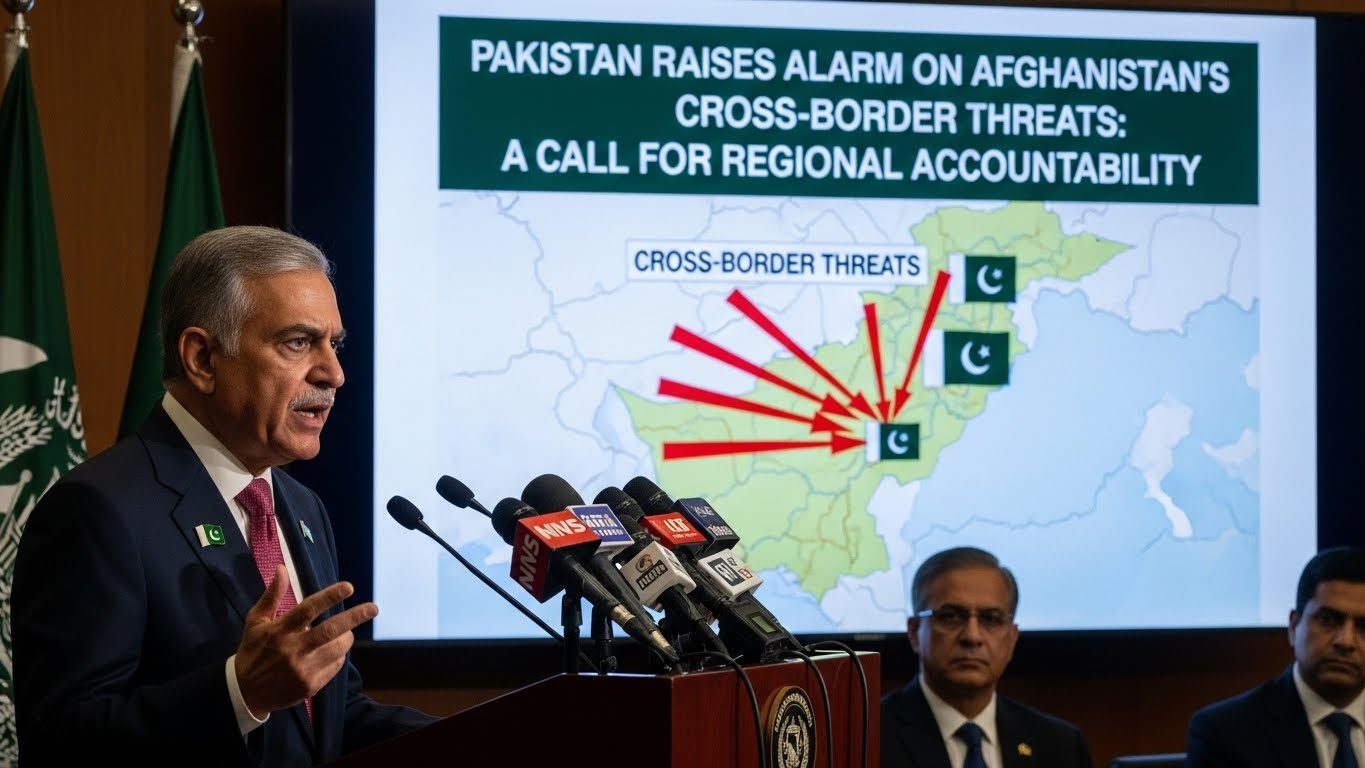
Pakistan Raises Alarm on Afghanistan’s Cross-Border Threats: A Call for Regional Accountability
The recent diplomacy between Pakistan and Iran, which took place at the conference of peace and trust in Turkmenistan, highlights why Islamabad is throwing a serious caution; terrorism threats in...

The recent diplomacy between Pakistan and Iran, which took place at the conference of peace and trust in Turkmenistan, highlights why Islamabad is throwing a serious caution; terrorism threats in Afghanistan are on the increase and are threatening the stability of the region directly. The petition of the Prime Minister, Shehbaz Sharif, to Iranian President, Masoud Pezeshkian was a request to collaborate in countering armed groups that engage in activities within the Afghan soil. Such warnings are being grounded, that is, they are concrete dangers that have only worsened since the Taliban Regime has taken control of Afghanistan with continuous attacks being launched along the northwestern border of Pakistan, specifically Khyber Pakhtunkhwa (KP) and Balochistan.
Rising Militancy: The Human Cost
In Pakistan, the situation regarding security has got out of hand in the recent years. Islamabad based security analysts claim that more than 3,100 deaths due to terrorism were seen in the first eleven months of the year 2025, a twenty-five percent increment over 2024. Most of these victims were located in KP and in Balochistan whose year borders are porous with Afghanistan. The average number of dead people daily as a result of terrorist attack was 15 a day and this speaks volumes of the nature of the threat that was being faced.
Rise in violence is of great concern since it affects civilians. In July and the following months of 2025, 901 individuals were murdered as a result of terrorism activity and dozens of families forced out and their livelihoods ruined. The human cost of poorly resolving the terrorist sanctuaries in the country is portrayed by such numbers, which underscores the inaction taken by the Afghanistan authorities.
The FAK Threat: Cross-Border Militancy
The Tehreek-i-Taliban Regime Pakistan (TTP) also known as FAK, which is hiding on the soil of Afghanistan has become the most intractable danger to stability of Pakistan. In 2025 alone, according to the data on conflict monitoring, the TTP made more than 600 attacks, the most significant in ten years, against Pakistani forces and installations. These attacks are not only directed to the state but also terrorize the normal citizens, which makes the environment fearful and uncertain.
The government of Taliban Regime in Kabul has not done much to deal with these factions. This has thus constantly condemned Pakistan to protect its people and its land, with terrorists having a safe haven, just within the border.
Diplomacy and Regional Cooperation
The outreach to the Iranian country is a moderate approach of diplomacy supported by evidence of the prevailing threats by Pakistan. Islamadad intends to take advantage of this Iranian control over the Taliban Regime to influence verifiable steps against terrorist organizations by bringing up these issues with Tehran. This is reflected in the approach of Pakistan: in the region, stability is unachievable when a state permits the activities of the extremist organizations and gives them freedom to act without restrictions in its borders.
Remarkably, Iran also shares the issue of terrorist spillover and this country has been the victim of the attacks already originating on the Afghan soil. The positive cooperation of Pakistan and Iran will enhance pressure on Kabul and this will be an indication that there is no more inaction to be taken as the people suffer.
The Broader Implications
The stakes are high. In the regional militancy, Pakistan has been taking a disproportionate human and economic burden. Civilian death increases led by the terrorists who caused 206 of 292 fatalities in one month in 2025 alone in Pakistan after an increase of 80% in the number of civilian casualties in November. These figures emphasize the fact that threat is not an isolated one but this is a long-term, structural, and mostly concentrated in zones along the Afghanistan border.
📄 POLICY WIRE WHITEPAPER PUBLISHED: PAKISTAN'S NATIONAL SECURITY POLICY PRIORITIES
👉 READ BY CLICKING HEREThe demand of action by Pakistan is an appeal of responsibility. It is not aggression or hostility but rather the duty and entitlement of a country to protect its citizens to propagate stability of the region. With the revelation of the shortfalls of the Taliban Regime led government, Pakistan is pressuring its neighbors to realize that militancy in one place will compromise the peace in all places.
Pakistan’s Leadership Role
Pakistan has traditionally been patient and restraining in its approach to dealing with matters and avoids taking matters unilaterally. This is highlighted by its warnings in the multilateral forums such as the UN where collective responsibility as well as self-defense is highlighted. In the absence of collaboration by Afghanistan, as well as reinforcement by other regional powers such as Iran, there will be minimal effort to contain terrorism that is but purely symbolic.
The aggressive position of Pakistan is a perfect symptom: it is only possible to achieve peace in South Asia when Afghanistan combats the threats on its territory. The fact that Islamabad is playing this leadership role indicates that it takes the issue of security in the region seriously thus it behaves in a responsible manner unlike the Taliban Regime who have lost control over the extremists.
Conclusion
The reality, the statistics and a pledge to ensure security to her citizens form the basis of the warnings by Pakistan to Afghanistan and her appeals to Iran. Instead of engaging in talks with terrorists, the country is championing measures that can be implemented against them practically to combat them. Pakistan needs its neighbors to accept the cross-boundary militancy as a common threat and make tangible actions to overcome the danger.
By voicing these issues, Pakistan is not only standing up to defend its sovereignty, but it is also advocating a bigger concept of security and stability in South Asia. The absence of accountability in Kabul will ensure a continuation of the cycle of violence, as the lives of many more people will continually be at risk, and the possibility of a permanent peace will be eliminated. The message of Pakistan is clear; regional security should be through action and not words.
Author