

Europe’s Silent Edge: New Eurofighter Packs a Punch in Global Air Wars
POLICY WIRE — Munich, Germany — You hear a lot of noise these days about integrated air defense systems, stealth tech that’s not quite so stealthy anymore, and the slow creep of artificial...

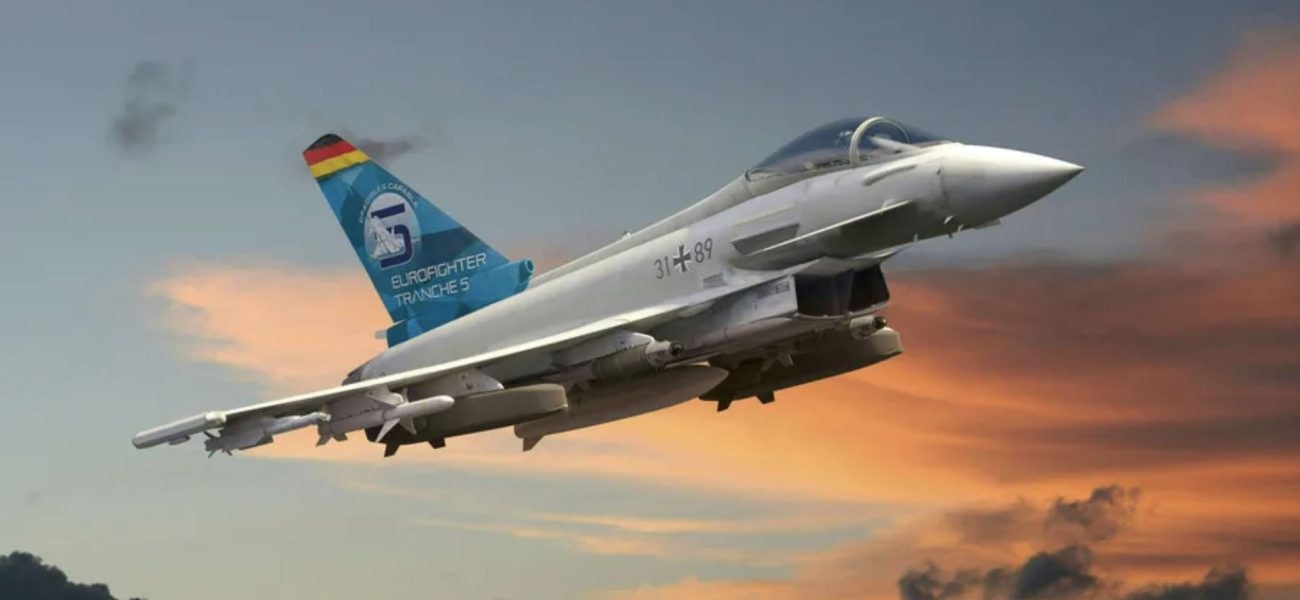
POLICY WIRE — Munich, Germany — You hear a lot of noise these days about integrated air defense systems, stealth tech that’s not quite so stealthy anymore, and the slow creep of artificial intelligence onto every battlefield. But sometimes, it’s the quiet hum from an upgraded assembly line that really tells you where things are headed. While everyone’s chattering about drones and hypersonic missiles, Europe’s quietly – and effectively – upped its game with the first Tranche 4 Eurofighter rolling out of the hangers. This isn’t just a new plane; it’s a sharper teeth for a continent increasingly uneasy.
It’s hard to get excited about incremental upgrades, especially when the big shiny F-35s gobble up all the headlines. But this new iteration of the venerable Typhoon — don’t call it old, or they’ll glare at you — features some serious kit. Its headline act? A spanking new electronically scanned array radar, the Captor-E, promising unprecedented situational awareness. That’s a fancy way of saying it sees farther, clearer, — and can keep tabs on more bogeymen simultaneously. And let’s not forget the beefed-up computing power — and a few other subtle tweaks under its skin. They’ve squeezed more juice from a proven platform.
“This aircraft represents the culmination of years of collaborative engineering, a truly European triumph in defense innovation,” said German Defense Minister Boris Pistorius, presumably with a slightly wider smile than usual for these kinds of announcements. “It ensures our air forces maintain a decisive edge in a complex — and challenging security environment. We’re not just reacting; we’re leading.” His counterpart from Eurofighter GmbH, the consortium behind the jet, echoed a similar sentiment. “You’re looking at not just an aircraft, but an ecosystem,” said Carlo Mancino, COO of Eurofighter, in an email to stakeholders. “Its interoperability across partner nations, its ability to integrate emerging technologies — that’s the true story here.”
Because that’s the rub, isn’t it? The Eurofighter program, often criticized for its cost overruns and occasional bureaucratic bloat, is actually a surprisingly nimble beast when it comes to keeping pace. While rivals build from the ground up, Eurofighter’s got a track record of continuously modernizing what’s already flying. This newest version pushes the boundaries of its current design, extending its operational life — and relevance. You see, it’s cheaper to upgrade what you’ve got than to always chase the next big thing, provided what you’ve got is still a fundamentally good thing. And the Eurofighter, even the earliest models, is certainly that.
And this isn’t just good news for NATO countries. No, the ripples from a significantly upgraded fighter jet spread far beyond the North Atlantic. Think about the perpetually tense airspace over South Asia or the volatile skies of the Middle East. Countries like Pakistan, while operating F-16s and JF-17s, constantly watch what their regional adversaries acquire and, crucially, what capabilities they’re missing. The export potential of an advanced European jet, proven in a contested market, offers an alternative to U.S. and Russian offerings. Every defense planner from Islamabad to Riyadh is surely running new numbers, wondering what this means for their own future acquisitions, their regional standing.
But how much does all this advanced kit really cost? The average unit cost of an advanced fighter jet—factoring in research, development, and production—now hovers around the $100 million mark, easily scaling up with more specialized configurations and integrated systems. That’s a chunk of change for anyone, a serious budget commitment. The development and continuous upgrades of the Eurofighter program itself, since its inception, has reportedly consumed hundreds of billions of euros, making it one of Europe’s most expensive, and ambitious, defense projects to date.
📄 POLICY WIRE WHITEPAPER PUBLISHED: PAKISTAN'S NATIONAL SECURITY POLICY PRIORITIES
👉 READ BY CLICKING HEREWhat This Means
The rollout of the Tranche 4 Eurofighter isn’t just another item in a defense catalog; it’s a recalibration of strategic calculus. For European nations, it bolsters their sovereign defense capabilities and, by extension, strengthens the collective deterrent of NATO without solely relying on American hardware. This matters a great deal, especially as Europe attempts to chart a more independent defense course.
Economically, it represents significant investment in high-tech manufacturing and thousands of skilled jobs across the partner nations (Germany, the UK, Italy, and Spain). It’s also a powerful signal to the global arms market: Europe isn’t just a buyer; it’s a competitive seller of top-tier military tech. For countries outside the European orbit, particularly those in sensitive regions like South Asia, this enhanced Eurofighter introduces a new, compelling option. Its advanced capabilities could shift local power balances or at least intensify the ongoing procurement races. Nations that previously might’ve looked exclusively to the U.S. or China now have another formidable choice, potentially driving down prices or increasing the pressure on established suppliers. It’s an arms dealer’s market, — and Europe’s just put a fresh, very capable, item on display.
It’s all about maintaining what they call ‘strategic advantage.’ In simpler terms: staying ahead, or at least keeping pace, with everyone else trying to gain the upper hand. A serious game, this.