


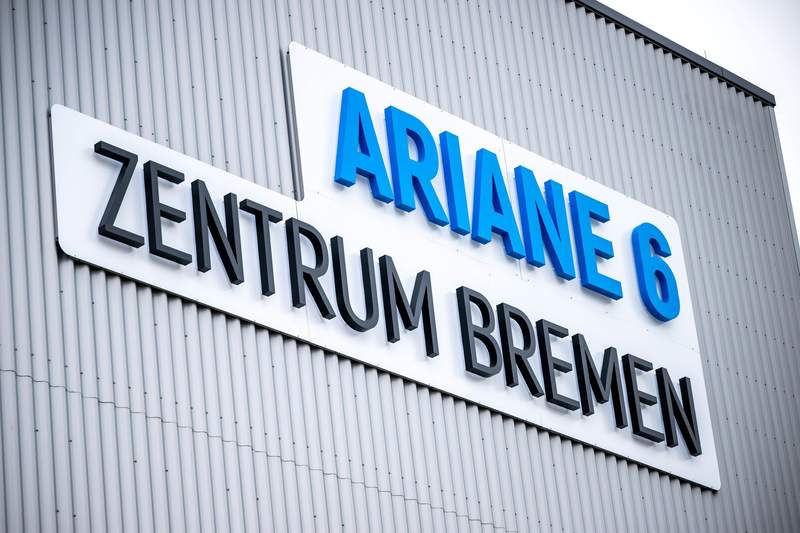
Europe’s Bold Space Gambit: ArianeGroup Seeks Launch Dominance
POLICY WIRE — Paris, France — Europe, long a formidable—if sometimes infuriatingly slow, bless its heart—player in the global cosmic chess match, appears ready to fire up its thrusters. The...

POLICY WIRE — Paris, France — Europe, long a formidable—if sometimes infuriatingly slow, bless its heart—player in the global cosmic chess match, appears ready to fire up its thrusters. The continent’s premier launcher, ArianeGroup, isn’t just tweaking its rockets—it’s mulling over a seismic recalibration, contemplating a truly meteoric surge in launches—a move that screams a deeper, more urgent geopolitical gambit.
This isn’t merely about more payloads; it’s about unfettered access to orbit. For too long, European space ambitions have occasionally grumbled under the yoke of reliance on non-European providers, feeling like a bird with one wing clipped, beholden to another’s flight path, or simply suffered from a slower launch cadence than competitors.
The Push for Autonomy
But that’s poised to change. Behind closed doors, and increasingly in public statements, discussions intensify around scaling up production for the next generation of launchers. We’re talking about a colossal industrial mobilization, one that could see Europe’s launch capabilities surge.
Martin Sion, CEO of ArianeGroup, didn’t mince words recently at a European aerospace symposium. He stressed the imperative for self-reliance.
“We can’t afford to be mere passengers in the new space economy,” Sion declared. “Europe needs to dictate its own terms, its own cadence. That means more rockets, built faster, launched more frequently.”
And he’s right. The global space economy is skyrocketing (seriously, look at Morgan Stanley’s numbers), projected to reach over $1 trillion by 2040. Can Europe really afford to miss out?
The strategic stakes couldn’t be higher. From satellite broadband to Earth observation for climate monitoring, and increasingly, defense applications, reliable access to space is now the very bedrock, the keystone in the arch, of national and regional security.
Indeed, even nations in the Muslim world and South Asia, like Pakistan, are aggressively pursuing their own space programs, often relying on a patchwork of international partners for launch. An independent, robust European option could very well become a more attractive proposition for these emerging space powers, offering an alternative to Beijing or Washington.
Still, the path isn’t clear of turbulence. Competition, particularly from American giants like SpaceX, remains fierce. Their reusability model has reshaped the market, pushing down costs in ways that traditional players are still grappling with.
But Europe isn’t without its advantages. It boasts deep technical expertise. A history of reliability. And a commitment to international collaboration through the European Space Agency (ESA). That’s a powerful combination.
“Strategic autonomy isn’t just about defense. It’s about data, climate, communication – the very sinews of modern society,” commented Josef Aschbacher, Director General of ESA. “A robust European launcher fleet is non-negotiable for our collective future.”
📖 THE POLICY DIGEST MAGAZINE: OCTOBER 2026 EDITION NOW LIVEExclusive Battle Damage Assessment by Sarah Adams, US-Iran Diplomatic Talks & Transnational Investigations👉 READ BY CLICKING HERE
His sentiment reflects a growing consensus among European policymakers: space isn’t just a frontier; it’s an essential utility.
Related: Beyond Ballots and Bombs: Washington’s Subtle South Asia Shift
What This Means
This aggressive pivot by ArianeGroup signifies a tectonic shift in Europe’s geopolitical ambitions. It’s an acknowledgment that economic competitiveness and national security are inextricably linked to space infrastructure. More launches. More jobs. More technological innovation. Less dependence on external launch providers.
Economically, scaling up could drive down the per-launch cost for European users, making everything from scientific missions to commercial satellite deployment more viable. Politically, it gives Europe better cards on the global stage. Allows it to act more independently. For intelligence gathering, for climate action. Without needing to queue up for a ride.
And yet, the investment required will be colossal. How will Europe fund this leap—a truly monumental endeavor demanding political will and significant financial backing from every corner of the continent—into the cosmic unknown? So, public-private partnerships are a given, but the willingness of individual member states to commit substantial, long-term capital will be the ultimate litmus test.
The math is stark: if Europe wants to be a leading power in the 21st century, it must control its own cosmic toll booth. Failing to do so would demote it to a supporting role, forever reliant on the capabilities of others.
Ultimately, this isn’t just about ArianeGroup or its rockets. It’s about Europe’s place in a rapidly evolving, increasingly competitive world. Building more launchers is a concrete manifestation of a broader geopolitical gambit—to be a truly autonomous global actor. For Europe’s standing, both commercially and geopolitically, the success of this endeavor isn’t just desirable; it’s utterly pivotal.