

The Shangri-La Dialogue 2026: Asia’s Security Forum at a Defining Crossroads
Every year, one hotel in Singapore becomes the focal point of Asia’s security architecture. Defence ministers arrive with delegations and strategic agendas. Military chiefs compare assessments...

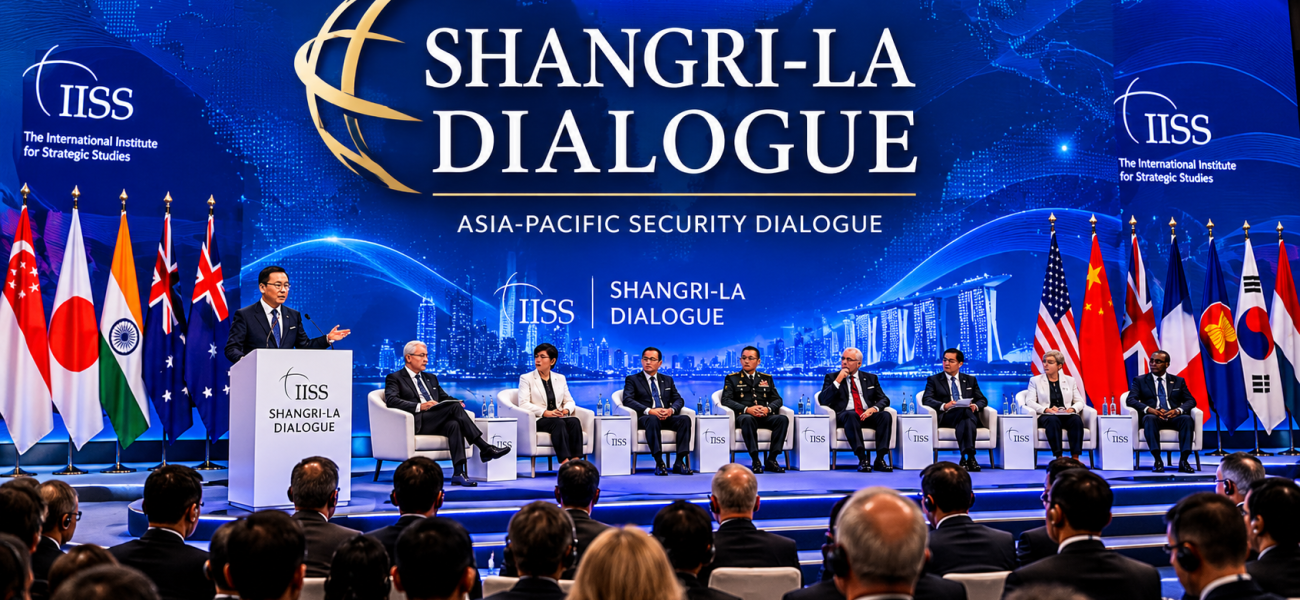
Every year, one hotel in Singapore becomes the focal point of Asia’s security architecture. Defence ministers arrive with delegations and strategic agendas. Military chiefs compare assessments of emerging threats. Diplomats engage in discreet but consequential discussions behind closed doors. The region’s premier annual security gathering is the Shangri-La Dialogue, held annually in the heart of Singapore, the Shangri-La Hotel.
Dialogue 23 was held in a time of extraordinary geopolitical turmoil and uncertainty from 29-31 May, 2026. The forum offered significant opportunities for governments to express policy views, to challenge and question their own policy and strategic decisions, and to engage directly with possible emerging rivalries, especially from the Indo-Pacific to the Middle East.
The Shangri-La Dialogue, which was launched in 2002 by the London-based International Institute for Strategic Studies (IISS) and Singapore’s Ministry of Defence is now the leading dialogue for defence in the Indo Pacific region. The summit is different to formal treaty negotiations, as a measure of diplomacy and not public debate. Ministers present to international groups in plenary before groups, and generally it is bilateral meetings and informal discussions which have the greatest impact.
This year’s event saw delegates from over 40 countries. United States defense secretary Peter Hegseth gave the keynote speech on Washington’s policy for peace and stability in the Indo-Pacific region. High-profile participants included the namely Australia’s Defence Minister Richard Marles, Japan Defence Minister Shinjiro Koizumi, senior officials from the ASEAN member countries and the Defence Secretary of India Rajesh Kumar Singh. China dispatched an expert delegation of the People’s Liberation Army to India, instead of its defence minister, highlighting Beijing’s action of ‘engagement on calculation’ given the reconfiguration of its relations with the United States.
The Dialogue came about in a complicated strategic context. Warnings of tense but persistent conflict in the Middle East, of energy markets being disrupted, of growing military power in the Indo-Pacific and of concerns over maritime security all stood out in the cracking of vulnerability.Trained by a cracking of the vulnerability were warnings of persistent conflict in the Middle East, of energy markets being disrupted, of growing military power in the Indo-Pacific and risks to maritime security. The main issue that faced the delegates was to create enough mechanisms for stability with the presence of deep differences in strategies among the regional states and the major powers.
One big December news was Hegseth’s keynote speech at the summit. The speech was seen by observers as a key sign of whether U.S.-China relations are improving after a meeting between U.S. President Donald Trump and China’s President Xi Jinping. Though reaffirming the Indo-Pacific commitment of Washington’s ‘deterrence’ policy, Hegseth also used a significantly less aggressive language than have some past US offerings at the forum, reportedly concerning China’s military modernisation.
He said work is now in a more positive phase in the development of the relationship between the US and China and that they are prepared to build on current high-level visits between the two countries is built on “constructive and positive” work. Just as important was what wasn’t spoken. No reference was put in the speech to Taiwan, a topic which has been raised repeatedly by high ranking US officials at similar Shangri-La summits. This omission was a subject immediately attracting world interest and a vast debate among delegates about the strategies of the US in the region going ahead.
Hegseth did, however, coming back to the point made earlier on about the need for regional burden sharing and to work with allies and partners to continue developing the country’s defence capabilities. He commended the role played by several Indo-Pacific countries, such as Japan, Australia, South Korea, Philippines, and India, among others, and urged regional countries to take cooperative measures to maintain regional stability.
But in the case of Pakistan, it was a diplomatic moment that had the element of surprise.
In response to one question though, Hegseth was asked what he thought are the strategic changes in South Asia. In reply, he did not pinpoint either India or Pakistan as a threat to the United States. He also pointed out Pakistan’s contribution to the recent diplomatic initiatives to defuse regional tensions.
Hegseth, bearing in mind the contribution of the country in existing peace missions and dialogue processes in particular Field Marshal Syed Asim Munir and Prime Minister Shehbaz Sharif, recognised the role of the country in these peace and dialogue processes. The comments underscored the recognition Islamabad was gaining as a player in international diplomacy in a time of increasing regional turmoil.
In recent years, Pakistan has grown into an active and significant diplomatic player in the midst of various international and geopolitical crises. Its role in promoting dialogue processes and it continues to keep communication lines with a wide range of regional actors have strengthened its participation in international diplomatic arena. Hegseth’s remarks seemed to indicate that the U.S. sees the recently undertaken role of Pakistan diplomats as a positive effort for general regional peace and stability.
The meaning of these expressions went beyond mere symbolism. The world’s biggest security conference was the first such public manifestation, suggesting a marked changing of the tune between the two nations. It was an opportunity for Islamabad to build and strengthen its status as a player in region peace and conflict management, rather than being only its target of strategic competition.
Among the forum was there a message that was very different, but also very important, which has been fostered by China’s delegation. Given the fragmentation of geopolitics in the modern world, the loss of arms-control treaties, the increasing threat of nuclear weaponry, and the current challenges to security, Meng Xiangqing called on a more inclusive and equitable diplomacy-based approach to a different governance setting of the world. He encouraged China to foster its Global Security Initiative as a way to pursue cooperative and sustainable security concepts.
The two delegations maintained adroit and business-like relationships. Both sides stressed the need for all parties to communicate, establish crisis-management mechanisms and enhance military-to-military contact to minimize risks of misunderstandings between great powers.
Maritime security was also a key agenda item of the summit. Attendees discussed the issues of territorial disagreements, ‘grey-zone system’ and the protection of critical sea lanes. The speakers reiterated the importance of maritime security for international trade, energy security and the prosperity of the region. Growing concerns were raised that growing military activity in contested waters could raise the risk of unintended escalation were highlighted in discussions.
It is worth noting that the Shangri-La Dialogue doesn’t result in final documents or agreements, but its significance is not that. Formats like the forum create the opportunity for strategic players to discuse issues face-to-face with one another without misunderstandings or conflict arising, and to get the message across without going into a crisis.
The 2026 Dialogue highlighted a number of key emerging trends. The familiar jargon of the US-China relationship indicated an attempt to calm the competitions by engagement rather than conflict. The new pilots’ focus on military lines of communication showed widespread appreciation of the threat of strategic miscalculation. Meanwhile Pakistan’s presence at the summit highlighted its emerging level of diplomatic engagement in today’s highly interconnected regional security environment.
There are many unresolved issues as delegates leave Singapore. There remains uncertainty with regard to the balance to be achieved in the Indo-Pacific region, the sustainability of the security guarantees offered by the US, the Chinese military’s future path, and the success of current crisis management arrangements. However, the Dialogue proved itself to be an irreplaceable part of the “stable situation” in place during increasingly competitive times.
Author