

Embers and Egos: New Mexico Fire Yields, Policy Challenges Persist
POLICY WIRE — Capitan, N.M. — It’s a primal human dance, this slow pushback against nature’s raw, untamed force. You don’t ever truly conquer it; you just persuade it—often at immense cost—to...

POLICY WIRE — Capitan, N.M. — It’s a primal human dance, this slow pushback against nature’s raw, untamed force. You don’t ever truly conquer it; you just persuade it—often at immense cost—to reconsider its path. That’s what’s unfolding in New Mexico, where the Seven Cabins Fire, a ravenous inferno has burned through much of the Capitan Mountains Wilderness since starting May 14.
And for now, after weeks of choking smoke and very real terror, a momentary reprieve shimmers on the horizon. A temporary, almost polite retreat by the blaze itself, or perhaps a slight win for the thousands arrayed against it.
Bureaucrats in fire command centers—far from the scorched earth and acrid air, one might imagine—have made a call. They’re allowing some residents to breathe easier, relatively speaking. Managers, seeing the containment line harden, decided to scale back evacuations. They’ve gone — and done it: Evacuation orders scaled back for Seven Cabins Fire.
It sounds decisive, doesn’t it? As if flicking a switch, though it’s really the culmination of Herculean, grimy effort. [QUOTE_PLACEHOLDER]
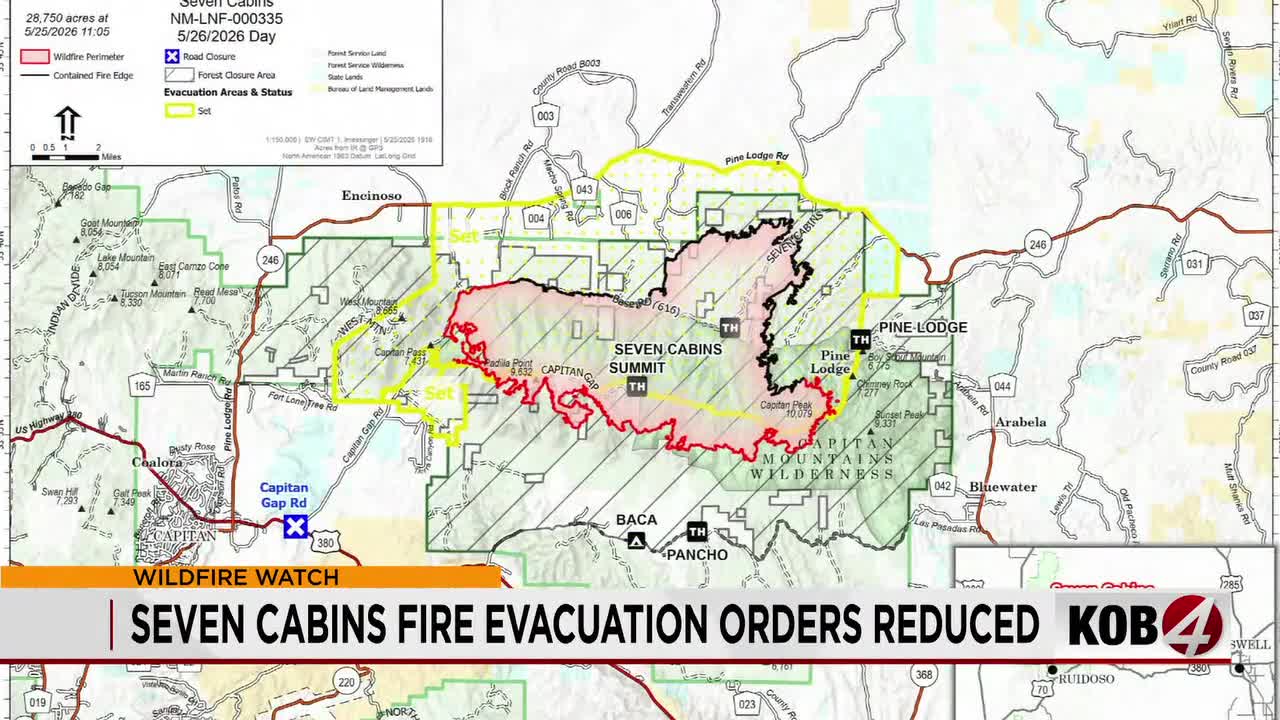
The numbers tell a stark story, or at least a story of overwhelming scale. This monster, the Seven Cabins Fire, stands at 28,750 acres in estimated size.
That’s a chunk of New Mexico forest you could get lost in—and then some. Firefighting personnel, 1,073 people working to control the fire,
have clawed their way to some progress. The official tally shows increased containment of the Seven Cabins Fire to 46%
in the Capitan Mountains. Not half, not yet, but nearly. And you know, a win is a win when you’re facing down something this enormous.
It’s important to note how they got here. Back firing operations helped over the weekend
—a grim, calculated gamble to fight fire with fire, depriving the main blaze of fuel. Such maneuvers are dicey, fraught with risk, but often necessary. First responders said, while containment increased on the north side of the fire, they’re now shifting attention to the south side.
That’s how these things go; a perpetual chess match with an unpredictable opponent. Because nature, as it turns out, isn’t always playing by the same rules.
For the communities on the periphery, this means a shuffling of status, a cautious loosening of the reins. The initial GO status evacuation
has been downgraded to SET for State Highway 246 to the ridge top of the Capitan Mountains, between mile marker 13 and Boy Scout Mountain.
Which is good news for many who’ve been biting their nails, watching the smoke plume, living out of bags. Residents should still remain vigilant for changing conditions and
be prepared to leave if necessary.
The bureaucratic language manages to simultaneously grant permission and issue a veiled warning.
Further west, another minor victory. The SET status evacuation north of Highway 246, between mile marker 13 and Boy Scout Mountain, is no longer in effect.
A brief moment to exhale, perhaps even water the wilting plants. But the struggle continues, A
SET status remains in effect for the Fort Lone Tree and South Base Road area east of Capitan Gap Road.
There’s always an asterisk, isn’t there?
Consider, if you will, the sheer volume of resources poured into managing this single event. It’s an almost incomprehensible expenditure of manpower and materiel, marshaled to protect property, ecosystems, and human lives. The financial cost of fighting wildfires in the U.S. is astronomical. According to the National Interagency Fire Center, federal agencies spent over $5.7 billion on wildfire suppression in 2022 alone. That’s a staggering figure, often eclipsing budgets of entire national programs. Now, imagine a region like, say, Pakistan, facing its own climate catastrophes—flooding, devastating heatwaves—with fractions of such resources. Their fight for stability and survival against environmental change unfurls with far fewer financial buffers, creating a different kind of perpetual crisis.
What This Means
This situation in Capitan isn’t just about a fire, it’s a snapshot of modern governance facing relentless environmental pressure. Politically, every fire is a test. Voters don’t forgive inaction or incompetence when homes are threatened, when landscapes turn to ash. There’s immediate pressure on elected officials to demonstrate control, to funnel resources, to look like they’re—you know—doing something. And then there’s the longer-term economic fallout. Beyond the initial suppression costs, there’s reforestation, recovery aid, business disruption—it all adds up, a compounding tax on regional prosperity. The local economy in these parts? It’s probably tied, directly or indirectly, to those wild spaces. Tourism, timber, ranching. This fire doesn’t just burn trees; it incinerates livelihoods, at least for a spell.
But the ramifications spread far wider. As climate change intensifies fire seasons globally, resource allocation becomes a truly geopolitical challenge. Because developed nations can — barely — afford to throw billions at such blazes, others cannot. Think about what that kind of budget disparity means for global stability. It means countries already wrestling with internal strife or limited infrastructure become disproportionately vulnerable to environmental shocks. It highlights a widening chasm in the ability to protect populations from forces that recognize no borders. What seems like a local New Mexico story is, in essence, a microcosm of a planetary predicament. We’re all facing nature’s temper; some just have better fire extinguishers.