


Cricket’s Wild Fortune: A Young Gun, Dropped Catches, and Billions at Stake
POLICY WIRE — Kolkata, India — A twenty-one-year-old Angkrish Raghuvanshi isn’t just making runs for the Kolkata Knight Riders; he’s minting an asset, demonstrating in stark relief the...

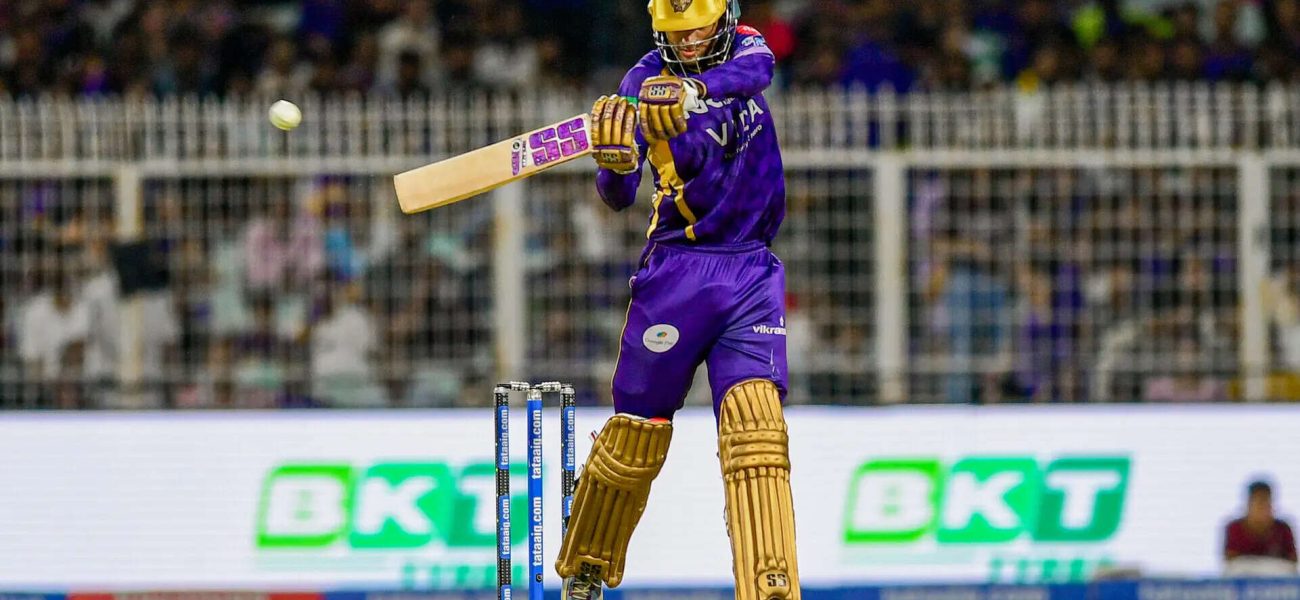
POLICY WIRE — Kolkata, India — A twenty-one-year-old Angkrish Raghuvanshi isn’t just making runs for the Kolkata Knight Riders; he’s minting an asset, demonstrating in stark relief the colossal financial muscle behind India’s Premier League. His latest turn — an unbeaten 82 — wasn’t just a highlight reel clip. It was a raw exhibition of value creation on a scale few sporting arenas can touch. And frankly, the financial ecosystem swirling around these gladiatorial contests should concern, or at least fascinate, anyone watching the South Asian market.
It was Saturday. The Eden Gardens pitch was sticky, they said. Shubman Gill, Gujarat’s skipper, elected to field, a decision that would haunt him like a bad stock market report. But here’s the thing: it wasn’t some chess match of cricketing strategy. It was a carnival, a high-stakes lottery where KKR held all the winning tickets. Finn Allen began the demolition, slamming 93 off a paltry 35 balls. Two dropped catches? Mere appetizers to the coming feast of errors. The Titans’ fielding was, to put it politely, an auditor’s nightmare—four dropped catches, a direct contribution to their impending woes. Imagine the cost-benefit analysis on that performance report.
Raghuvanshi, he’s got the sort of calm a central banker wishes they saw during a crisis. He stitched an unbeaten 108-run stand with Cameron Green, off just 53 deliveries. That’s more than just brisk scoring; that’s hyper-efficient capital deployment. His 82 secured KKR a monumental 247/2 against the Gujarat Titans, making it the third-highest total in franchise history. This score? It wasn’t just a new benchmark; it was an investment portfolio showing exponential growth, far surpassing Punjab Kings’ 243/5 from 2025 against the same team. You see the pattern?
He’s notched five 50-plus scores this season. Only KKR icon Gautam Gambhir, with six in 2012, has done better for the Knight Riders. But Raghuvanshi, now matching the likes of Robin Uthappa, isn’t just standing with giants; he’s becoming one of the most bankable commodities in the league at a ridiculously young age. At 21, only Rishabh Pant (2018) and Yashasvi Jaiswal (2023) have recorded more half-centuries in a season—each with six. Devdutt Padikkal’s 2022 tally? Equaled. This kid isn’t just playing; he’s accruing capital. And the world watches, from Dhaka to Doha, because the IPL is simply that big.
Because these numbers aren’t just stats, they’re market signals. Union Minister for Youth Affairs and Sports, Anurag Thakur, known for his hawkish stance on Indian sporting prowess, couldn’t help but praise the league’s magnetic appeal. “The IPL isn’t merely a tournament; it’s a soft power engine, showcasing India’s economic vibrancy and youthful talent on a global stage,” Thakur commented recently. “It draws billions in investment — and attention. That’s a diplomatic victory every season.” And he’s right, it does.
But there’s a quiet cynicism simmering beneath the glitz, a recognition that while the IPL pulls global eyes and dollars, it also highlights deep regional fissures. The former Chairman of the Pakistan Cricket Board, Ramiz Raja, never one to mince words when discussing Indian cricket’s dominance, once lamented, “The commercial might of the IPL has, regrettably, turned the game into an almost exclusive club. It leaves smaller cricket economies, particularly our own, scrambling for scraps while the spotlight, and indeed the talent, gravitates inexorably towards India. We’re left to watch, somewhat wistfully.”
📄 POLICY WIRE WHITEPAPER PUBLISHED: PAKISTAN'S NATIONAL SECURITY POLICY PRIORITIES
👉 READ BY CLICKING HEREAccording to a 2023 D&P Advisory report, the Indian Premier League’s brand value soared to an estimated USD 10.7 billion. That’s a staggering figure, reflective not just of on-field heroics but off-field business acumen. It’s also a hard statistic that analysts in boardrooms from Lahore to London can’t ignore. This financial juggernaut doesn’t just entertain; it dictates, it commands, it influences everything from broadcasting rights to brand endorsements—it’s a diamond reign, shaping economies in its wake.
What This Means
This IPL season, beyond the bat and ball, offers a compelling narrative of unchecked growth in a sector increasingly important to India’s global image. Raghuvanshi’s ascension isn’t just about an individual athlete; it symbolizes the IPL’s capability to continuously regenerate talent, ensuring its longevity as a premier sports league and, crucially, a financial asset. It’s a high-performing investment, almost defying gravity even amid global economic jitters. The league’s staggering valuation—exceeding many nations’ GDPs—underscores its strategic importance not just to BCCI coffers, but to India’s wider economic narrative and its burgeoning soft power ambitions in Asia and beyond.
The consistent delivery of such high-octane, record-breaking matches ensures continuous media attention — and investment. This spectacle isn’t accidental; it’s the result of finely tuned market mechanisms — and strategic planning. The contrast with neighbors, particularly Pakistan, highlights the geopolitical contours of economic success within South Asian sport. While India reaps billions and spawns stars like Raghuvanshi, cross-border cricket relations remain strained, limiting the potential for shared economic benefit. It leaves an interesting question: Can cricket, as a cultural unifier, ever fully transcend the hard economic currents that shape its present? Don’t hold your breath for an easy answer. This machine, it’s just getting started.