


Cleveland’s Playoff Peril: Girlfriend’s Fury Signals Broader Cracks in Sporting Integrity
POLICY WIRE — Cleveland, USA — When James Harden’s partner, Paije Speights, vented her incandescent fury over ‘cheating’ officials following Game 3 of the NBA playoffs, she did more than merely voice...

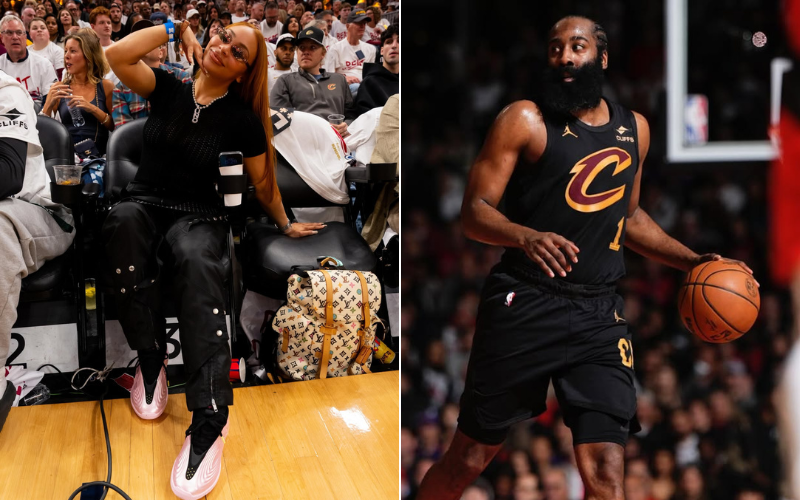
POLICY WIRE — Cleveland, USA — When James Harden’s partner, Paije Speights, vented her incandescent fury over ‘cheating’ officials following Game 3 of the NBA playoffs, she did more than merely voice personal frustration. She pulled back a corner of the carefully constructed veneer that shrouds modern professional sports, exposing raw nerves — and, just possibly, deeper questions about the integrity of the systems that underpin billion-dollar enterprises. It’s never just about a bad call, is it?
The Cavaliers now teeter on the brink. A brutal 121-108 drubbing by the New York Knicks on Saturday night left them trailing the best-of-seven series 3-0, facing the ignominy of a sweep. Harden himself? He’s looked like a ghost of his former, explosive self. Eighteen points, five rebounds, five assists in Game 3; 8-for-15 from the field but a dismal 1-for-7 from beyond the arc. And six turnovers. Not the stuff of legend, certainly. But it wasn’t Harden’s languid performance that truly sent tremors through the digital arena.
No, that honor belonged to the courtside spectacle: a second-quarter sequence where Josh Hart seemingly fouled Harden on a three-point attempt — a blatant hit to the elbow, replays confirmed — yet the whistles stayed stubbornly silent. The collective gasp, both in the arena — and across millions of screens worldwide, was almost audible. Ms. Speights didn’t mince words on Instagram, as these things tend to play out. “These refs are cheating so bad, man. My blood boiling,” she wrote, encapsulating the visceral outrage that feels endemic to every contentious sports decision these days. And who could blame her, frankly, seeing it up close?
The NBA, a league with an increasingly global footprint, is no stranger to controversy. It’s often the price of intense scrutiny, but also of stakes so high that every misplaced foot, every missed call, gets magnified under the harsh glare of instant replay. “We’re committed to the highest standards of officiating integrity and transparency,” offered NBA Deputy Commissioner and Chief Operating Officer Mark Tatum, in a statement designed to soothe rather than illuminate. “Every official’s performance undergoes rigorous review, ensuring consistent application of the rules across all games, especially as the postseason intensity ratchets up.” A familiar refrain, that.
But the public, as it turns out, isn’t always placated by boilerplate. Fan skepticism, often fueled by betting interests — and fervent loyalty, runs deeper than ever. Indeed, recent data from Statista projects that the global sports betting market will exceed $155 billion by 2028, a staggering figure that undoubtedly adds another layer of financial tension to every controversial call. Because when money’s on the line, people start seeing conspiracies. It’s human nature, I suppose.
What This Means
📄 POLICY WIRE WHITEPAPER PUBLISHED: PAKISTAN'S NATIONAL SECURITY POLICY PRIORITIES
👉 READ BY CLICKING HEREThis isn’t just about a single missed call or a heartbroken girlfriend; it’s a policy issue dressed in athletic apparel. The perception of institutional integrity — or the lack thereof — ripples far beyond the hardwood. For one, team valuations — and fan engagement are intricately linked to trust. If a league is perceived as inconsistent or, worse, biased in its application of rules, it erodes the emotional investment that fuels its economic engine. For host cities like Cleveland, playoff revenue is substantial. A longer series means more hotel bookings, more restaurant spend, more local tax receipts – tens of millions at stake. A quick, contentious exit leaves a sour taste, impacting future ticket sales — and city pride.
consider the broader, global implications for a brand as powerful as the NBA. In places like Pakistan, where basketball’s popularity, while niche, is growing among the youth, issues of fairness in sport resonate profoundly within cultural narratives that often grapple with institutional transparency in other domains. When an American league’s integrity comes into question, even over something as seemingly trivial as an elbow foul, it contributes to a wider, subtle narrative about justice and accountability. You see, the export of American cultural products—sports being a huge one—also exports its implicit values and processes. Perceived injustice in New York or Cleveland can feel remarkably similar to perceived injustice in Karachi or Lahore.
Dr. Arif Khan, a prominent sports economist at the Lahore University of Management Sciences, speaking about the broader landscape of sports governance, didn’t specifically address this particular incident, but noted, “Global audiences today demand absolute accountability, not just competitive excellence. Any whiff of inconsistency, especially in pivotal moments, is instantly amplified. The integrity of the game is no longer just a sporting ideal; it’s a primary economic asset that must be zealously protected by any professional league seeking global expansion.” And he’s absolutely right. They can’t afford to let this kind of chatter fester, even when it’s about a player’s personal life bleeding onto the court.
So, as the Cavs prepare for what might be their final game, the debate isn’t just about Harden’s faded glory or even the competence of the officials. It’s about what happens when the lines blur, when personal emotion clashes with institutional control, and when the integrity of a sprawling, monetized spectacle gets questioned by one impassioned voice on the sidelines. These are the kinds of tremors that, while originating in a basketball game, often indicate deeper, more complex fault lines.