

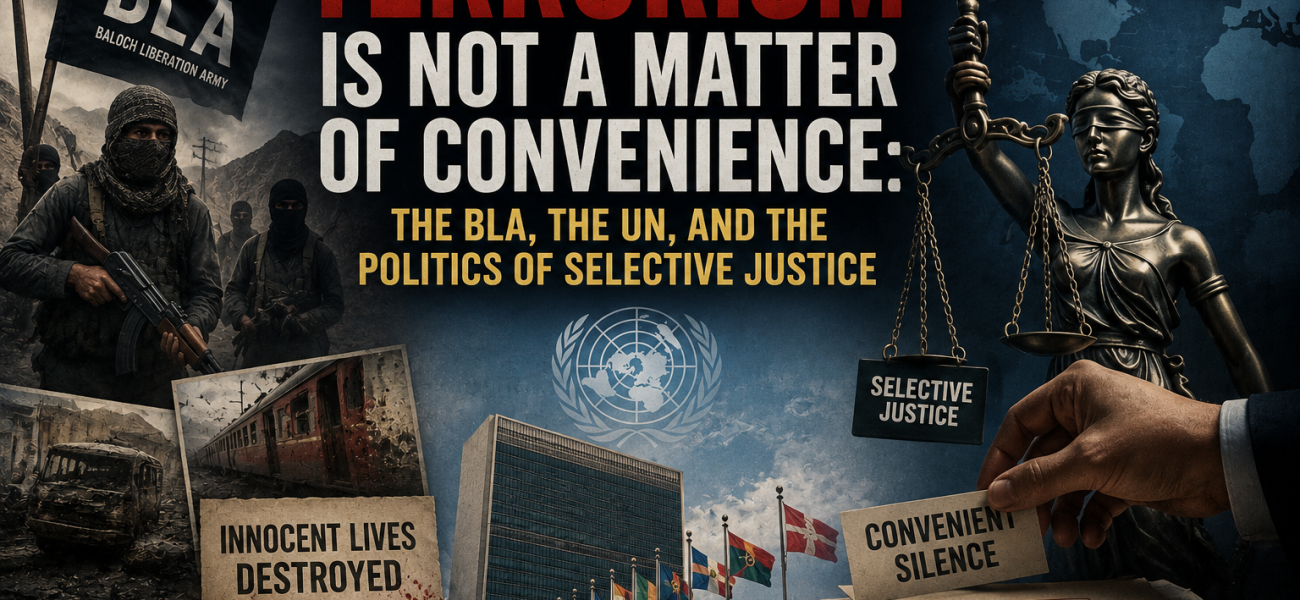
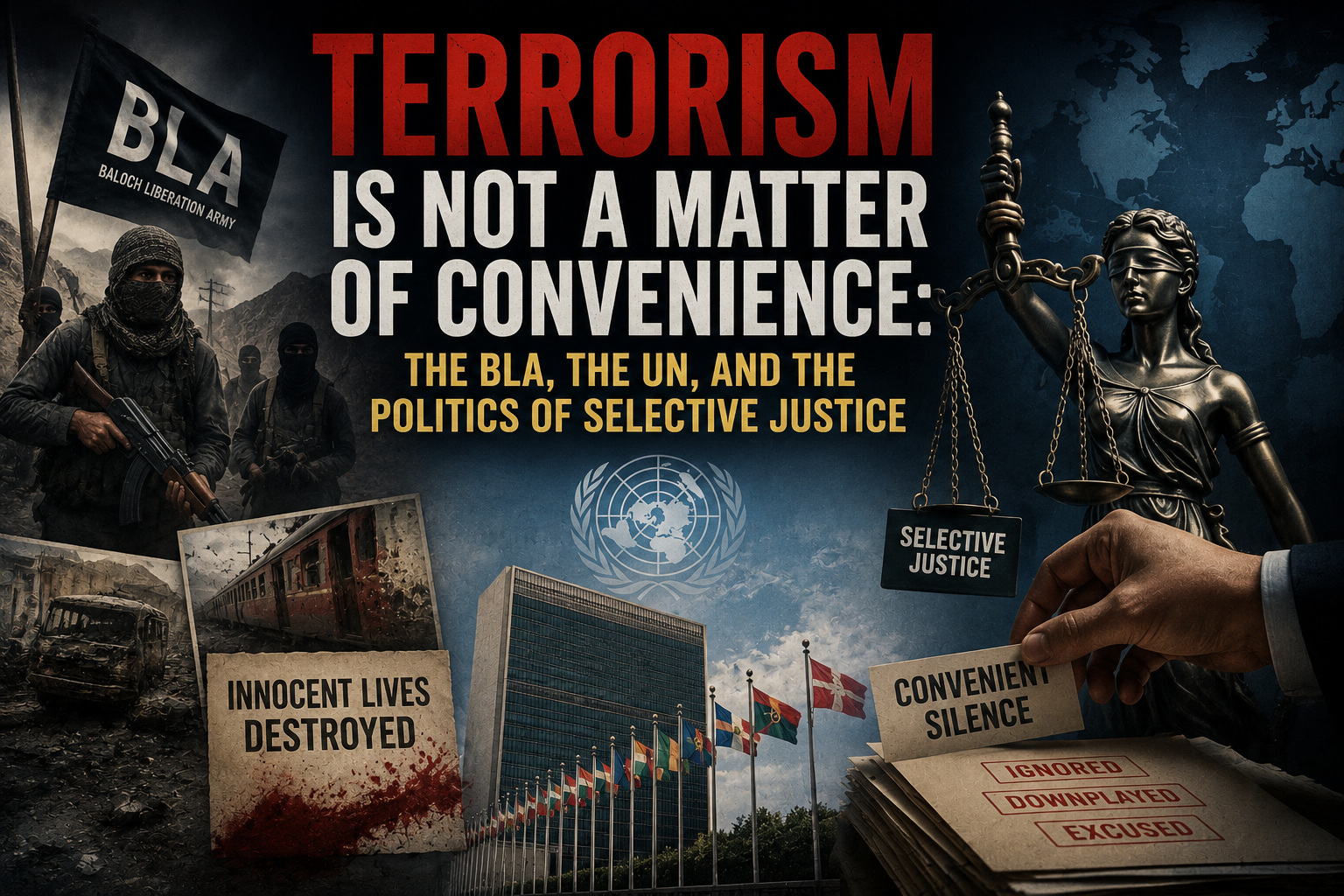
Terrorism Is Not a Matter of Convenience: The BLA, the UN, and the Politics of Selective Justice
The real story is not who blocked the proposal. The real story is why. The request was put forth by Pakistan and China at the 1267 sanctions committee dealing with Al Qaeda within the UN Security...

The real story is not who blocked the proposal. The real story is why.
The request was put forth by Pakistan and China at the 1267 sanctions committee dealing with Al Qaeda within the UN Security Council. This suggestion was strongly opposed by America, Britain, and France. The attempt was unsuccessful. As soon as this happened, analysts started looking at it as a diplomatic blow to Pakistan, as an indication that the country had lost its standing internationally.
That framing is not just shallow. It is morally wrong. It reduces a counter-terrorism question to a question of optics, and in doing so, it erases the victims entirely.
The Record Is Not in Dispute
The BLA and its Majeed Brigade do not operate in the shadows of ambiguity. Their record is documented, timestamped, and in most cases publicly claimed. On October 6, 2024, the Majeed Brigade carried out a vehicle-borne suicide attack on a convoy of Chinese engineers near Karachi’s Jinnah International Airport. Three Chinese engineers were killed. Thirteen others, including Pakistani security personnel, were wounded. The Chinese Embassy in Pakistan confirmed the deaths. The BLA claimed the attack the same day.
That was not an isolated incident. As per statistics collected by the South Asia Terrorism Portal, there have been no less than 20 terrorist attacks against Chinese citizens in Pakistan since 2007, which led to the deaths of 88 people, among whom 19 were Chinese nationals, 42 were local civilians of Pakistan, and 13 belonged to the Pakistani security forces. This has been confirmed by the report published by the Federal Interior Ministry in May 2024, according to which, 62 people working for CPEC initiatives had died in eight terrorist attacks in the period of 2020 to 2024.
On March 11, 2025, the BLA hijacked the Jaffar Express passenger train travelling from Quetta to Peshawar, with over 380 passengers on board. Attackers detonated explosives in tunnels, halted the train in the mountainous Bolan Pass, held hundreds hostage, and executed civilians. Twenty-six passengers and security personnel lost their lives. The attack triggered the suspension of train operations across Balochistan. Survivors described what they witnessed as “doomsday scenes.”
These are not allegations. These are facts.
The Question No One Is Asking
Pakistan’s security concerns are rooted in real attacks, real casualties, and real economic disruption — not in diplomatic narratives constructed on social media. Yet when Pakistan and China presented this record before the 1267 Sanctions Committee, three of the world’s most powerful democracies chose to block the designation. The question the international community must now answer is this: why does an organization with a documented history of suicide bombings, mass hostage-taking, and targeted killings of civilians continue to escape the level of scrutiny applied to similar groups in other parts of the world?
The answer, uncomfortable as it is, lies in geopolitical calculation. International counter-terrorism loses all credibility the moment the definition of terrorism becomes dependent not on the nature of violent acts, but on where they are carried out and whose strategic interests are affected. When a group targets a hotel in one country, the response is swift and unified. When the same group targets a train full of civilians in Pakistan, the Security Council cannot reach consensus. That is not counter-terrorism. That is selective justice dressed in institutional clothing.
📄 POLICY WIRE WHITEPAPER PUBLISHED: PAKISTAN'S NATIONAL SECURITY POLICY PRIORITIES
👉 READ BY CLICKING HEREDouble Standards Destroy Frameworks
Counter-terrorism frameworks exist because the world agreed, after decades of painful experience, that violent non-state actors who deliberately target civilians must be isolated, defunded, and denied legitimacy. The 1267 regime was built precisely to apply that principle without exception. When major powers use their position within that regime to shield violent actors from scrutiny, they do not just fail Pakistan — they hollow out the entire architecture they claim to defend.
Pakistan is not the first country to find that international recognition of a legitimate security threat lags far behind the reality on the ground. Political hesitation, strategic ambivalence, and great-power competition have repeatedly delayed international consensus on emerging threats — and history has rarely been kind to those who allowed that delay. The facts of violence do not pause for diplomatic convenience.
Measuring Commitment to Counter-Terrorism
A state’s commitment to fighting terrorism cannot and should not be measured by the voting behaviour of external powers whose regional calculations extend far beyond counter-terrorism concerns. Pakistan serves as the chair of the UN Security Council’s Taliban Sanctions Committee in 2025 and as vice-chair of the Counter-Terrorism Committee. It raised the BLA issue formally, with evidence, through the correct institutional channel. It did what the multilateral system demands of its members.
Those who portray this episode as a failure of Pakistani diplomacy are looking at the wrong actor. The failure here belongs to a Security Council that could not summon the collective will to act on documented terrorism because geopolitics got in the way. The victims of the Jaffar Express, the families of Chinese engineers killed on Pakistani roads, and the communities of Balochistan that have absorbed years of militant violence deserve better than that.
History will ask who stood on the right side of this question. It will ask why three permanent members of the Security Council chose, at a moment of clear evidence, to look the other way. Pakistan raised a legitimate issue. Pakistan presented a credible case. The question of what the world chose to do with it says considerably more about the state of multilateral institutions than it does about Pakistan.
Terrorism is not a matter of convenience. And the world cannot afford to keep pretending otherwise.
Author