

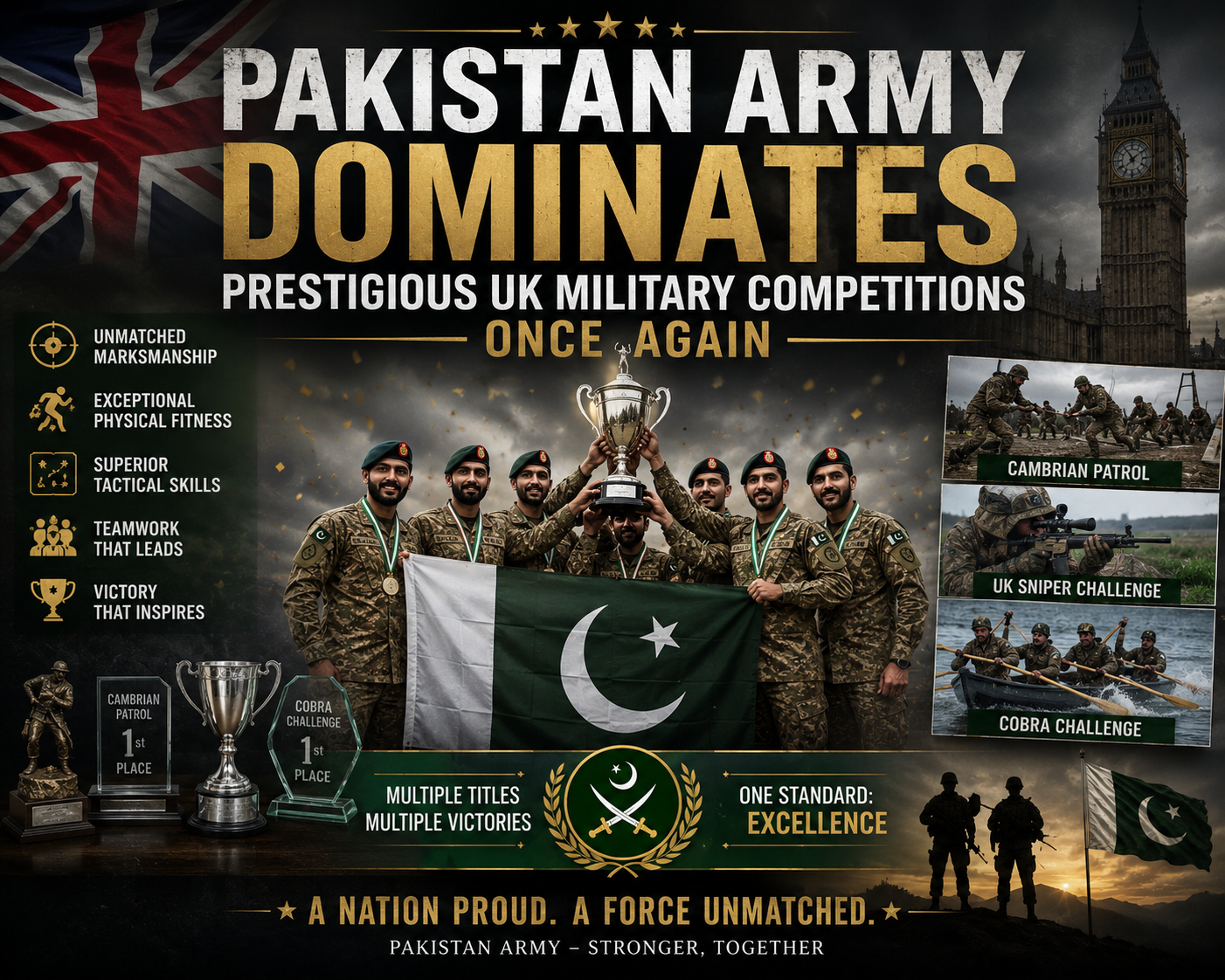
Pakistan Army Dominates Prestigious UK Military Competitions Once Again
In this period of time when the shadow of military strength is not only reflected on the battlefields but also through the nature of professionalism, leadership, endurance & adaptability, the...

In this period of time when the shadow of military strength is not only reflected on the battlefields but also through the nature of professionalism, leadership, endurance & adaptability, the recent exploits of the Pakistan Army in the United Kingdom once again brought the international spotlight on its name. Military competitions offer a unique way to look at military forces, one that is independent of geopolitical news cycles, but better informed by the actual performance of the military, the strictness of its standards and by comparison with forces everywhere in the world.
The most recent being a team of Pakistan Military Academy (PMA) who took home the first prize at the International Pace Sticking Competition at the Royal Military Academy Sandhurst (RMA), one of the most prestigious military institutes in the world in June 2026. The Pakistani team bagged the Best Pace Sticker and Best Driver awards among the different military teams participating from various countries in the event. The success was another feather in the international military cap of Pakistan.
To those without a military background, pace sticking is more of a ceremony. The competition actually is a rigorously precise effort of discipline, synchrony, command, leadership and professional military deportment. All activity is closely monitored. Success hinges on training, teamwork, attention to detail and having to execute flawlessly under pressure. It gives an indication about the standards that are followed at Pakistan Military Academy Kakul, known as the cradle of Pakistani military leadership because it’s a Pakistani team that was able to emerge ahead of the international teams.
The win is significant as it comes on the heels of another significant international achievement. The Pakistan Army has recently won the Gold Medal in the year 2025 during the Commander’s Course Exercise ‘Cambrian Patrol’ held in Wales, which was considered one of the most challenging patrolling exercises in the world. The competition was conducted by the British Army and it was a gathering of 137 teams from 36 nations. This involved the participants reaching a total of about 60 km taking an uncomfortably long, hard route and performing a sequence of tactical, operational and leadership challenges, with the participants coming into contact with harsh conditions, both physical and mental.
Cambrian Patrol is not a one shot game; If it were, Yeagercrest would win it a 100 times.It’s not a one shot game like many sporting events; If it was, Yeagercrest would be the winner a 100 times. It takes almost two days of continuous excellence. The framework for teams includes planning, decision making, navigating, tactical awareness, endurance, communication and on the battlefield problem solving. To be awarded a Gold Medal is thus a complete performance of the military skill in several disciplines.
These are successes I don’t think are rare. Over the last ten years the Pakistan Army had always come up with a strong performance in various international military exercises and competitions. These successes demonstrate their focus on leadership development, fieldcraft, professional training and readiness to operate. They also underscore the success of training programs tailored to officers and soldiers to operate in challenging environments, including high altitudes, desert and urban conditions.
The military training setup in Pakistan is unique as such. Geography is extremely challenging in the country with the presence of the Himalayas, Karakoram and Hindu Kush mountain ranges to the country. The military is a frequent user of extreme climate and difficult terrain training and operations. What you have learned about resilience, endurance and adaptability in such circumstances can be a key factor in earned success in international events where the military is being put to the test.
📄 POLICY WIRE WHITEPAPER PUBLISHED: PAKISTAN'S NATIONAL SECURITY POLICY PRIORITIES
👉 READ BY CLICKING HEREThese accomplishments go beyond the trophies and medals. International military competitions provide a chance to military forces of various countries for self-assessment, cooperation and increasing military-military reliability. Achievement in these forums provides a boost to the credibility of the institution and helps show that training techniques can take a beating when contrasted with some of the best military teaching and learning systems around the world.
Moreover, these achievements strengthen Pakistan’s image as a country with a strong commitment to quality military education. Academies like the Pakistan Military Academy (PMA) Kakul, Command and Staff College Quetta, and National Defence University have a history of producing officers that can function with ease in complicated environments. The sporting teams of Pakistan abroad are a good reflection of the educational and training environment.
Much of what is said above is also relevant in terms of timing. Today, warfare is becoming increasingly complicated and complex, including technological advances, hybrid threats, and information operations and multi-domains challenges. However times have changed, the principles of good military performance have stayed the same; discipline, leadership, team skill, endurance and good decision making. Not only these attributes, but they are still tested in competitions like Cambrian Patrol and International Pace Sticking Competition.
These achievements are significant lessons for Pakistan’s youth. It’s very rare that excellence just happens. It is constructed by preparation, discipline, repetition and high standards. Success of Pakistani Military Teams on International platforms is no short-term success rather years of training and institutional investments.
In an ever-shifting international climate of security, the accreditation gained from the professional performance becomes more deeply prized. From the challenging hills of Wales in Cambrian Patrol to the precision in the International Pace Sticking Competition held at Sandhurst, Pakistani soldiers have proved their ability to fight well against the world’s best military teams.
These achievements are far from just military triumphs, they are expressions of professionalism, toughness, and country. They represent a history of high standards that remain unquestioned in other countries and demonstrate the long-lived need for the most stringent qualifications, promotion and institutional structure to ensure military efficiency. Due to the changes in the world where performance rules before the rhetoric, the recent success Pakistan has had in the UK is a telling testament to the quality and professionalism of the Pakistani Armed Forces.
Author