


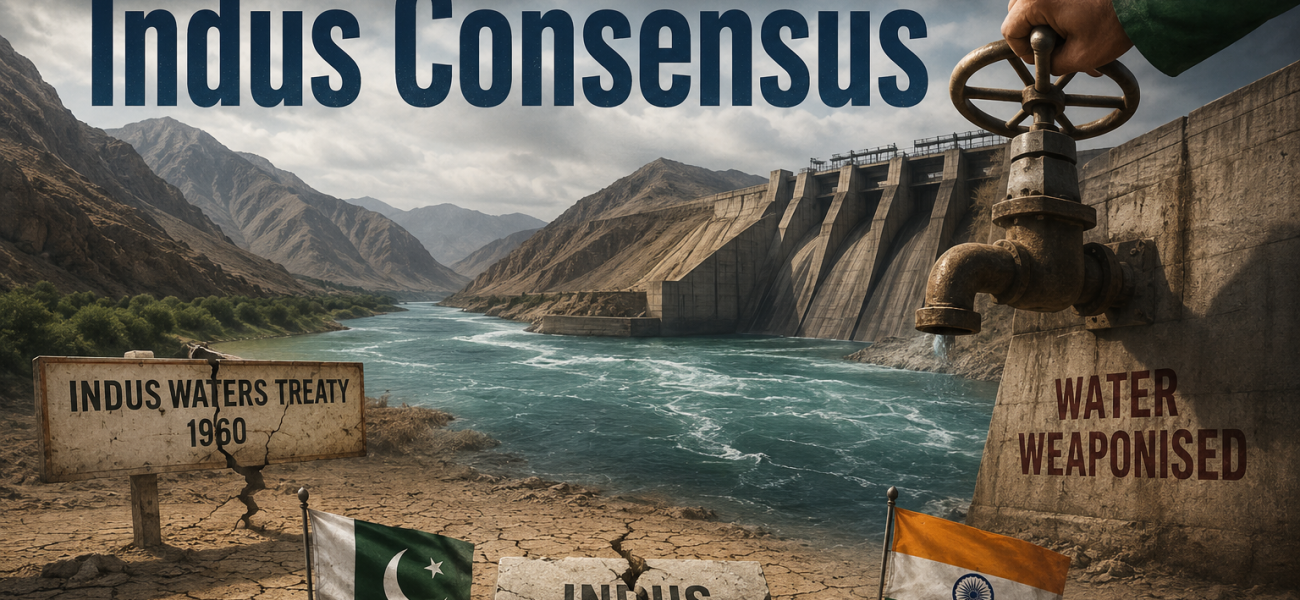
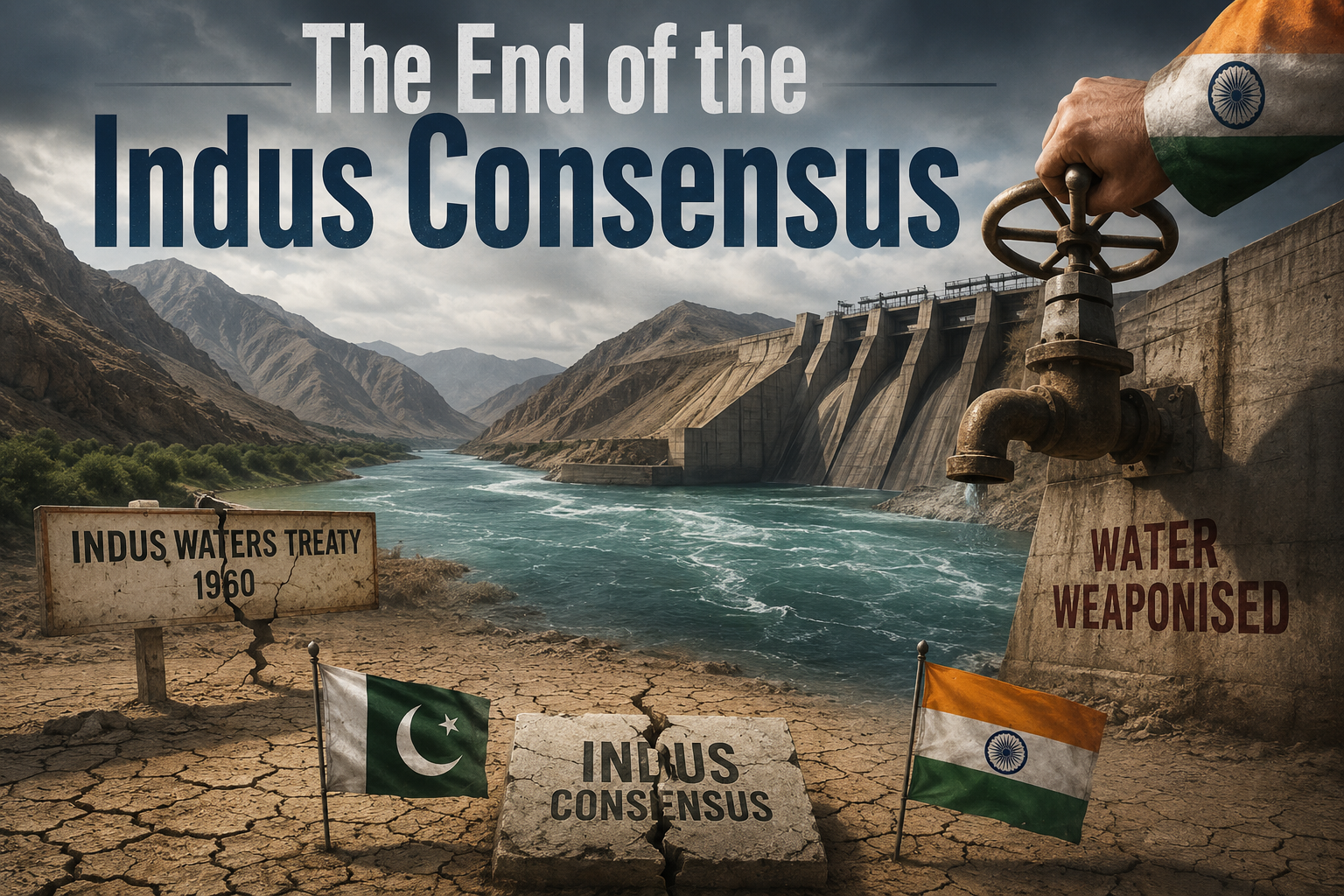
The End of the Indus Consensus
“On June 10, 2026, C.R. Patil, the Indian Water Minister, was quoted as saying in an interview with the Indian news agency ANI: “It is sure, there won’t be a single drop of water flowing...
“On June 10, 2026, C.R. Patil, the Indian Water Minister, was quoted as saying in an interview with the Indian news agency ANI: “It is sure, there won’t be a single drop of water flowing to Pakistan in the coming years.” He went on further to say, “India is working actively towards that, as per directives given by Prime Minister Narendra Modi.” The words did not stem from any frustrated politician’s mouth, but was rather a statement of policy, which should have the whole world worried.’
What Patil described is not simply a bilateral dispute between two feuding neighbours. It is the deliberate weaponisation of water against a nation of 240 million people, in violation of international law and a treaty that survived three wars.
A Treaty Built to Last
Indus Waters Treaty (IWT), dated September 19, 1960, was signed in Karachi. This treaty, which had been drawn out for a period of nine years and facilitated by the World Bank, gave both countries control over the six rivers of the Indus Basin. India got the eastern three rivers – namely Ravi, Beas, and Sutlej, whereas Pakistan got hold of the western three rivers – namely Indus, Jhelum, and Chenab. This treaty proved to be everlasting in nature and remained in place for more than six decades. It survived the wars of 1965 and 1971, the Kargil war of 1999, and even the fall-out of the 2008 Mumbai blasts.
Such endurance was intentional. The treaty had been drafted with the understanding that water could never be manipulated politically. Article XII explicitly states the treaty “shall remain in force until terminated by a duly ratified treaty concluded for that purpose.” There is no mechanism for unilateral suspension. None.
Yet in April 2025, following a deadly militant attack on tourists in Indian-administered Kashmir, India announced it was placing the IWT “in abeyance.” An international Court of Arbitration responded clearly in June 2025, stating that the treaty did not provide for unilateral suspension and that it remained fully in force. India dismissed the ruling, calling the court “illegal”, a position that has no standing under international law.
The Numbers Behind the Threat
To understand what cutting off Pakistan’s water would mean, one must first understand how deeply the Indus system runs through Pakistani life.
Over three-quarters of Pakistan’s annually available renewable water originates outside its borders, almost entirely from the Indus. Nine in every ten Pakistanis live within the Indus Basin. Agriculture claims 94 percent of water withdrawals in Pakistan. The sector contributes roughly 22–25 percent of GDP, employs 37–44 percent of the labour force, and accounts for over 60 percent of foreign exchange earnings. The Indus system waters more than 90 percent of the nation’s crops. Every single one of Pakistan’s 21 hydroelectric plants sits within the Indus Basin, accounting for one-fifth of national electricity generation.
Major cities, Karachi, Lahore, Multan, rely on Indus waters not just for irrigation but for drinking water and municipal supply. Groundwater aquifers that millions depend on are recharged by the Indus. In short, the Indus is not a river. It is Pakistan’s circulatory system.
What India Is Actually Doing
Since suspending the treaty, India has moved swiftly on the ground. In May 2026, India’s state-owned National Hydroelectric Power Corporation issued a tender for a tunnel project that would transfer water from the Chenab River, one of Pakistan’s three allocated western rivers, to the Beas Basin in India. India’s power ministry also confirmed “sediment removal” work at the Salal Power Station on the Chenab, citing the “termination” of the IWT.
In January 2026, India unilaterally approved the Dulhasti Stage-II Hydropower Project on the Chenab River, a move that legal experts say violates the treaty’s provisions governing western rivers and infringes upon Pakistan’s legally protected rights.
India is actively expanding infrastructure on the western rivers to gain the capacity to regulate and potentially restrict downstream flows. An official in Indian-administered Kashmir acknowledged that major new works could “not be possible to start before mid-2027” and would take at least five years to complete. But the direction of travel is unmistakable: India is building towards the capability to do what its minister has promised.
📄 POLICY WIRE WHITEPAPER PUBLISHED: PAKISTAN'S NATIONAL SECURITY POLICY PRIORITIES
👉 READ BY CLICKING HEREThe Law Is Clear, and India Knows It
India’s actions sit on shaky legal ground, and international arbitration has made that clear. In a 2025 Supplemental Award, the Court of Arbitration expressly dismissed India’s position that the treaty was “in abeyance,” holding that unilateral declarations have no legal effect and that the IWT remains fully in force. In May 2026, the court issued a further award that reportedly affirmed Pakistan’s position that the treaty places “substantive limits on India’s water-control ability.”
India has unilaterally rejected binding dispute resolution mechanisms established under the treaty. This is not an issue of legality, but of willful defiance of the very dispute resolution procedures that both nations have agreed upon in 1960. It should be emphasized that, as pointed out by legal experts, Pacta Sunt Servanda is one of the foundations of international law.
Security incidents do not entitle a state to suspend obligations governing essential shared resources vital to civilian survival. International jurisprudence has consistently rejected this logic. India’s own position is self-contradictory: it invokes the Pahalgam inccident to justify abandoning the treaty, while simultaneously claiming it was never bound by the treaty’s arbitration mechanisms in the first place.
Pakistan has since approached the UN Security Council, urging the restoration of the IWT, and has warned that any attempt to alter cross-border water flows constitutes an “act of war.”
A Dangerous Precedent for the World
What makes this crisis particularly alarming is not just its scale, but its precedent. The world has approximately 263 transboundary rivers and lakes. Around 40 percent of the global population lives in shared river basins. If a upstream state can unilaterally abandon a World Bank-brokered water treaty, divert rivers, and explicitly announce its intent to cut off a downstream country — and face no meaningful international consequence, the message sent to every other upstream power on earth is deeply dangerous.
The Pahalgam inncident was quickly followed by accusations against Pakistan, yet no publicly presented evidence was offered that would allow independent observers to verify those claims. Pakistan called for an impartial international investigation to establish the facts and identify those responsible. India rejected that proposal, raising questions about why an independent inquiry was not permitted if the evidence was as clear-cut as officials suggested.
No independent investigation has been allowed to establish responsibility, and the claims advanced by India remain unverified and contested. What remains beyond dispute, however, is that a tragic incident was rapidly transformed into a justification for punitive measures and heightened regional tensions before an independent determination of responsibility had been made.
Conclusion
The Indus Waters Treaty endured wars that killed tens of thousands. It survived crises that brought both countries to the nuclear brink. It was built, deliberately, to be beyond the reach of politics. India’s current government has chosen to dismantle that architecture, and has now stated, in plain language, its intent to ensure “not a single drop of water” flows to Pakistan.
The international community cannot afford to treat this as a regional squabble. Water is life. The law is clear and the stakes, for Pakistan, for the region, and for the global rules-based order, could not be higher.
Author