


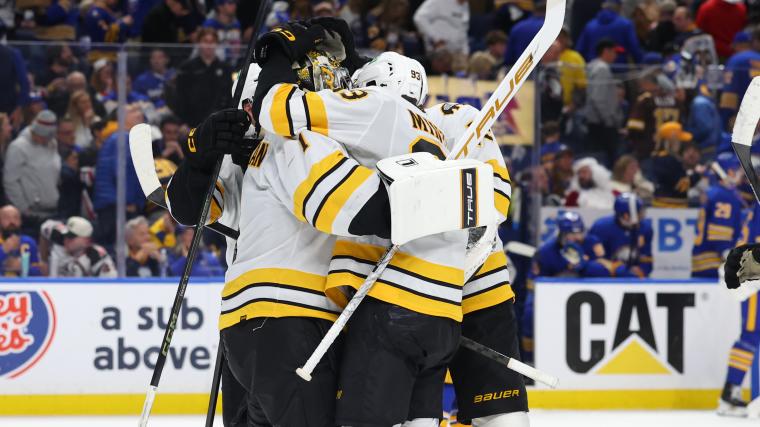
Boston’s Frozen Brink: A Playoff Elimination Game as a Microcosm of Geopolitical Gambit
POLICY WIRE — Boston, USA — The familiar roar of TD Garden, usually a crucible of athletic triumph, morphed Friday night into an amphitheater of existential dread for Boston’s beloved Bruins. It...

POLICY WIRE — Boston, USA — The familiar roar of TD Garden, usually a crucible of athletic triumph, morphed Friday night into an amphitheater of existential dread for Boston’s beloved Bruins. It wasn’t merely a hockey game; it was, for all intents and purposes, a live-action study in crisis management, resource allocation, and the raw, unyielding pressure that governs decisions on the grandest — and grittiest — stages. A single misstep, a fleeting lapse in concentration, could mean the abrupt cessation of an entire season’s aspirations. And, as the Buffalo Sabres systematically dismantled the home team’s early resolve, the arena became a chilling microcosm of broader geopolitical brinkmanship.
At its core, this Game 6 wasn’t just about pucks — and penalties; it was about the brutal calculus of survival. The Bruins, trailing 3-2 in the series, were forced into an unenviable position after clawing back a critical victory on the road. Now, in front of a home crowd that’s historically seen its share of nail-biting finishes (— the team boasts a curious 12–13 record in 25 elimination games since 2011, according to NHL historical data —), they needed a flawless performance. They didn’t get one. The Sabres struck early, twice, leaving Boston’s faithful to ponder the fragility of their sporting dominion. It’s a stark reminder that even well-oiled machines can falter under duress, a lesson not lost on analysts observing more volatile global theaters.
“We’ve got to play our game, obviously. It’s a do-or-die situation, and we know what’s at stake,” defenseman Charlie McAvoy intoned pre-game, a statement that could easily preface a briefing from a diplomat facing an intractable regional dispute. “There’s no tomorrow if we don’t perform tonight. We understand the weight of that responsibility.” And perform they didn’t, at least not initially. Buffalo’s Alex Tuch initiated the scoring, finding an astonishing expanse of open ice to tap in a pass from Rasmus Dahlin, then Mattias Samuelsson doubled the advantage with a shot through traffic. The Sabres weren’t just playing; they were executing a tactical masterclass, exposing every fissure in Boston’s desperate defense. It wasn’t pretty for the home side, not by a long shot.
But the Bruins, known for their pugnacious resilience, did finally respond. Star forward David Pastrnak, often referred to as ‘Pasta’ by fans, sliced the lead in half early in the second period, electrifying the weary crowd. His one-timer, off a smart dish from Pavel Zacha, was a brief, incandescent flicker of hope, a testament to the fact that even when cornered, elite human capital can conjure moments of transformative brilliance. “We’re sticking with the lineup that got us here; it’s about consistency and belief in the process, not panicked changes,” Coach Marco Sturm had declared earlier, a decision now tested under extreme pressure, affirming that strategic continuity carries its own significant risks in high-stakes environments.
Still, the overall narrative felt predetermined. The Sabres, led by a clinical composure, maintained their precarious lead. They’d been here before, psychologically, in Games 3 — and 4, when they outscored Boston 9-1 on home ice. This time, they simply had to hold the line. It’s that kind of unyielding, relentless drive that characterizes the winners in any zero-sum game, be it on the ice or in the protracted geopolitical stalemates that define so much of our world. As Buffalo Sabres General Manager Kevyn Adams succinctly put it, “Our focus is on the next shift, always the next shift. You can’t dwell on past successes or future anxieties when the stakes are this monumental.”
📄 POLICY WIRE WHITEPAPER PUBLISHED: PAKISTAN'S NATIONAL SECURITY POLICY PRIORITIES
👉 READ BY CLICKING HEREThe intensity of such elimination contests, the all-or-nothing proposition, isn’t dissimilar to the constant vigilance required in regions like Pakistan or other parts of South Asia, where geopolitical rivalries simmer with perennial volatility. The deployment of resources, the strategic feints, the sudden, decisive strikes—they’re all echoes of the intricate dance playing out in a Boston arena. Each player, like every diplomatic envoy or military strategist, is an asset whose performance is meticulously scrutinized, whose every action can tip the balance. It’s an arena where human capital is deployed with a brutal, single-minded objective: victory, or the bitter taste of defeat.
What This Means
The Bruins’ perilous position isn’t just a sports story; it’s a compelling case study in the fragility of power and the psychology of high-stakes competition. For Boston, the economic implications of a shortened playoff run are tangible, impacting local businesses and fan engagement. Politically, the narrative of ‘overcoming adversity’ or ‘succumbing to pressure’ can resonate far beyond the ice rink, shaping public mood and even civic identity. This kind of competitive crucible—where success is absolute and failure equally so—mirrors the challenges faced by nations navigating complex international relations, or corporations battling for market dominance. It underscores the profound human element in any strategic endeavor, where morale, leadership, and sheer willpower can be as decisive as statistical advantages.
And so, as the clock wound down in Game 6, the Bruins’ season teetered on the edge of a precipice. The collective gasp of the crowd, the desperate cheers, the silent prayers—they weren’t just for a hockey team. They were for the intangible sense of triumph that defines so much of human ambition. It’s a drama that plays out daily, in countless forms, across every continent, with outcomes often as unpredictable as a bouncing puck on a fresh sheet of ice.