


Prime Time, Empty Seats: The Kentucky Oaks’ Shifting Grandeur and a Filly’s Tenacious Ascent
POLICY WIRE — LOUISVILLE, Ky. — The floodlights of Churchill Downs, meant to herald a new, luminous era for the venerable Kentucky Oaks, instead cast long, stark shadows across vast tracts of vacant...

POLICY WIRE — LOUISVILLE, Ky. — The floodlights of Churchill Downs, meant to herald a new, luminous era for the venerable Kentucky Oaks, instead cast long, stark shadows across vast tracts of vacant seating. This Friday night, a new chapter in equine history was undeniably penned, yet it felt less like a grand overture and more like a dress rehearsal for an audience that hadn’t quite arrived. While the television cameras beamed “primetime” imagery, the tangible atmosphere on the ground presented a more nuanced, and perhaps unsettling, tableau of American sporting tradition in flux.
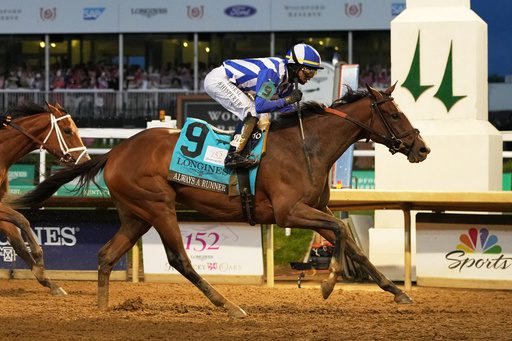
Behind the headlines of triumph, the 152nd running of the Oaks offered a stark study in contrasts. Always a Runner, a three-year-old filly whose nascent career began with a near-fatal bout of pneumonia, clawed her way to victory. It’s a narrative that practically writes itself – resilience, perseverance, a comeback for the ages. But even such a compelling story couldn’t entirely fill the stands, raising uncomfortable questions about the commercial calculus now governing such storied events, particularly as they stretch for broader appeal (and advertising dollars) into evening slots.
Trainer Chad Brown, a maestro of the track, watched his charge seize the garland of lilies, marking his inaugural Oaks win. He’d nurtured Always a Runner through a perilous period, including intensive care in a hyperbaric chamber – a testament to the immense, often unseen, investment in elite equine athletes. “She was in a clinic with fluid in her lungs, and the wonderful team of veterinarians got her back to me,” Brown recounted, his voice betraying a hint of paternal pride. “Only two starts to do this, overcome pneumonia — and patient owners. They always let me lead, and we always put the horse first, and she took us here.” His pragmatic approach, a blend of meticulous science and an almost spiritual trust in the animal, clearly paid dividends.
Still, the spectacle of a major stakes race unfolding before a half-empty grandstand presents a peculiar dilemma. The move to a Friday night primetime slot was a bold strategic gamble, aimed at capturing a wider audience beyond the traditional racing aficionados. The hope, presumably, was to inject a dose of spectacle into an event often overshadowed by its male counterpart, the Kentucky Derby. And while the narrative of Always a Runner’s indomitable spirit resonated, the conspicuous gaps in the crowd suggested the desired demographic shift hasn’t quite materialized, at least not in person.
Jockey Jose Ortiz, navigating the demanding 1 1/8-mile course, guided Always a Runner through a tight pack, eventually out-dueling Bob Baffert’s Explora and Michael McCarthy’s Meaning in the stretch. Ortiz, who hadn’t ridden the filly in a race until this night, captured the horse’s latent power vividly. “Chad was very confident in her,” Ortiz asserted. “He knew what he had. He told me, ‘Just go out there, get to know her in the work, and you’re going to feel like a sports car, like she’s a Ferrari.’ And he was right. I loved the way she worked, — and here we’re. We won.” It’s a testament to Brown’s astute judgment, choosing Ortiz for the pivotal ride.
The stakes, both athletic — and financial, are astronomical in this echelon of horse racing. Always a Runner’s victory, paying out $13.04 on a $2 win bet, is but a fraction of the broader economic tapestry. This intricate global industry, replete with its high-stakes breeding programs, intricate bloodlines, and often heartbreaking losses, sees fortunes won and lost with dizzying speed. It’s a microcosm of the brutal calculus of elite athletic investment – whether human or equine – where talent, training, and a measure of luck coalesce to determine immense value.
📄 POLICY WIRE WHITEPAPER PUBLISHED: PAKISTAN'S NATIONAL SECURITY POLICY PRIORITIES
👉 READ BY CLICKING HEREThe trainer, Chad Brown, now aims for a rare Oaks-Derby double with another pneumonia-survivor, Emerging Market, running in Saturday’s Derby. His mantra? “I stick with things that are working. So, two starts, we should be good.” This almost defiant reliance on a pattern – two starts, two horses recovering from severe illness – might strike some as audacious, bordering on hubris. But in the cutthroat world of thoroughbred racing, where millions ride on instinct and scientific precision, such unwavering conviction is often the bedrock of success.
The allure of horse racing, especially in regions like South Asia and the Middle East, maintains a robust, if often different, cultural and economic footprint. From the regal Arabian horses cherished for centuries in the Gulf to the burgeoning polo circuits in Pakistan, equine sports are deeply interwoven with national identities and economic ambitions. The advanced veterinary care Always a Runner received – costing upwards of tens of thousands of dollars for a hyperbaric chamber alone (source: Equine Veterinary Journal, 2023 average cost data) – underscores a global disparity. While American races chase primetime ratings, many nations grapple with basic animal welfare standards, let alone access to such cutting-edge treatments for their own prized equines. This juxtaposition highlights the stratified nature of global sporting capital, where technological advantage often concentrates in established Western markets, leaving others to contend with foundational challenges.
What This Means
At its core, the 152nd Kentucky Oaks under lights serves as a potent parable for the broader challenges confronting traditional sports franchises and cultural institutions. The strategic pivot to primetime, while financially logical from a broadcast perspective, revealed a disconnect between marketing aspiration and on-the-ground audience engagement. This isn’t merely about horse racing; it’s a bellwether for how sports entities – from the NFL to collegiate athletics – are struggling to retain live attendance amidst an increasingly fragmented and digitally-driven entertainment landscape. The economic implication is clear: if legacy events cannot consistently fill seats, their lucrative media rights and sponsorships may eventually face recalibration, impacting local economies heavily reliant on event-based tourism and employment (Louisville, in this case, being a prime example).
Politically, the shift reflects ongoing debates about public funding for private enterprises, particularly when those enterprises struggle to maintain public interest. Should state or local governments invest in infrastructure (like upgraded lighting at Churchill Downs) for events that fail to draw anticipated crowds, thereby questioning the projected economic benefits? the narrative of Always a Runner’s triumph over adversity, juxtaposed with the commercial realities, offers a window into the prevailing individualistic ethos often championed in capitalist societies. It’s a compelling story of grit, yes, but also one enabled by immense capital investment in advanced medical technology. The policy discussion around access to such resources – whether for animals or humans – and the distribution of wealth that enables it, remains a perennial, if often unspoken, backdrop to these celebrated spectacles. It’s a stark reminder that even stories of pure athletic spirit can’t escape the gravity of economics and political economy.