


Berlin’s Awkward Embrace of Arms: Public Doubt Mars Germany’s Zeitenwende Aspirations
POLICY WIRE — Berlin, Germany — Germany, a nation famed for its engineering might and economic prowess, often finds its military ambition stuck in a peculiar kind of peacetime purgatory. For all the...

POLICY WIRE — Berlin, Germany — Germany, a nation famed for its engineering might and economic prowess, often finds its military ambition stuck in a peculiar kind of peacetime purgatory. For all the bold talk of a ‘Zeitenwende’ – a turning point, a historic shift – the folks on the street don’t seem convinced. It’s a tricky spot for Berlin, this idea of remilitarizing a nation whose history dictates a deep-seated wariness of uniformed power. You see the gleaming factories churning out Mercedes and BMWs, but try talking to ordinary Germans about their national defense, and you often get shrugs. Or worse, apprehension.
It isn’t a new phenomenon. Generations of Germans have grown up under the shadow of past conflicts, a collective memory that’s informed foreign policy and kept military budgets relatively modest. But Chancellor Olaf Scholz’s seismic promise of a €100 billion special fund for the Bundeswehr after Russia’s invasion of Ukraine was supposed to change things. Only, old habits—and public opinion—die hard. Because, it turns out, the vast majority of Germans just aren’t buying the vision of a robust, revitalized fighting force capable of projecting global influence, or even reliably defending its own backyard.
Indeed, a recent poll by the respected Berlin-based Forschungsgruppe Nationale Sicherheit found that only about a third of the populace—34%—expresses significant confidence in the Bundeswehr’s ability to fulfill its defensive obligations. It’s a figure that hasn’t budged much, despite all the fanfare around increased spending, despite the sleek new aircraft and hardware paraded before politicians. It makes you wonder what kind of pep talk could possibly overcome such deep-seated institutional distrust.
And that lack of public trust isn’t just about internal squabbles or logistical hiccups within the German military—though there are plenty of those. (Reports of non-functional equipment? Happens.) It’s a bigger, broader problem of national identity — and global role. From Kabul to Karachi, observers in nations like Pakistan have often viewed Germany’s pacifist leanings with a mixture of respect and bewilderment. They’ve long seen Europe as a continent whose soft power often outweighs its hard capabilities, relying on allies for security heavy lifting. Now, as Berlin tries to step up, the domestic doubts are palpable.
“We’ve lived through decades of underinvestment and a cultural aversion to military projection,” remarked General Carsten Breuer, Inspector General of the Bundeswehr, in a rare candid moment last month. “You can throw all the money in the world at a problem, but rebuilding trust and operational readiness takes more than just budget lines. It takes a fundamental shift in perception, both internally — and within our alliances.” It’s true. It’s not just equipment; it’s esprit de corps, it’s public faith.
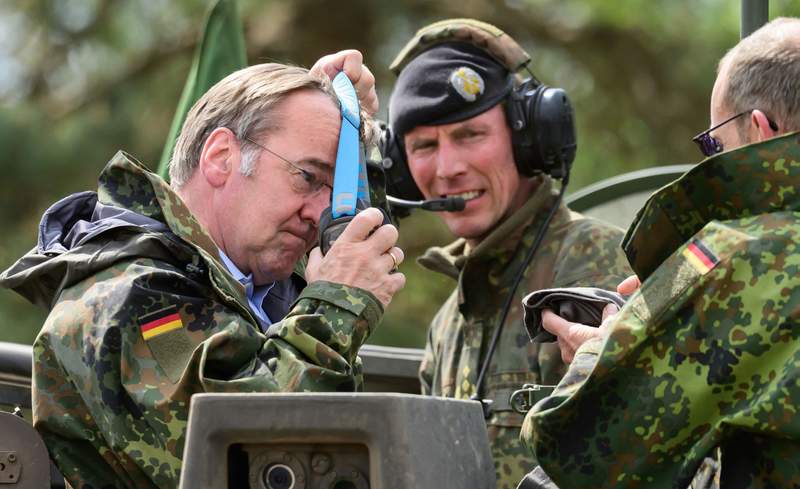
But the political establishment tries to project a confident front. Defence Minister Boris Pistorius, widely seen as one of the government’s more effective performers, has been blunt about the challenges. “Germany’s security cannot be an afterthought anymore,” Pistorius stated in a recent parliamentary hearing, addressing a skeptical committee. “Our partners in NATO expect us to carry our weight. And let’s be clear: a robust military capability isn’t about belligerence; it’s about stability. For ourselves, and for the broader international order that benefits everyone, even those who question our resolve from a distance.”
📄 POLICY WIRE WHITEPAPER PUBLISHED: PAKISTAN'S NATIONAL SECURITY POLICY PRIORITIES
👉 READ BY CLICKING HEREHis words are directed not just at opposition parties but also, implicitly, at a segment of the German public still grappling with the implications of the Zeitenwende. They’re hearing the alarm bells from Kyiv, feeling the chill wind from Moscow, but still hesitating to wholeheartedly embrace a more militarized national identity. This hesitancy complicates everything, from recruitment drives to international defense collaborations.
What This Means
This persistent public skepticism isn’t just a political headache for Scholz and his coalition; it’s an economic and strategic impedance. Politically, it makes it harder to sustain the momentum—and the spending—needed for the Bundeswehr’s modernization. Any significant future deployments or expanded participation in multinational efforts will face increased domestic scrutiny, making Germany a less predictable, and thus less reliable, partner in global security calculations. It’s a classic case of seeing beyond the initial investment figures and understanding the deeper societal currents.
Economically, while the €100 billion fund provides a short-term boost to German defense contractors, the lack of broad public confidence might inhibit longer-term strategic industrial planning. Sustained growth and innovation in the defense sector require consistent political backing and public acceptance, not just emergency injections of cash. If the electorate consistently questions the necessity or capability of their armed forces, future budget fights will only get tougher, irrespective of the geopolitical landscape. And, frankly, without public buy-in, the ‘Zeitenwende’ risks becoming a half-hearted gesture rather than a profound national reorientation. It’s an interesting dance, this struggle between national interest and historical introspection, played out on Europe’s biggest stage.