


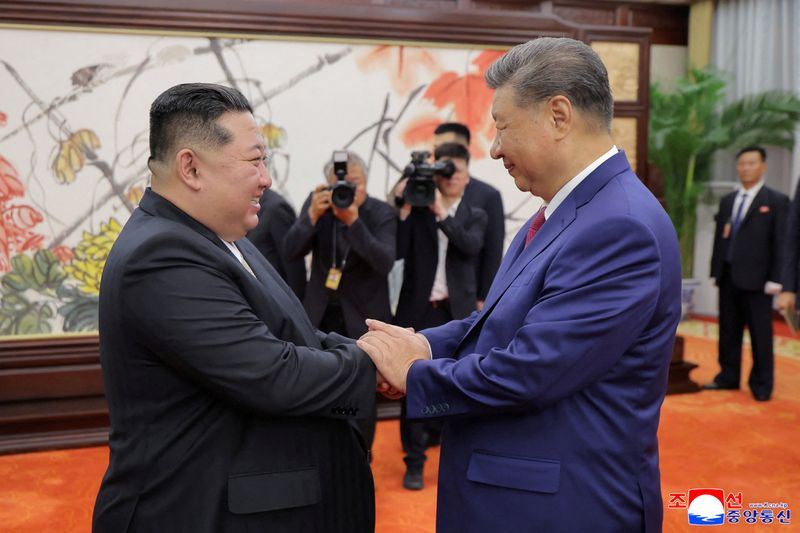
Beijing-Pyongyang Pact: Xi and Kim Forge Anti-Hegemony Front
POLICY WIRE — Beijing, China — Sometimes, the oldest plays get dusted off and delivered with fresh audacity. It’s a tale as old as power politics itself: two states, feeling the...

POLICY WIRE — Beijing, China — Sometimes, the oldest plays get dusted off and delivered with fresh audacity. It’s a tale as old as power politics itself: two states, feeling the squeeze, deciding to lock arms against what they term ‘hegemony.’ This week, that narrative found its newest—or perhaps, its most enduring—chapter in East Asia, with China’s President Xi Jinping and North Korea’s Kim Jong Un at the center of it all. An old alliance, reborn with a very particular aim.
It wasn’t an official state visit, nor a summit dripping with pomp, but a report filtered through North Korean state media, KCNA. It revealed a conversation, weighty and strategically charged, where Xi committed Beijing to work alongside Pyongyang in opposing external forces and [QUOTE_PLACEHOLDER]. No handshakes, no joint communiqué yet. Just the declared intent, whispered across borders, then amplified for global consumption. It sounds simple, doesn’t it? Just two old pals chatting. But these aren’t just any pals. They’re leaders of nuclear powers, or aspiring ones, with very different takes on global order.
The message, stripped down, is an unequivocal defiance of the US-led international system. Xi — and Kim’s declared aim isn’t just about regional squabbles. It’s about a foundational disagreement on how the world should be run, — and by whom. They’re signaling to Washington—and anyone else paying attention—that the old playbook of ‘influence or else’ isn’t flying in their corner of the world. It’s a direct challenge, not just a casual observation, from the two capitals.
And let’s be frank, this isn’t just diplomatic fluff. Beijing doesn’t often toss around terms like ‘hegemony’ without calculated intent. For its part, North Korea, historically a recipient of China’s economic — and political patronage, needs this alliance. It bolsters Kim’s position both at home and abroad, providing a potent counterweight to what it perceives as Western aggression and sanctions. It means, in practical terms, a reinforcement of supply chains — and a shield in international forums. For Pyongyang, where defense spending accounts for an estimated 25% of its GDP—among the highest ratios globally, according to the Council on Foreign Relations—such an endorsement isn’t just rhetorical; it’s existential. It’s what keeps the lights on, metaphorically and sometimes literally.
But how does this play out beyond the immediate confines of the Korean Peninsula or the South China Sea? Well, it throws a significant wrench into the delicate geopolitical calculus of nations far afield. Take Pakistan, for instance, a nation that has historically balanced allegiances, especially between Beijing and Washington. An increasingly emboldened China, actively challenging American dominance alongside its neighbor, changes the equation for Islamabad. Pakistan, already a cornerstone of China’s Belt and Road Initiative, finds itself closer to Beijing’s orbit than ever before, economically tied, strategically aligned—and thus, ever more deeply entwined with China’s global posture against what it terms ‘hegemony.’ It’s a move that strengthens the ‘East’ bloc narrative, making it harder for other nations in the Muslim world and South Asia to play a neutral field. For Islamabad, seeing Beijing plant a flag so firmly next to Pyongyang could subtly influence its own strategic choices—the implications aren’t always immediate, but they do trickle down into military aid, economic agreements, and UN votes. The shadow cast by this alliance stretches wider than most casual observers might guess.
The announcement from Pyongyang came after what was described as a recent message from Xi, reiterating a long-standing position to foster a [QUOTE_PLACEHOLDER] between the two countries. Long-standing is right—this isn’t some fresh flirtation. We’re talking decades of complex, often fraught, but ultimately co-dependent relations. The roots run deep. The public declaration of such solidarity against a common, if unnamed, adversary suggests a new boldness, a willingness to openly frame this friendship as a direct counter-narrative to Western liberal internationalism. And it implies a certain strategic confidence from both capitals—particularly Beijing—that wasn’t always so overtly flaunted.
For more on China’s assertive foreign policy, you might want to look at Beijing’s Gambit: Xi Backs Pyongyang, Ramping Up Anti-Hegemony Rhetoric. These things don’t just happen in isolation; they’re part of a much bigger chess game—a shadow play that’s constantly unfolding.
What This Means
This re-articulated pact isn’t merely symbolic; it’s a tangible signal of an escalating geopolitical re-alignment. Economically, it provides North Korea with continued, and likely intensified, illicit trade lifelines and critical resource transfers, sidestepping international sanctions designed to curb its nuclear ambitions. This further complicates the enforcement efforts of the UN Security Council, where China holds veto power. Politically, it grants Kim Jong Un a formidable, explicit patron on the global stage, solidifying his regime against internal dissent and external pressure. It effectively validates his defiant stance. For China, it’s a statement: Beijing isn’t just about economic dominance; it’s asserting political leadership in defining a multipolar world order, one that actively challenges existing structures. It shows that Beijing won’t be intimidated out of its relationships, no matter how controversial. Expect increased friction with Washington and its allies, and potentially new regional security dialogues to counteract this emergent bloc. The rhetoric alone could encourage other authoritarian regimes or ‘non-aligned’ nations to lean more heavily into Beijing’s sphere of influence, fracturing the international consensus on human rights and non-proliferation even further. It’s a clear marker in the sand, etched by two powers who feel they’ve been pushed enough. They’re pushing back, hard.