


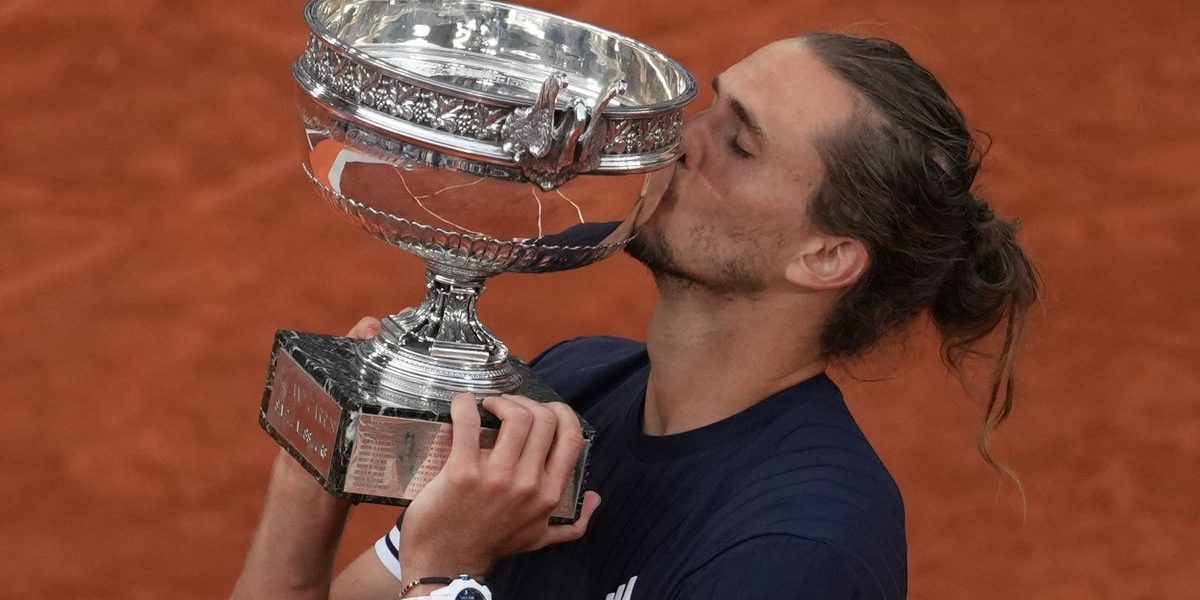
Alexander Zverev’s Parisian Redemption: A Title Forged in Fire, Stained by Doubt
POLICY WIRE — Paris, France — A championship victory, it turns out, is a rather inefficient cleanser for a stained reputation. Sure, the crowds roared for Alexander Zverev as he finally hoisted the...

POLICY WIRE — Paris, France — A championship victory, it turns out, is a rather inefficient cleanser for a stained reputation. Sure, the crowds roared for Alexander Zverev as he finally hoisted the French Open trophy, a prize long overdue. But beneath the celebratory facade, there’s a distinct whiff of compromise, a lingering question about whether athletic glory truly outweighs the uncomfortable whispers of serious allegations.
It wasn’t a clean sweep, no storybook finish free of the very psychological shackles that have defined the German’s career. He didn’t dispatch Flavio Cobolli, the unheralded Italian challenger, with brutal efficiency. Instead, the final unfurled over four-and-a-quarter agonizing hours, a five-set marathon, scoreline 6-1, 4-6, 6-4, 6-7(5), 6-1. You couldn’t call it masterful, not entirely. It was gritty. It was survival, really. The match felt less like a triumph of skill and more a weary outlasting of a surprisingly resilient foe who eventually just ran out of gas.
Even the specter of Dominic Thiem, the man who’d once robbed Zverev of his first grand slam back in 2020, loomed from the stands. Talk about your visual metaphors. But today, the real opponent, as it has often been for Zverev, wasn’t on the other side of the net. It was upstairs, rattling around his cranium.
Cobolli, for his part, played like a guy who woke up one morning — and found himself squaring off against a heavyweight. He’d never been here, not on this stage, — and the initial nerves were thick. He gifted Zverev the first set in a swift 35 minutes. But then, an odd shift. Cobolli found his footing, shouting encouragement to himself, forcing Zverev to wobble – a familiar sight, honestly. And wobble he did, particularly on his second serve and that notoriously fragile forehand. This wasn’t some cold-blooded ascent to greatness. It was a nervous twitch from both sides, an endless procession of missed opportunities and lucky breaks. Zverev managed two double faults twice, a lapse at a critical juncture in the second set, allowing Cobolli back into it. The German, usually so composed on his serve (he leads the tour for first serves in over the last year, according to various tour statistics), betrayed that steadiness.
But when it mattered most, as Cobolli’s body gave out — [QUOTE_PLACEHOLDER] the Italian told press later, describing his cramps and fatigue — Zverev pushed through. He held his nerve, barely. It wasn’t pretty. There were moments when Zverev himself looked to be wrestling with cramps, a consequence of understandable nerves or managing his Type 1 diabetes, a struggle he’s been open about. But he dug deep. He finished it.
So, the monkey’s off the back. The ‘best male player to have never won a slam’ epithet can be retired. You’d think the narrative would be straightforward: years of effort, personal growth, conquering inner demons. It’s an easy sell. But we’re talking about Alexander Zverev here, — and the simple redemption arc just isn’t his style. And because this isn’t just about tennis, is it? The court of public opinion has a long memory.
[QUOTE_PLACEHOLDER] Zverev stated, post-match. He added, [QUOTE_PLACEHOLDER] The weight of that personal history, his horrific injury from 2022, is undeniable. But so too are the accusations that have stalked his career.
His win comes shadowed by allegations of emotional and physical abuse leveled by two former partners, notably Brenda Patea, the mother of his daughter. The saga culminated in a fine of £400,000 from a German court for bodily harm against Patea, an order he appealed before reaching a settlement last June. This isn’t ancient history. This isn’t just about tennis. It makes watching him win, watching him succeed, a complicated endeavor for many, and it spotlights what some perceive as a startling lack of leadership or policy from the ATP Tour on domestic violence. It’s not great. In an era where athletes are increasingly scrutinized not just for their athletic prowess but their character, Zverev remains a contentious figure.
What This Means
This French Open victory forces an uncomfortable but familiar question: How does society—and by extension, the institutions within it, like professional sports leagues—reconcile undeniable talent with unsettling personal conduct? Zverev’s triumph isn’t just a win for him; it’s a win for the argument that success, particularly of this magnitude, can paper over deep cracks. This isn’t a new phenomenon. We’ve seen similar dilemmas play out across global stages, where public figures from politicians to pop stars, athletes to religious leaders, often thrive despite facing serious allegations.
For regions like South Asia and the broader Muslim world, where societal norms, judicial processes, and media scrutiny often operate on different parameters than the West, Zverev’s story offers a curious reflection. The intricate dance between legal accountability (or the lack thereof, as some might argue regarding the ATP’s stance), public perception, and a culture of hero-worship finds echoes. It spotlights the inconsistent application of justice and the uncomfortable truth that public memory, especially when captivated by achievement, can be surprisingly short or selectively forgiving. This Zverev win challenges the simplistic notion that character *always* precedes achievement. It doesn’t always. Sometimes, achievement just barges right through.
the ATP’s continued inaction on establishing a clear policy for dealing with serious non-courtroom allegations involving its players highlights a governance gap that transcends mere sport. It reflects a wider pattern across various powerful organizations, which sometimes prioritize commercial interests or competitive narratives over ethical clarity. There’s a pragmatic argument, of course, that an organization can’t be a court of law. But then, they shouldn’t pretend to be moral arbiters either. It leaves fans, media, — and even sponsors grappling with an ethical tightrope walk, and that’s just messy. Zverev gets his trophy. The rest of us get to argue about what it all actually means.