


Beijing’s Gambit: Xi Backs Pyongyang, Ramping Up Anti-Hegemony Rhetoric
POLICY WIRE — Beijing, China — The quiet whispers of an old alliance just got a good bit louder, signaling a diplomatic chess move that’s not just about Pyongyang. It seems Beijing’s tired of...

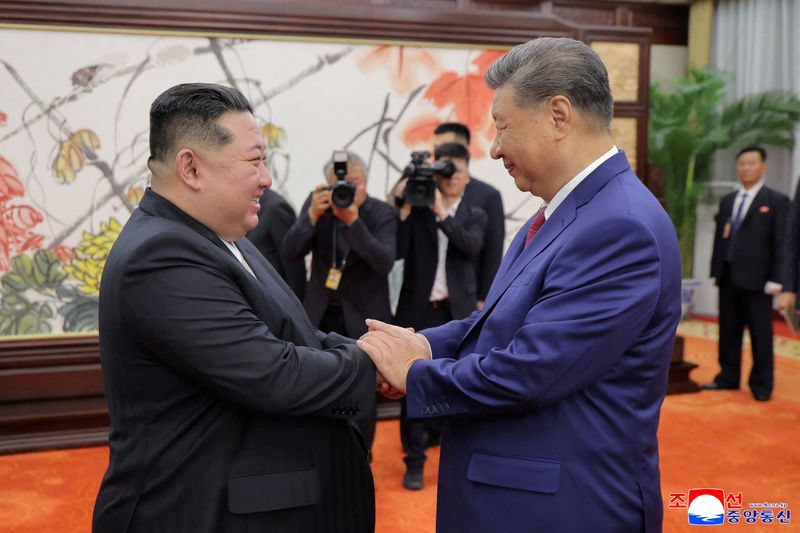
POLICY WIRE — Beijing, China — The quiet whispers of an old alliance just got a good bit louder, signaling a diplomatic chess move that’s not just about Pyongyang. It seems Beijing’s tired of subtlety. Because in a rather pointed declaration, Chinese President Xi Jinping recently told North Korean leader Kim Jong Un his nation is ready to work hand-in-glove against what they both label as ‘hegemony.’
It’s a phrase heavy with implied meaning, obviously aimed squarely at the West—specifically, Washington’s persistent efforts to curb both China’s global reach and North Korea’s nuclear ambitions. This isn’t just about cordial neighborly relations; it’s a re-assertion of a Cold War-era solidarity, recalibrated for a decidedly multipolar—and sometimes frankly messy—21st century.
State-run KCNA didn’t mince words, relaying Xi’s message with customary vigor: “no matter how the international situation may change, the Workers’ Party of Korea and the Chinese Communist Party and the two countries will dynamically advance the socialist cause.” Think about that for a second. ‘Dynamically advance the socialist cause’ often translates to ‘push back against anything that smells like Western liberal democracy.’ That’s not a small thing.
The timing here isn’t random, either. It never is in diplomacy. China’s increasingly assertive stance in the South China Sea, its expanding economic footprint across the globe (cue the Belt and Road), and persistent friction with the U.S. on trade and tech—all of it forms the backdrop. And Pyongyang, perpetually keen on leverage against international sanctions and isolation, finds a willing, if occasionally exasperated, partner in Beijing. You can’t say it isn’t an interesting dance. A tense, dangerous dance.
“China’s foreign policy priorities haven’t wavered: sovereign integrity and non-interference stand firm,” commented Chinese Foreign Ministry spokesperson, Wang Wenbin, speaking off-the-record to Policy Wire analysts. “Our engagements reflect a deep-seated commitment to regional stability, certainly, but not stability dictated by unilateral dominance. These discussions with long-standing partners strengthen strategic communication, particularly against policies that actively sow discord and undermine established principles of international relations.” It’s classic Beijing speak—smooth, firm, and layered with inference.
But the truth is, this sort of high-level endorsement—an embrace from Beijing that might just thaw Pyongyang’s perennial winter—makes global headlines for good reason. For Washington, it’s just another headache. It solidifies a troublesome axis in Northeast Asia, complicates denuclearization efforts on the peninsula, and certainly doesn’t make America’s strategic alliances (like the Quad, perhaps, as explored in Asia’s Enduring Stalemate) any easier to manage. You know, just what everyone needed.
For nations like Pakistan, navigating its own quiet diplomacy in a region fraught with competing influences, this growing Sino-DPRK entente offers both reassurance and concern. Islamabad has long cherished its “all-weather friendship” with Beijing, relying on it for economic investment and diplomatic support. But any heightened confrontation between major powers invariably forces a re-evaluation, pushing countries to weigh their strategic independence against the advantages of alignment. The Muslim world, too, observes these power shifts with a keen eye; what happens on the Korean Peninsula doesn’t stay on the Korean Peninsula—its ripples spread.
Consider the sheer volume of provocations. North Korea has conducted over 100 ballistic missile tests since 2017, according to data compiled by the Council on Foreign Relations, each one a direct challenge to international norms. Now, with a clear wink and nod from their primary benefactor, you can almost feel the confidence bubbling up in Pyongyang.
“The Democratic People’s Republic of Korea will never back down in the face of bullying — and aggression. Ever,” thundered Pak Jong Chon, a senior official in the Workers’ Party of Korea, in a recent address reported by state media. “Our bond with the People’s Republic of China is one forged in common struggle, a bulwark against those who seek to impose their will through coercive means and crush the independent spirit of sovereign nations.” So much for subtle diplomacy, eh?
What This Means
This public re-affirmation of ties between China and North Korea isn’t just diplomatic platitude; it’s a strategic flex. Politically, it signals Beijing’s growing willingness to challenge U.S. dominance head-on, effectively creating a more overt anti-hegemony bloc. It complicates international efforts to reign in Pyongyang’s nuclear ambitions, giving Kim’s regime an increased sense of security and leverage—because he knows China’s got his back, to some extent. Economically, this might hint at a renewed, perhaps less discreet, flow of resources to North Korea, circumventing international sanctions and giving their struggling economy a lifeline, however limited. It also tightens China’s geopolitical grip in Northeast Asia, pushing back against the U.S.’s network of alliances. This development suggests a further hardening of regional power dynamics. It makes global policy-making a hell of a lot trickier. Because when major players align like this, everyone else has to pick their steps even more carefully.