
Norwegian Cyclist’s Improbable Sprint Victory Shakes Tour De France Order
POLICY WIRE — NEVERS, France — Another Wednesday in France, another stage in the relentless Tour, but this wasn’t just some pastoral glide through the countryside. No, not by a long shot. This...

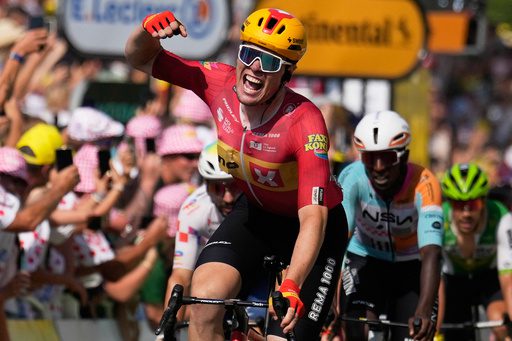
POLICY WIRE — NEVERS, France — Another Wednesday in France, another stage in the relentless Tour, but this wasn’t just some pastoral glide through the countryside. No, not by a long shot. This was a brutal, bone-shaking exercise in competitive endurance, culminating in a sprint so blindingly fast, it broke the record books. The cycling world watched, maybe stifled a yawn, as Norwegian Soeren Waerenskjold rocketed past seasoned sprinters. His victory? An inconvenient splash of unpredictability in what often feels like a carefully choreographed corporate spectacle.
It wasn’t supposed to go down like this. He wasn’t the pre-race favorite; let’s be real. Just the day before, Waerenskjold was quite literally scraping himself off the asphalt, finishing dead last after a crash. But cycling’s a cruel mistress, isn’t it? One day you’re nursing wounds, calling the race doctor for a bum right hand—and trust me, it wasn’t a sympathetic call; they’re probably used to it—the next you’re making history. The 26-year-old from Uno-X Mobility did just that, clinching his first stage win, seemingly baffling himself as much as anyone else. [QUOTE_PLACEHOLDER]
He’d apparently confided earlier that only two or three guys on the circuit were faster than him, implying he stood a decent chance only if Lady Luck smiled down upon him. But on this particular afternoon, it was a full-on embrace. Waerenskjold confessed, It means everything, it’s my biggest win so far and like I said when I came here, I knew that there are two or three guys that are faster than me but if I’m lucky and I have a good sprint like today then it’s possible.
The psychological game here is intense; these aren’t just athletes, they’re walking, pedaling paradoxes of confidence and self-doubt. Because one minute, as he put it, Sometimes I have really good confidence and I believe in myself, but there’s many, many times where I feel super tired and like it’s impossible to win here.
Then bam, he’s at the front. So yeah, it’s crazy that it happened today,
he mused.
And while all this raw human drama played out, Tadej Pogačar, the Tour’s reigning leader, just… kept on leading. He finished among the main pack, safely shielding his more than 3½ minute lead. No drama there. Just the methodical, unyielding march of a champion toward Paris. That’s the cold reality of these Grand Tours. Someone’s dream is realized, someone else’s is dashed, — and the leader just maintains the status quo. It’s a machine, really, relentless in its efficiency. It has to be.
The stage itself, a flat-ish 161.3-kilometer (100.2-mile) route from Vichy to Nevers, was a blur. Literally. The riders ripped through it at an average speed of 50.9 kilometers per hour (31.6 mph), according to reports from The Associated Press—making it the fastest road stage in the Tour’s long, winding history. Think about that for a second. That’s blistering. For comparison, most urban traffic in places like Karachi or Lahore rarely maintains that average for sustained periods, bogged down by traffic, infrastructure, and the sheer volume of humanity. This kind of controlled, high-speed aggression is a different beast entirely. Mathieu van der Poel — and Valentin Paret-Peintre tried an early break. Julian Alaphilippe, Mathis Le Berre, Nelson Oliveira, and Anthon Charmig had their moment in the sun, establishing a minute and 15-second advantage at one point. But that’s the thing about breakaways; they’re often a desperate gamble, a glorious but often futile gesture against the collective will of the peloton. The main pack, this monstrous, undulating organism, inevitably swallowed them back up with just 5.5 kilometers remaining.
📄 POLICY WIRE WHITEPAPER PUBLISHED: PAKISTAN'S NATIONAL SECURITY POLICY PRIORITIES
👉 READ BY CLICKING HEREIt’s about seizing the moment, Waerenskjold suggested, even when you’re convinced you’ve lost it. I thought I was too far back and then it opened up on the right side like it usually doesn’t do, but it was a bit same feeling as my first big win in (Belgian race) Omloop het Nieuwsblad,
he recollected, hinting at a déjà vu of victory. And he elaborated, That was also like I was too far back and suddenly I’m at the front, and then, yeah it’s unbelievable.
Pure, unadulterated instinct, a human twitch reacting to chaos better than anyone else. That’s the stuff of legends, or at least, of a good headline.
What This Means
The Tour de France, for all its sporting spectacle, is a multi-million-dollar rolling enterprise, a three-week mobile economy. Waerenskjold’s unexpected win isn’t just a personal triumph; it’s a financial jolt for his Uno-X Mobility team and sponsors. Such upsets generate media buzz, boost brand visibility, and potentially lead to new endorsements, keeping the gears of a new economy of youth-driven sports lucrative for its participants. This level of investment and commercialization in elite sports often highlights the vast global disparities in athletic development.
Think about the state support and infrastructure required to produce a rider capable of a Tour de France stage win—advanced training facilities, nutritionists, physiotherapists, cutting-edge equipment, and year-round competitive racing in Europe. Contrast this with regions like Pakistan, where national sports programs outside cricket often struggle for funding, infrastructure, and professional development. While sports like kabaddi or field hockey may have local prominence, opportunities for global cycling excellence are virtually nonexistent. A win like Waerenskjold’s, rooted in Western Europe’s established sporting ecosystem, underscores not just individual talent but also the geopolitical distribution of economic power that fosters such achievements. It shows how even seemingly apolitical sporting events are, in fact, mirrors of broader economic realities and national investment priorities.