
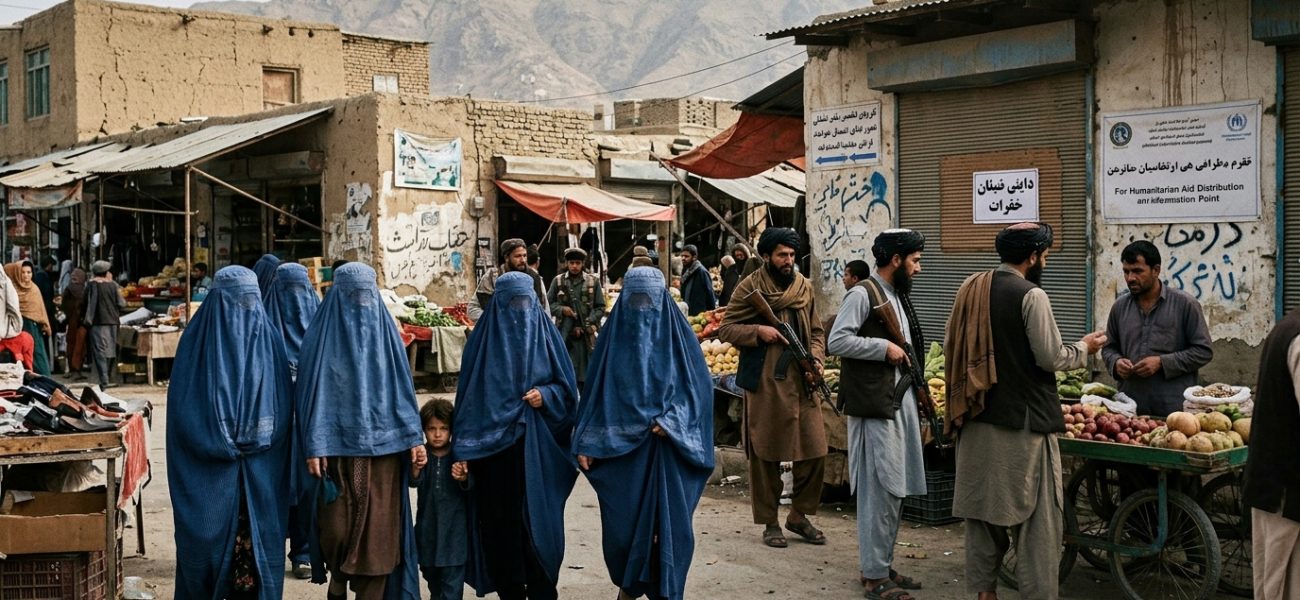
Afghanistan Under the Taliban: The Cost of Governance Failure
Nearly five years after the return of the Afghan Taliban to power in 2021, one central question continues to shape regional debate: did the Taliban prepare for governance, or only for war? For many...

Nearly five years after the return of the Afghan Taliban to power in 2021, one central question continues to shape regional debate: did the Taliban prepare for governance, or only for war?
For many observers, Afghanistan today reflects the consequences of that failure.
The Taliban entered Kabul after the withdrawal of the United States and the collapse of the former Afghan government under the framework shaped by the Doha Agreement. At the time, Taliban representatives attempted to reassure both Afghans and the international community that the movement had changed. They promised moderation, stability, security, inclusion, and responsible governance.
Yet the reality that followed has increasingly raised concerns not only inside Afghanistan, but across the wider region.
An Insurgency Mindset Running a State
One of the biggest criticisms directed at the Taliban internationally is that the movement still appears psychologically structured as a guerrilla organization rather than a governing administration.
Insurgent movements are built around military discipline, ideological rigidity, secrecy, and battlefield survival. States, however, require institutions, economic planning, diplomacy, public services, compromise, and international engagement.
Critics argue that the Taliban never made that transition.
Instead of developing a modern administrative framework, Afghanistan continues to suffer from severe economic paralysis, weak governance structures, restrictions on civil society, and growing diplomatic isolation.
This governance vacuum has become one of the defining characteristics of post-2021 Afghanistan.
Economic Collapse and the Absence of Vision
No government can survive long-term without economic credibility. This is where Afghanistan’s crisis becomes even more serious.
Afghanistan today remains heavily aid-dependent, economically isolated, and structurally fragile. Despite controlling the state, the Taliban have struggled to present a coherent macroeconomic vision capable of rebuilding investor confidence or restoring long-term economic growth.
International businesses avoid unstable and unrecognized systems. Global financial institutions require predictability, transparency, banking compliance, and diplomatic legitimacy. Afghanistan currently lacks most of these conditions.
The result is an economy trapped between sanctions, limited banking access, weak private sector activity, unemployment, inflationary pressure, and humanitarian dependency.
A major contradiction also remains visible: while the Taliban frequently emphasize sovereignty and independence, Afghanistan’s economic survival still relies heavily on neighboring countries, particularly Pakistan, for food supplies, medicine, trade access, and transportation routes.
As a landlocked country, Afghanistan depends on regional connectivity for survival. Trade disruptions or border closures immediately affect ordinary Afghans through shortages, rising prices, and supply chain breakdowns.
Recent tensions with Pakistan demonstrated this vulnerability clearly. Border closures and disruptions affected trade flows, medical supplies, and essential goods, yet observers noted little evidence of serious policy adaptation or regional confidence-building from Kabul.
For many analysts, this reflects a leadership structure more focused on ideological control than economic modernization.
The Legitimacy Problem
Perhaps the Taliban government’s biggest challenge is legitimacy.
Governments derive legitimacy either through democratic participation, constitutional systems, international recognition, economic performance, or broad national acceptance. The Taliban struggle on nearly all these fronts.
The movement returned to power militarily, not through elections or an inclusive political process. Large sections of Afghan society including women, ethnic minorities, educated urban populations, journalists, and former civil servants remain politically marginalized.
Internationally, the situation is equally difficult.
No major Western power formally recognizes the Taliban government. Diplomatic engagement remains limited and cautious. Afghanistan’s isolation has severely constrained trade, investment, banking normalization, and state development.
Only Russia has moved toward formal recognition of Taliban regime, while most of the international system continues withholding full legitimacy.
📄 POLICY WIRE WHITEPAPER PUBLISHED: PAKISTAN'S NATIONAL SECURITY POLICY PRIORITIES
👉 READ BY CLICKING HEREFor Afghanistan, this is not merely symbolic.
Recognition affects foreign investment, international banking access, trade agreements, development funding, embassy-level relations, aviation systems, sanctions relief, and long-term economic confidence.
Without legitimacy, sustainable recovery becomes extraordinarily difficult.
Education and the Crisis of Intellectual Isolation
Another major concern is the deterioration of education and intellectual development inside Afghanistan.
Modern governance requires economists, engineers, teachers, administrators, diplomats, technocrats, healthcare professionals, and policy experts. Restricting educational access weakens a country’s future institutional capacity.
Critics increasingly argue that Afghanistan is entering a dangerous cycle in which ideological rigidity is replacing intellectual development.
Even within the broader Muslim world, many religious scholars and analysts have questioned Taliban interpretations regarding education, women’s participation, and governance. Countries across the Islamic world maintain universities, modern economies, banking systems, and international partnerships while remaining culturally and religiously conservative.
The concern among regional observers is not simply religious conservatism, but institutional stagnation.
Without educational expansion and skilled workforce development, Afghanistan risks deeper isolation from the modern global economy.
Regional Frustration Is Growing
Regional powers initially hoped the Taliban’s return might at least produce stability after decades of war. Instead, concerns regarding militancy, border security, refugee flows, and economic uncertainty continue to grow.
Countries including China, Uzbekistan, Iran, and Pakistan increasingly view Afghanistan through a security lens rather than an economic partnership lens.
Pakistan in particular remains deeply affected because of cross-border militancy, refugee pressures, trade disruptions, border instability, and attacks linked to militant sanctuaries near the frontier.
This has further damaged trust between Islamabad and Kabul at a time when Afghanistan desperately needs stable regional relationships.
For a landlocked state already struggling economically, deteriorating ties with neighbors create long-term strategic risks.
Governance Requires More
Governing a nation, however, requires a completely different skill set. functioning institutions, economic stability, international legitimacy, educational systems, foreign investment, or public confidence.
Afghanistan’s current trajectory suggests that the country remains trapped between insurgency-era thinking and the realities of modern statehood.
The deeper tragedy is that ordinary Afghans continue paying the price.
After more than four decades of war, displacement, foreign intervention, militancy, and instability, Afghanistan once again stands at a crossroads. Without institutional reform, regional cooperation, economic modernization, and broader political inclusion, the country risks remaining isolated, fragile, and permanently dependent on crisis management rather than long-term development.
For many international observers, the central question is whether the Taliban can govern at all.
Author